
Coil curvature
A curved tube can generate secondary motion across its section. The effect depends on tube diameter, coil radius, fluid properties and flow rate; a coil alone does not guarantee turbulent flow.
SHELL & COIL Technologie
Helical coil heat exchangers, also called shell and coil heat exchangers, use removable coiled tube bundles for steam-to-water heating, process cooling and industrial heat recovery.

Arbeitsprinzip
Ein Medium strömt durch das Wendelrohrbündel, während das zweite Medium durch die umgebende Hülle wandert. Die gekrümmte Rohrbahn ergibt eine große Wärmeübertragungslänge in einem kompakten zylindrischen Körper.
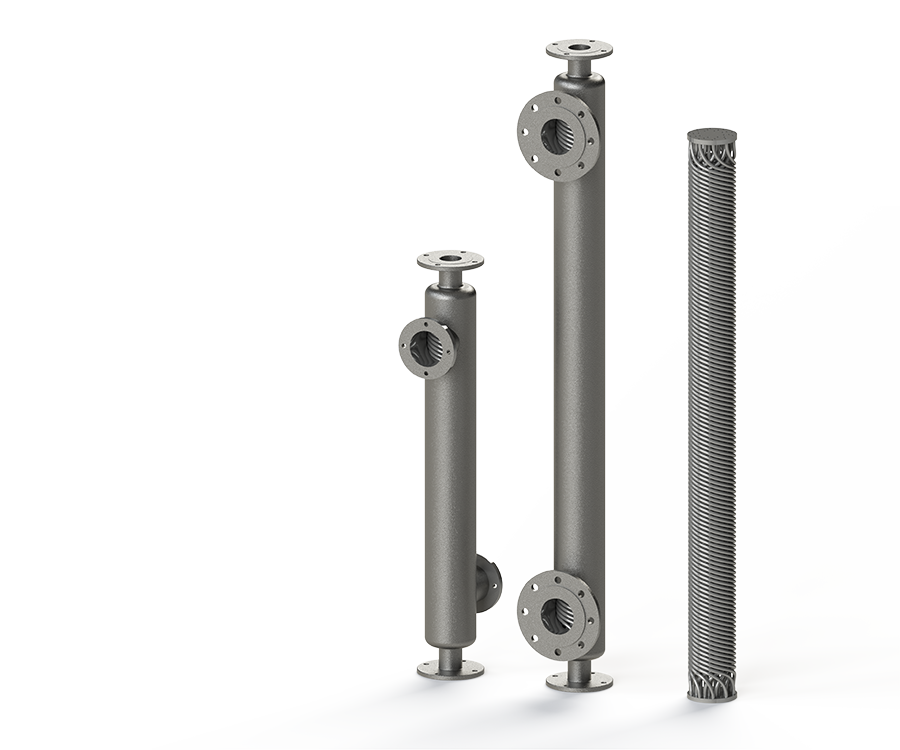
Shell, dished heads and coil bundle are based on the supplied HEXNOVAS CAD. Animated liquid paths illustrate flow direction; the transparent shell and tubes are viewing aids.
COIL DESIGN & DUTY SELECTION
The coil geometry, flow distribution and maintenance arrangement must work together. Start with the operating duty, then choose the construction.
The tube-side medium stays inside the coil. The shell-side medium occupies the space around it. A temperature difference drives heat through the metal without mixing the fluids.
Helical winding fits tube length into a cylindrical envelope. In a multi-tube bundle, the tubes share the flow; their number and length affect velocity, area and pressure loss.
Confirm the actual inlet/outlet assignment on the drawing. Steam duties also require a suitable condensate exit, rather than simply reversing a liquid-flow diagram.
A curved tube can generate secondary motion across its section. The effect depends on tube diameter, coil radius, fluid properties and flow rate; a coil alone does not guarantee turbulent flow.
Smooth and corrugated tubes represent different heat-transfer and pressure-loss choices. Compare both at the same duty and pumping limit. Tube profile availability must be confirmed for the selected HEXNOVAS design.
Shell flow must reach the active tube surface. Bundle spacing, internal flow guidance and nozzle position matter alongside the tube area. Avoid treating a large shell volume as proof of good distribution.
| Duty | What determines the selection | Installation focus |
|---|---|---|
| Hot water / glycol | Design and part-load temperatures, concentration, viscosity and pressure loss on each side. | Pump capacity, insulation and vent/drain points. |
| Steam-to-water | Steam pressure at the exchanger, heating load, control range and condensate conditions. | Control valve, drainage and condensate return backpressure must be reviewed together. |
| Oil / process cooling | Viscosity at startup and operation, fouling behaviour and cooling-water availability. | Access for flushing, sampling and maintenance. |
| Wärmerückgewinnung | Simultaneous source and demand profiles, target temperatures and available pumping head. | Bypass/control strategy when source temperature or flow changes. |
For a removable bundle, reserve its withdrawal length and lifting access. Extraction exposes external tube surfaces; it does not make a helical bore straight-through brushable. Confirm the internal cleaning method separately.
A welded non-removable exchanger needs a different service plan. A flanged pipe connection does not prove that the bundle can be extracted. Check the construction drawing and cleaning instructions.
Send your shell-side and tube-side duty →Industry reference: HEXONIC JAD / JAD X and its shell-and-coil brochure. These explain another manufacturer’s construction; its model ratings, certifications and proprietary details are not HEXNOVAS specifications.
Manufacturing & quality control
Follow four workshop stages behind the compact shell-and-coil construction.

Corrugated tubing is wound into a compact helical bundle while the operator checks spacing and alignment.

Each tube end is positioned and welded at the tubesheet to maintain separation between the tube-side and shell-side circuits.

The shell nozzle is aligned before welding so the connection matches the project piping arrangement.

The completed assembly is inspected and tested against the approved project procedure before release.
Warum diese Technologie
Produktkonfiguration
Typische Anwendungen
This vertical installation shows a shell-and-coil exchanger integrated into an industrial steam system. The cylindrical format provides a compact footprint where piping space is limited.

Confirm steam pressure at the exchanger, condensate drainage, trap selection, control-valve range and return backpressure for the actual duty.
Angaben zur Auswahl
Geben Sie schalenseitige und spulenseitige Medien, Temperaturen, Durchflussraten, Auslegungsdruck, zulässigen Druckabfall, Materialien, Anschlussstandard und Installationsorientierung an.
Häufig gestellte Fragen
No. Flow regime and secondary motion depend on velocity, viscosity, tube diameter and coil curvature. Selection must check heat transfer together with pressure loss across the operating range.
No. Welded non-removable designs and removable-bundle constructions require different maintenance plans. Confirm the offered construction and access requirements on the HEXNOVAS project drawing; a connection flange alone does not establish removability.
Compare heat-transfer duty, available pumping head, fouling behaviour and cleaning requirements. Surface enhancement may improve mixing but must be assessed against pressure loss. Confirm available tube profiles for the selected design.
A helical coil heat exchanger places a coiled tube bundle inside a surrounding shell. One medium flows through the coil and the other through the shell, creating a long heat-transfer path within a compact cylindrical body.
Shell and coil is the broader product description; helical coil identifies the spiral tube geometry inside the shell. This HEXNOVAS product page covers removable helical tube-bundle shell and coil exchangers.
The two fluids remain in separate shell-side and coil-side circuits. The curved coil provides a long flow path and promotes secondary flow, transferring heat through the tube wall in a compact space.
Yes. Steam may be assigned to the shell or coil side according to pressure, condensate drainage, control and maintenance requirements. The final arrangement is confirmed from the full operating conditions.
Provide both fluids, flow rates, inlet and outlet temperatures, phase condition, operating and design pressure, allowable pressure drop, materials, connection standard, installation orientation and cleaning requirements.
Produktdokumentation
Verwenden Sie den veröffentlichten Katalog als Produktsortiment-Referenz. Endabmessungen, Bewertungen und Materialien werden für das ausgewählte Modell und die Betriebspflicht bestätigt.
Diskutieren Sie dieses Produkt