
Chemical processing · Plate & block replacement
Compabloc CP75 Plate Pack Replacement
HEXNOVAS manufactured a replacement welded plate pack for an existing Compabloc CP75 while retaining the pressure casing. The engineering task centred on interface compatibility, plate alignment, welding integrity and leak-tight verification.
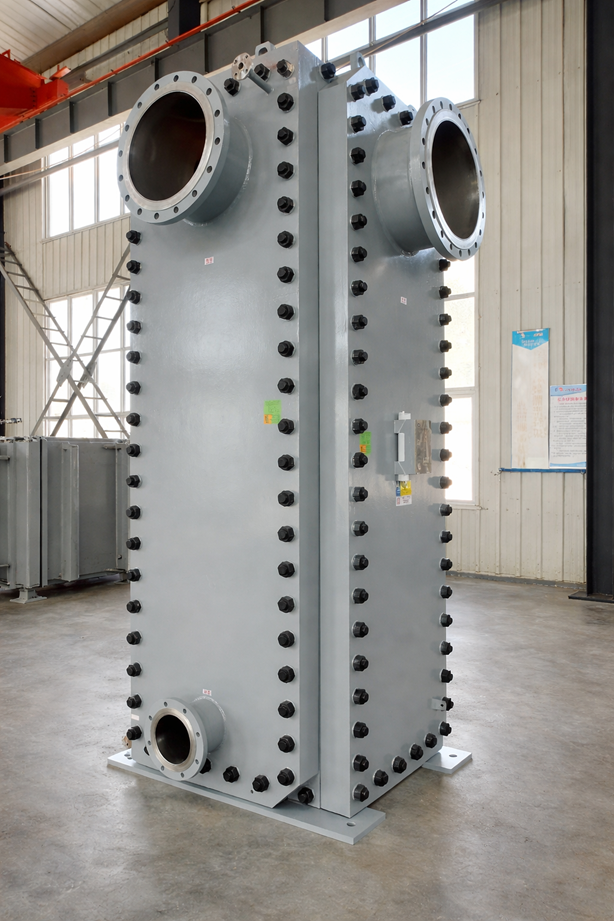
Project at a glance
Replacing the heat-transfer core while retaining the casing.
- Existing equipment
- Compabloc CP75
- Project scope
- Replacement plate pack / core
- Existing casing
- Retained
- Engineering focus
- Dimensional and interface compatibility
- Manufacturing focus
- Plate alignment and welding integrity
- Verification
- Leak-tightness and inspection
These points come from the surviving HEXNOVAS project record. The record does not publish the customer, location, process conditions, materials, plate count or test pressure.
01 · The customer challenge
The customer needed a new core, not an unnecessary new installation.
The documented objective was to restore an existing Compabloc CP75 by replacing its internal welded plate pack while retaining the pressure casing. That distinction defines the project. A complete new exchanger can be designed around new nozzles, supports and site connections. A replacement core has to enter an installed mechanical system whose boundaries already exist.
Retaining the casing can preserve more of the installed asset and may reduce changes to surrounding pipework, supports and foundations. Those are practical reasons to investigate a core-only retrofit, but they are not automatic benefits. They depend on the condition of the retained casing and on whether the old and new interfaces can be verified accurately.
The project therefore could not be treated as “CP75 equals another CP75.” Model identification starts the review; it does not complete it. The replacement pack still had to be engineered around the actual dimensional interface, assembled without cumulative drift and checked for leak tightness before shipment.
02 · Interface review
Why a replacement core requires controlled reverse engineering.
A fully welded plate pack is part of a larger pressure-containing assembly. Its outside envelope matters, but so do the locations and orientation of the fluid interfaces, the relationship between the plate block and cover faces, and the clearances needed to install the core inside the retained casing. A pack that is close in overall size can still be unusable if those relationships are wrong.
For this CP75 project, the surviving record confirms a dimensional interface review and manufacture around the existing casing. It also confirms that dimensional compatibility was a fabrication priority. It does not preserve the project drawing, measured dimensions or pass arrangement, so those details are intentionally not reconstructed here.
For a comparable retrofit, HEXNOVAS normally reviews the external plate-pack envelope, port or nozzle locations, plate orientation, flow-pass arrangement, sealing and cover interfaces, assembly clearances and the tolerances that control fit-up. The original drawing is preferred. Where it is unavailable, controlled measurements and clearly referenced photographs are required. This is the same evidence-led approach described on the Compabloc heat exchanger product page.
03 · Replacement engineering
Engineering the CP75 plate pack as an assembly.
Replacement engineering has to connect three groups of requirements: the retained mechanical interface, the internal flow-path geometry and the manufacturing sequence. The outer frame cannot be reviewed in isolation from the welded plate block. Likewise, a plate pattern cannot be copied without confirming how the finished stack locates inside the casing and communicates with the two circuits.
On the CP75 project, HEXNOVAS controlled plate alignment, weld integrity and dimensional compatibility. These controls address a specific risk in a tall welded core: a small positional error introduced early in the stack can accumulate as the block grows. Even when individual plates are within their own tolerances, the final assembly can drift unless datum control, sequence and intermediate checks are built into fabrication.
Fit-up is therefore more than matching external length and width. The finished pack must maintain the intended circuit separation, preserve flow-path continuity and arrive at the retained interfaces in the correct position. For readers comparing technologies, the plate-and-block heat exchanger page explains the broader welded-block construction used for this class of equipment.
04 · Manufacturing control
Plate alignment and welding control were treated as linked tasks.
The project record identifies production quality control, plate alignment, welding inspection and welding integrity as part of the scope. It does not identify a welding process or inspection standard, so no process name or acceptance class is claimed. What can be stated is why these controls matter: welded containment and final geometry are produced together, and a correction made late in the stack may be difficult or impossible without disturbing completed work.
A disciplined sequence checks component preparation, establishes a repeatable datum for stacking, monitors alignment while the block is built and verifies critical dimensions before access is lost. Welding control must also protect the separation between circuits and the integrity of the external boundary. Inspection points therefore belong inside the manufacturing plan, not only at final completion.
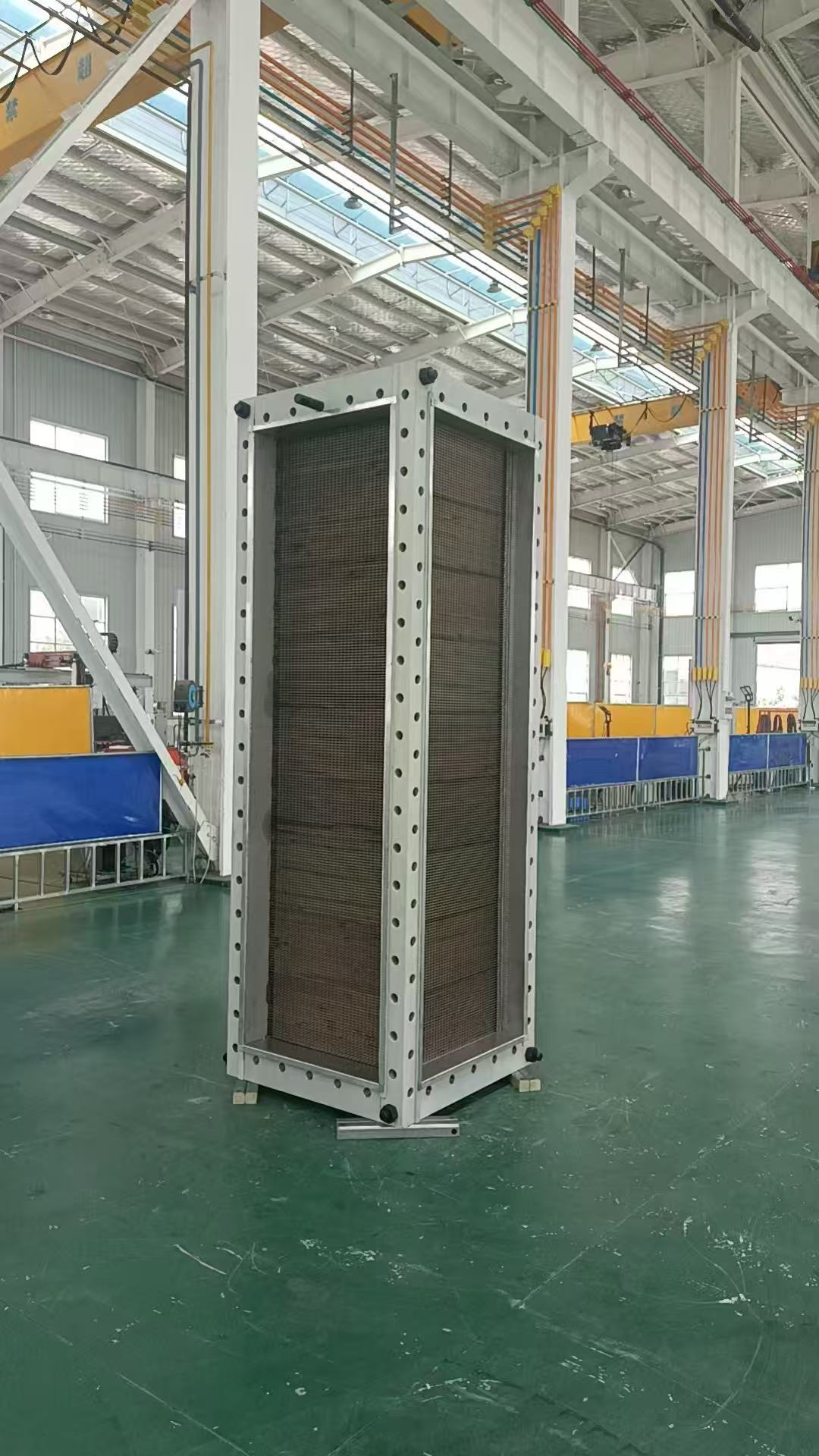
The photograph shows the height of the assembly and why cumulative alignment control is important. It also shows the perimeter frame and exposed plate-block faces before installation into the finished casing. The photo is used as project evidence, not as a basis for inferring undocumented metallurgy or welding parameters.
05 · Quality verification
Leak tightness had to be demonstrated before the retrofit reached site.
The surviving project record confirms leak testing and leak-tight verification. In a two-circuit welded core, this concerns both external containment and internal separation. A leak to atmosphere is one failure mode; communication between the two fluid circuits is another. Either can make a mechanically well-fitting replacement unacceptable.
Pre-shipment verification is especially important for retrofit work. Once the core is inside the retained casing, access is more restricted and a defect can consume valuable shutdown time. Testing does not replace dimensional inspection or welding control; it confirms a different part of the acceptance case.
The available record does not publish the test medium, pressure, duration or acceptance criteria. Those values should be agreed for each project from the design conditions, materials, applicable code and customer inspection requirements rather than copied from an unrelated exchanger.
06 · Retrofit decision
When replacing the core is sensible—and when it is not.
A plate-pack replacement is worth evaluating when the existing casing remains serviceable, its critical interfaces can be inspected, and the required duty can still be met within the retained configuration. In that situation the existing footprint, supports and much of the site connection arrangement may remain usable. This project demonstrates that HEXNOVAS has executed that type of CP75 replacement.
A core-only approach should not be forced onto unsuitable equipment. Damage or severe corrosion in the casing, distorted cover or sealing faces, unverified geometry, inaccessible pressure-boundary defects, or a process duty that has moved beyond the old configuration can justify complete replacement. Pressure-code and inspection requirements also have to be reviewed before defining the scope.
Plant owners comparing a welded block with other layouts can also use the technical guide on Compabloc versus shell-and-tube heat exchangers. Other documented retrofit work is available in the HEXNOVAS case-study library.
07 · Required project inputs
Information normally required for a comparable replacement project.
The following is general engineering guidance. It is not a claim that every item survives in the CP75 project archive.
Existing equipment
- Manufacturer, model, serial number and a clear nameplate image
- Original general-arrangement and plate-pack drawings, if available
- Overall pack and casing-interface dimensions with defined datums
- Port, nozzle, cover and sealing-interface locations
- Photographs of the casing, removed core and accessible interfaces
Process and design data
- Both fluids and their relevant physical properties
- Normal, minimum and maximum flow rates
- Inlet and required outlet temperatures
- Design pressure, design temperature and allowable pressure drop
- Known fouling, corrosion, deposits or contamination concerns
Mechanical and quality requirements
- Required materials and evidence for any proposed substitution
- Applicable design code and retained-casing assessment
- Test, inspection, documentation and witness requirements
- Site lifting, access, installation and shutdown constraints
08 · Practical lessons
What this CP75 project demonstrates.
- A model designation starts the retrofit review; it does not prove interchangeability.
- The retained casing and its interfaces must be evaluated before committing to a core-only scope.
- External dimensions alone do not define flow-path and fit-up compatibility.
- Alignment control has to continue through the complete welded stack because dimensional errors accumulate.
- Welding, dimensional inspection and leak-tight verification answer different acceptance questions; none replaces the others.
- The current process duty should be reconfirmed instead of assuming the old core remains thermally suitable.
For additional construction context, see the guide to the Compabloc heat exchanger working principle.
09 · FAQ
Frequently asked questions
Can the plate pack of an existing Compabloc CP75 be replaced without replacing the complete exchanger?
Yes, in principle, when the pressure casing and its sealing interfaces remain suitable and the replacement core can be engineered to the existing mechanical envelope. This CP75 project followed that route. Suitability still has to be established for each installed unit before interchangeability is promised.
What information is required to manufacture a replacement CP75 plate pack?
HEXNOVAS normally requests the nameplate, available drawings, photographs, plate-pack and interface dimensions, nozzle or port locations, material information, and the operating and design data. The model designation alone does not define every detail needed for a reliable retrofit.
Can a replacement core be manufactured from only the model number?
A model number is a useful starting point, but it is not sufficient evidence for manufacture. Existing geometry, pass arrangement, casing clearances, connection interfaces and process duty should be checked against drawings or controlled measurements.
Why is dimensional verification important for a replacement plate pack?
The new core must fit the retained casing and align with its interfaces. Small alignment or pitch errors can accumulate across a welded block, so the review must consider the complete assembly rather than only nominal outside length and width.
How is a welded replacement plate pack checked for leakage?
The test plan must verify external containment and separation of the two fluid circuits before shipment. The surviving CP75 project record confirms leak-tight verification, but it does not publish the test medium, pressure, duration or acceptance criteria.
When should the complete Compabloc exchanger be replaced instead of only the core?
Complete replacement should be considered when the casing, cover faces, sealing interfaces or pressure boundary are damaged; when geometry cannot be verified; when the revised duty is incompatible with the retained arrangement; or when applicable code and inspection requirements cannot be satisfied by a core-only retrofit.
Can HEXNOVAS review other Compabloc sizes or fully welded block-type exchangers?
Yes. The same evidence-led review can be applied to other fully welded plate-and-block equipment. HEXNOVAS first checks the available identification, drawings, measurements, photographs and duty before confirming whether a replacement core or a complete replacement is technically practical.