Heat Exchanger Technologies
HEXNOVAS Heat Exchanger Types and Applications
Shell & Plate heat exchanger overview and selection guide. Compare BPHE, GPHE, semi-welded, shell & plate, spiral, and pillow plate designs, with practical selection factors and downloadable catalog PDF.
Original HEXNOVAS article
HEXNOVAS Heat Exchanger Types and Applications
Understanding Heat Exchanger Types & Their Specialized Applications
Heat exchangers move energy between fluids for heating, cooling, condensing, and evaporation. The “best” design depends on pressure, temperature, fouling risk, maintenance access, and footprint.
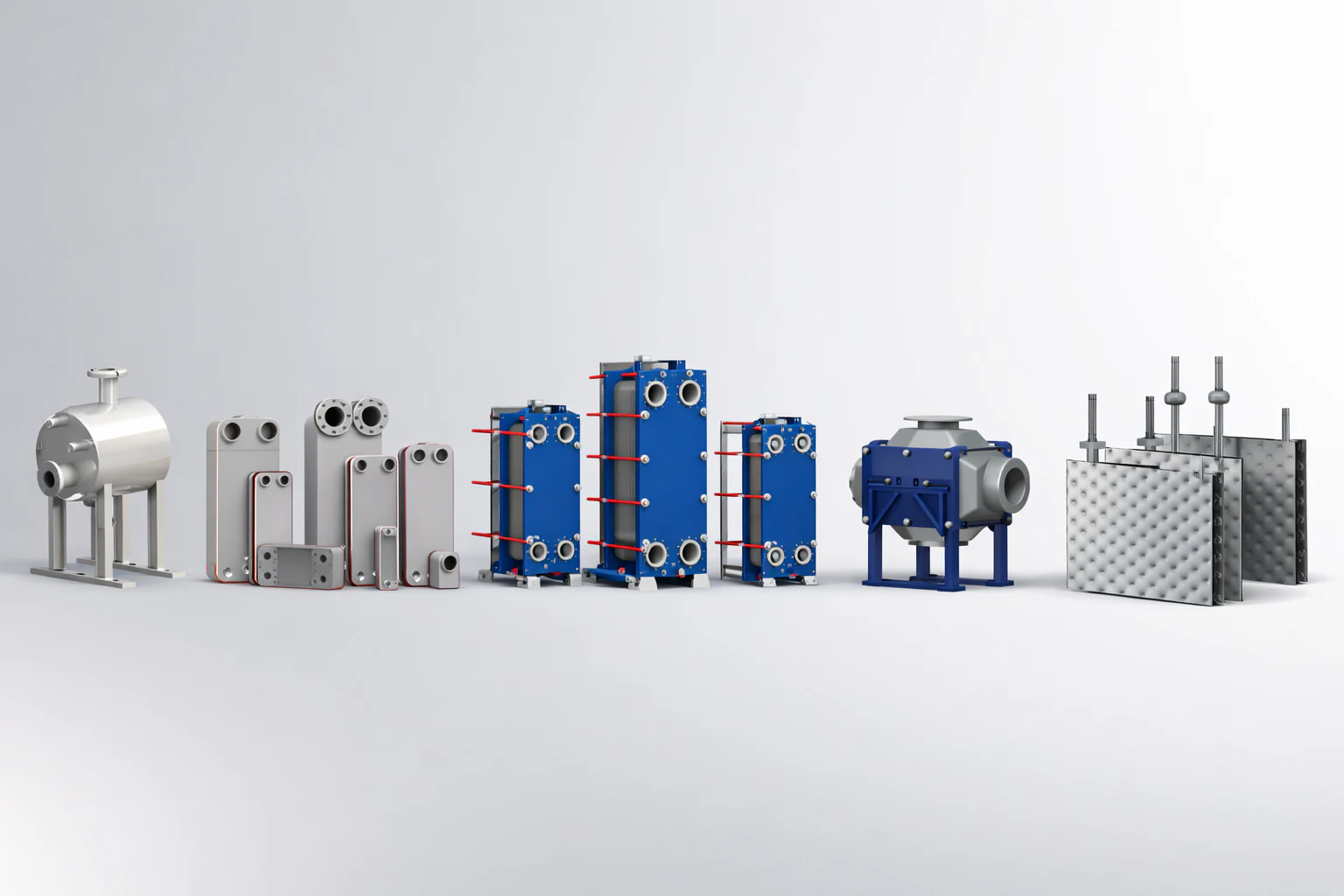
1) Brazed Plate Heat Exchanger (BPHE)
- Design highlights: stainless plates brazed with copper or nickel; compact; low hold-up volume.
- Typical applications: heat pumps, chillers, DHW, CO₂/R410A/R32 refrigeration, oil cooler loops.
Explore BPHE: Copper Brazed PHE / Stainless Brazed PHE .
2) Gasketed Plate Heat Exchanger (GPHE)
- Design highlights: replaceable gaskets; easy inspection; capacity adjustable by adding/removing plates.
- Typical applications: district heating/cooling, food & beverage, pharma, heat recovery, cooling water.
Learn more: GPHE Overview .
3) Semi-Welded Plate Heat Exchanger
- Design highlights: welded cassettes + gasketed side; ideal where one side must be leak-tight (e.g., ammonia).
- Typical applications: R717 ammonia condensers/evaporators, brine/glycol loops, chemical process cooling.
Product page: Semi-welded PHE
4) Shell & Plate Heat Exchanger (Fully Welded Plate Core)
A shell & plate heat exchanger combines a fully welded plate pack with a pressure shell—delivering plate-style heat transfer with shell-side mechanical robustness.
- Typical applications: oil & gas, marine cooling, steam condenser duties, high-temperature process loops.
Product page: Shell & Plate Heat Exchanger
5) Pillow / Dimple Plate Heat Exchanger
- Design highlights: laser-welded inflated plates; flexible shapes; good for fouling-prone fluids with low pressure drop needs.
Product page: Pillow Plates
Key Selection Factors (Practical)
Plate-level efficiency with a pressure shell—well-suited to high-pressure/high-temperature and two-phase duties.
Choose GPHE when you need routine opening/inspection, capacity expansion, or handling variable operating conditions.
Often yes—especially when you need compactness and high efficiency at the same duty. Final selection depends on fouling, allowable ΔP, and materials.