
Industrial Applications
How Heat Exchangers Improve Refrigeration Efficiency
Learn how heat exchangers improve refrigeration efficiency through higher evaporation temperatures, reduced pressure drop, improved heat transfer, and heat recovery integration.
Original HEXNOVAS article
How Heat Exchangers Improve Refrigeration Efficiency
How Heat Exchangers Improve Refrigeration Efficiency
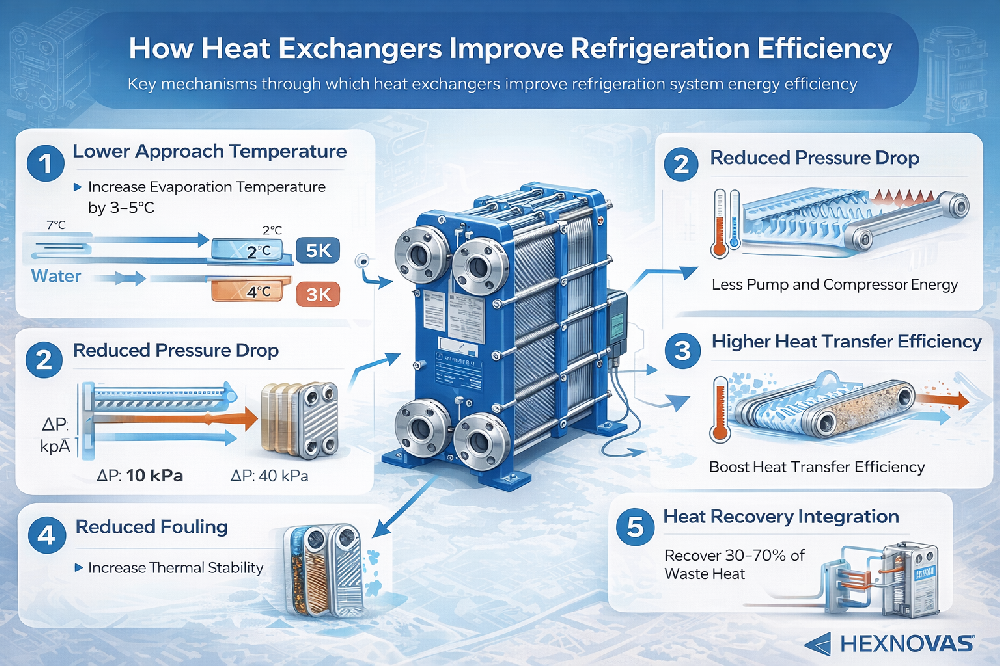
Heat exchangers are one of the most critical components in refrigeration systems. Their thermal performance directly influences evaporation temperature, compressor workload, and overall system energy consumption. Optimized heat exchanger design enables higher system efficiency, lower operating costs, and improved thermal stability.
Key Engineering Factors Affecting Refrigeration Efficiency
Lower Approach Temperature
Reducing the temperature difference between the secondary fluid and refrigerant allows the system to operate at higher evaporation temperatures. Even a 1°C increase in evaporation temperature can improve system efficiency by approximately 2–3%.
Reduced Pressure Drop
Optimized flow channels reduce hydraulic resistance and minimize pump energy consumption while maintaining strong heat transfer performance.
Higher Heat Transfer Coefficient
Advanced plate geometries create strong turbulence, increasing heat transfer coefficients and allowing the system to achieve the same cooling capacity with smaller temperature differences.
Improved Fouling Resistance
High turbulence flow paths reduce fouling buildup and maintain consistent thermal performance over long operating periods.
Impact of Evaporation Temperature on Energy Consumption
One of the most important parameters in refrigeration systems is evaporation temperature. Higher evaporation temperatures reduce compressor compression ratios and improve system efficiency.
Heat Exchanger Role in System Optimization
High-performance heat exchangers allow refrigeration systems to operate with smaller temperature differences, reduced pressure losses, and improved thermal stability. By enabling higher evaporation temperatures, heat exchangers directly reduce compressor workload and lower system power consumption.
Modern plate heat exchangers are particularly effective in refrigeration applications due to their compact size, high heat transfer coefficients, and efficient flow distribution.
Heat Recovery Opportunities
Refrigeration systems reject a large amount of heat during operation. By integrating heat recovery heat exchangers, this waste heat can be used for domestic hot water, building heating, or industrial processes.
Depending on system configuration, between 30% and 70% of rejected heat can be recovered, significantly improving overall energy efficiency.
Conclusion
Heat exchangers play a central role in refrigeration system efficiency. Through optimized thermal performance, reduced pressure drop, and effective heat recovery integration, modern heat exchanger technologies help minimize compressor workload and significantly improve energy performance.
Related Heat Exchanger Products
Technical Knowledge
| Evaporation Temperature Increase | Efficiency Improvement |
| +1°C | ~2–3% |
| +3°C | ~6–9% |
| +5°C | ~10–15% |