Operation & Maintenance
Maintenance and Cleaning of Plate Heat Exchangers
Expert plate heat exchanger cleaning services to boost efficiency & prevent downtime. Get reliable solutions today from industry professionals.
Original HEXNOVAS article
Maintenance and Cleaning of Plate Heat Exchangers
Maintenance and Cleaning of Plate Heat Exchangers
When and How to Maintain & Clean Your Plate Exchanger
1. Why Maintenance Is Critical
Plate heat exchangers operate with very high heat-transfer efficiency, but their narrow flow channels make them sensitive to fouling. Without regular maintenance, even a small amount of scaling, sludge, biofilm, or oil residue can drastically reduce performance, increase pressure drop, and shorten gasket life.
2. When Should a Plate Heat Exchanger Be Cleaned?
Typical Cleaning Intervals
3. Cleaning Methods
3.1 CIP – Cleaning in Place (Chemical Cleaning)
CIP is recommended for light to moderate fouling where disassembly is not required.
Procedure:
- Isolate the heat exchanger from the system.
- Connect a CIP pump and tank.
- Circulate the cleaning solution through the exchanger.
- Rinse with clean water until pH is neutral.
Typical Cleaning Chemicals:
- Mineral scale: citric or phosphoric acid
- Oil & grease: alkaline detergent
- Biological fouling: disinfectant solution
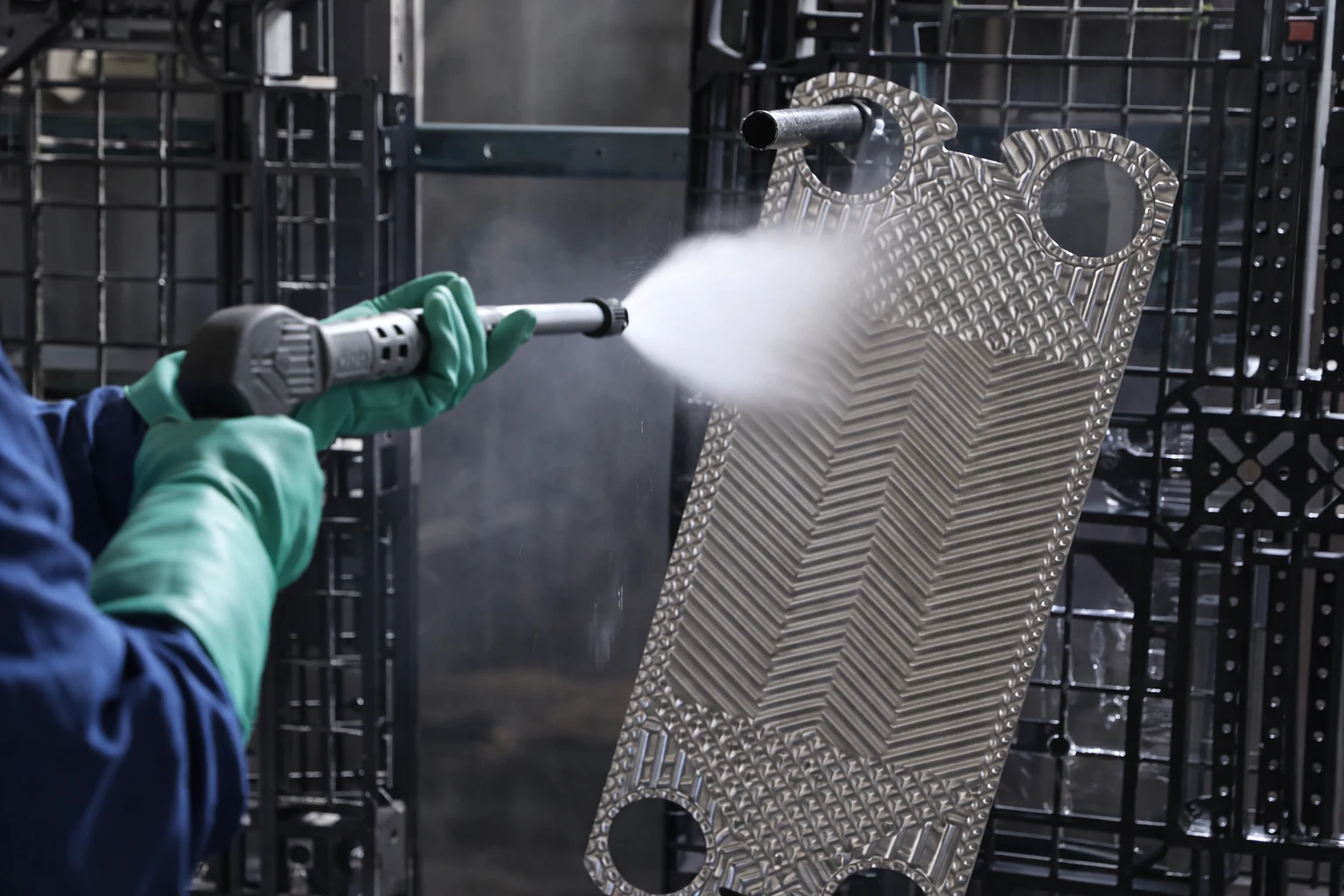
3.2 Mechanical Cleaning (Plate Disassembly)
Required when fouling is severe or gaskets must be replaced.
Steps:
- Mark plate order and orientation.
- Loosen tightening bolts evenly.
- Remove plates and gaskets.
- Clean with warm water and a soft brush (no metal tools).
- Inspect for corrosion, cracks, or deformation.
- Reassemble and tighten to the original frame dimension.
4. Gasket Care
5. Preventive Measures
- Install strainers or filters upstream
- Maintain proper flow velocity
- Avoid thermal shock
- Monitor pressure drop and temperatures
- Apply suitable water treatment
6. Summary
Regular maintenance and proper cleaning extend the service life of plate heat exchangers, minimize downtime, and ensure stable, efficient operation.
| Indicator | Typical Sign |
| Heat duty drops by 10–15% | Lower outlet temperature difference |
| Pressure drop increases by 20–30% | Pump power rises |
| Higher energy consumption | Chiller or boiler runs longer |
| Uneven outlet temperatures | Temperature instability |
| Visible leakage or gasket hardening | Drips, stains, or cracks |
| Abnormal vibration or noise | Flow restriction or fouling |
| Application | Recommended Interval |
| HVAC chilled water | Every 6–12 months |
| Industrial process water | Every 3–6 months |
| Food & beverage | Every 1–3 months |
| Oil, resin, slurry service | As required |
| Do | Don’t |
| Store in a cool, dry place | Avoid direct sunlight |
| Use compatible cleaning chemicals | Avoid strong solvents |
| Replace hardened or damaged gaskets | Do not overstretch gaskets |