
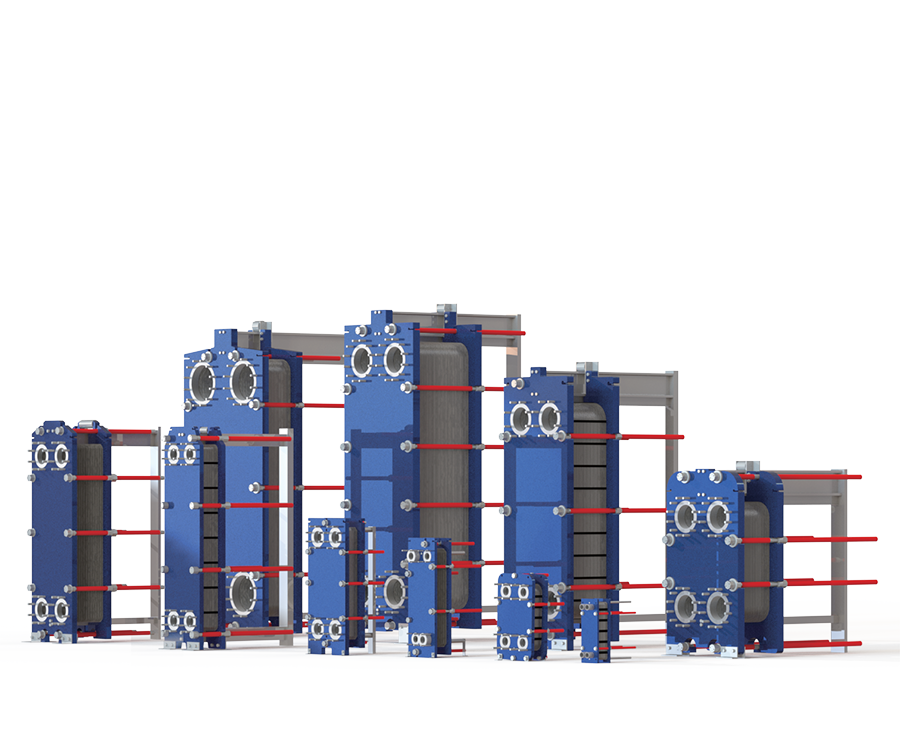
Overview
Startup leakage requires assessment. A temporary gasket response is one possible cause, but improper compression, gasket damage, plate misalignment or an unsuitable gasket can also cause leakage. Follow the site response procedure, including shutdown and inspection where required; disappearance of a leak does not prove the equipment is sound.
Reported startup observations — not acceptance criteria
- Leakage appears only during start-up
- Leakage is usually limited to small droplets or slight seepage
- The location is typically: Head plate First or second plate circular (port) gasket area
- Leakage may diminish after temperatures stabilize, but still requires assessment.
Root Cause Analysis
Possible differential thermal expansion
During start-up, the hot medium enters the head plate section first. This causes:
- Rapid thermal expansion of the head plate and the first plates
- Slower temperature rise of the frame, tightening bolts, and tie bars
Differential expansion may change gasket compression, depending on the frame, bolts, plates and thermal transient.
2. Compression Sensitivity of the Head Plate Area
From a structural standpoint:
- Local clamp distribution depends on assembly condition and design.
- Head-end sealing can be sensitive to local thermal or compression changes.
The leak location alone does not identify the cause.
3. Material Behavior of Viton (FKM) Gaskets
FKM behavior depends on the compound and service conditions; possible factors include:
- Temperature-dependent hardness
- Compound-dependent elastic recovery
Interaction between gasket response and available compression
4. Pressure and Flow Transients During Start-Up
Rapid valve opening or sudden pump start-up can generate:
- Short-term pressure spikes
- Differential pressure fluctuations across the plates
These transient loads may momentarily disturb the gasket sealing line at the most sensitive location — the head plate ports.
Startup Leakage Is Not Automatically Acceptable
Investigate the actual leak path and possible causes:
- Gasket damage or an unsuitable compound
- Plate damage or misalignment
- Incorrect compression or sealing-interface defects; assess whether internal leakage is also possible
Do not classify leakage as normal solely because it occurs during startup or later stops.
Recommended Preventive Measures
Controlled Start-Up Procedure
- Gradually increase flow and temperature
- Avoid rapid valve opening or sudden pump start-up
- Allow the unit to warm up progressively
Inspection and Manufacturer-Approved Adjustment
- Assess leaks from a safe position under site procedures; isolate and inspect when required.
- Any tightening or compression adjustment must follow the exchanger manufacturer’s approved maintenance procedure, including the required isolation, depressurization and temperature conditions. Do not use this article as authorization to tighten a hot, pressurized or operating exchanger.
- Use only the equipment-specific compression or tightening limits and sequence; no generic torque or A-dimension is provided here.
Gasket Material Selection
- Select a gasket compound for the actual fluids, temperature and cleaning regime with the manufacturer; a softer compound is not automatically a remedy.
Conclusion
Controlled startup may reduce thermal and pressure transients, but it does not replace investigation of leakage or verification of gasket condition, alignment and compression.
FAQ – Minor Leakage at Head Plate Gaskets (GPHE with FKM)
1. Is minor leakage at the head plate during start-up a defect?
Not necessarily, but startup timing does not rule out a defect. Evaluate gasket condition, alignment, compatibility and compression under the approved procedure.
2. Why does leakage usually occur at the head plate area?
The head plate and the first one or two plates experience:
- Differential thermal response may affect local sealing.
- Compression sensitivity depends on the actual assembly.
- Clamp distribution should be checked against the manufacturer’s requirements.
The location is a diagnostic clue, not proof of a harmless mechanism.
3. Does this leakage mean the gasket is damaged?
A leak that stops does not demonstrate that a gasket is undamaged or correctly compressed.
Persistent or recurrent leakage requires assessment and shutdown/inspection as indicated by the fluid hazards and site procedure.
4. Why are FKM (Viton) gaskets more sensitive during start-up?
FKM gaskets:
- Hardness varies with the selected compound and temperature.
- Elastic recovery varies with compound and condition.
- Sealing depends on the specified compression and assembly condition.
These factors may contribute to a transient leak but do not establish an acceptable leak condition.
5. Does this indicate internal mixing between fluids?
An external leak does not by itself establish internal mixing, but it also does not rule out an internal defect. Assess the actual leak path and containment condition.
6. Can this issue occur with EPDM or NBR gaskets?
Other elastomers can also leak; behavior is compound- and service-dependent.
Compare the approved compounds for the actual fluid, temperature and cleaning regime rather than relying on a universal softness ranking.
7. How can this start-up leakage be minimized?
Recommended measures:
- Gradual heating during start-up
- Slow valve opening
- Controlled pump ramp-up
- Inspect and adjust only under the manufacturer-approved maintenance and isolation procedure.
Avoid sudden temperature or pressure spikes.
8. Should bolts be retightened when leakage is observed?
Do not retighten solely because the unit has reached operating temperature.
Any tightening or compression adjustment must follow the exchanger manufacturer’s approved maintenance procedure, including the required isolation, depressurization and temperature conditions. Do not use this article as authorization to tighten a hot, pressurized or operating exchanger.
Verify the specified compression and assembly condition under that procedure; do not compensate for leakage by uncontrolled tightening.
9. When should gasket replacement be considered?
Replacement or repair should be based on inspection and manufacturer guidance, including:
- Leakage continues under stable operating conditions
- Visible gasket damage or extrusion is present
- Aging, chemical attack, or hardening is confirmed
A temporary leak still requires assessment; its duration alone does not determine whether replacement is needed.
10. Is this phenomenon common in high-temperature GPHE applications?
Startup transients can contribute to leakage in some installations, including:
- High-temperature systems
- Units with large temperature gradients
- Systems with rapid thermal cycling
- Frequent cold start-ups
These operating conditions do not make leakage acceptable or remove the need to investigate it.
11. Does this affect long-term reliability?
Reliability cannot be inferred from leakage stopping. Confirm that:
- Start-up procedures are controlled
- Compression is within design limits
- The cause has been assessed and any required repair or inspection completed.
Return to service only under the applicable manufacturer and site requirements.