Chemical Processing
Palm Oil Refining Heat Exchanger Solution for BPO to RBDPO Processing
Discover the HEXNOVAS palm oil refining heat exchanger solution for BPO to RBDPO processing. Improve deodorization heat recovery, reduce steam consumption, and optimize final cooling with spiral, full welded, and gasketed plate heat exchangers.
Original HEXNOVAS article
Palm Oil Refining Heat Exchanger Solution for BPO to RBDPO Processing
Palm Oil Refining Heat Exchanger Solution for BPO to RBDPO Processing
In palm oil refining plants, the conversion of Bleached Palm Oil (BPO) into Refined, Bleached and Deodorized Palm Oil (RBDPO) requires reliable heat recovery, accurate temperature control, and equipment that can handle high temperatures, viscous oil, fouling risk, and continuous industrial operation. HEXNOVAS provides a multi-stage heat exchanger solution using Spiral Heat Exchangers , Full Welded Plate Heat Exchangers , and Gasketed Plate Heat Exchangers to improve thermal efficiency, reduce steam demand, and stabilize product quality across the entire palm oil refining process.
Why Heat Recovery Matters in Palm Oil Refining
Palm oil refining is not simply a heating process. It is a staged thermal system involving deodorization, heat recovery, intermediate cooling, final product cooling, and temperature stabilization before storage or downstream processing. Because the process typically operates with hot edible oil, steam, vacuum systems, and multiple cooling duties, every lost kilowatt of heat directly affects energy cost and plant efficiency.
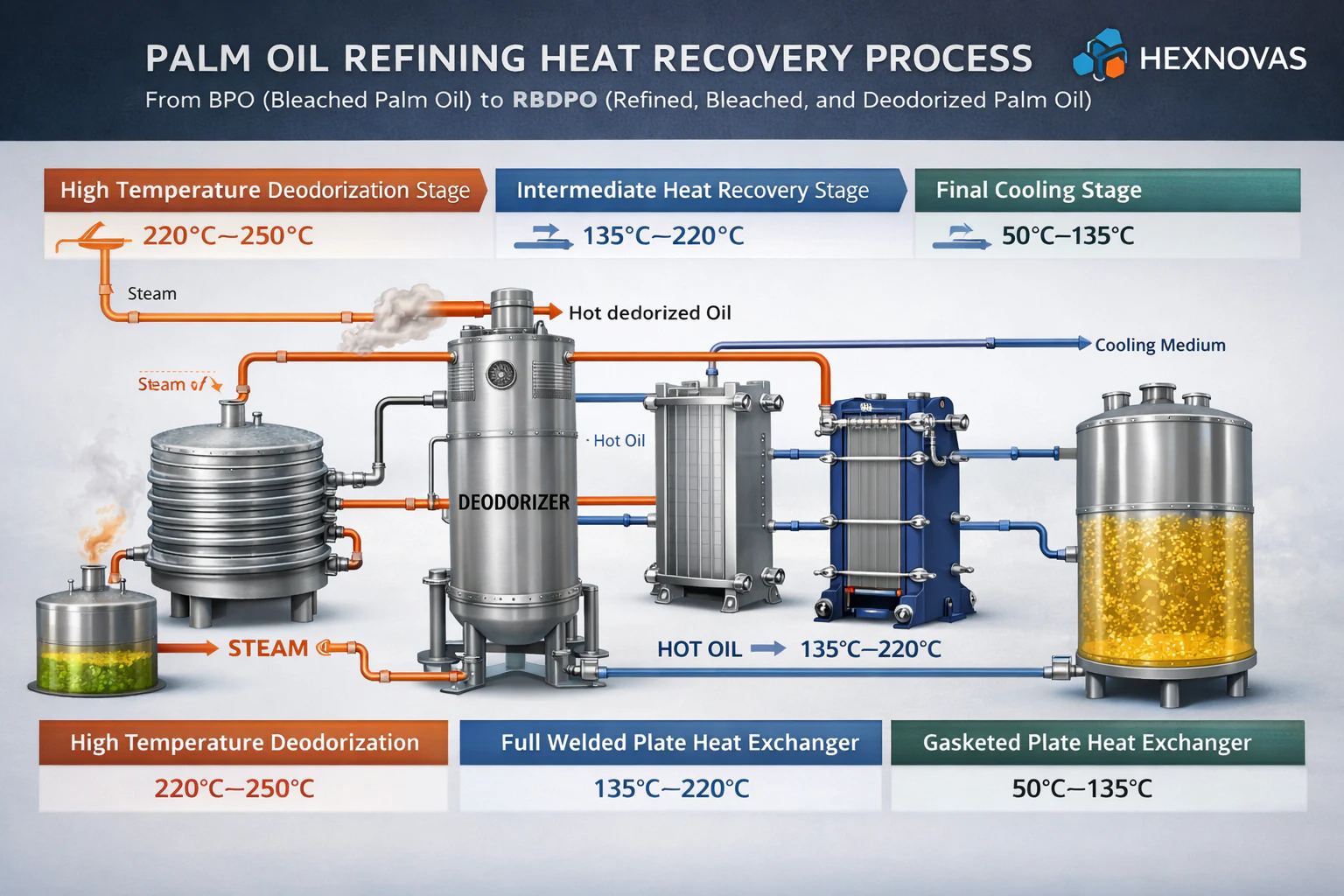
In a typical BPO to RBDPO line, oil may enter high-temperature deodorization zones at approximately 220°C to 250°C , then pass through one or more cooling or regenerative heat exchange stages before reaching storage temperatures in the range of 50°C to 80°C . Without an optimized heat exchanger arrangement, the refinery will consume more steam, reject more recoverable heat, and operate with higher utility cost per ton of refined oil.
This is why a proper palm oil refining heat exchanger solution is not just about selecting one exchanger. It is about matching the correct exchanger type to the correct temperature range, viscosity condition, cleanliness requirement, and maintenance strategy. HEXNOVAS approaches this with a staged engineering logic instead of a one-size-fits-all product recommendation.
Palm Oil Refining Process Challenges
Palm oil refining creates several thermal and mechanical challenges for industrial heat exchangers. The fluid is not as easy to handle as clean water. It can be viscous, temperature-sensitive, and prone to fouling if heat transfer is poorly managed. In addition, edible oil systems often require stable, hygienic, and maintenance-friendly equipment to support continuous plant operation.
The deodorization section may operate up to 250°C. This demands exchanger designs with strong structural stability and reliable performance under elevated process temperature.
Palm oil and related streams can create fouling layers if the exchanger flow pattern is not suitable. Channel design and turbulence behavior become critical.
Large quantities of usable heat are present in outgoing hot oil streams. Recovering this heat can significantly reduce utility consumption.
Some stages require lower maintenance and sealed construction, while other stages benefit from easy opening and plate cleaning access.
HEXNOVAS Multi-Stage Heat Exchanger Solution
For palm oil refining systems, HEXNOVAS recommends a three-stage arrangement that aligns exchanger type with process duty. This improves heat recovery efficiency, controls thermal stress, and helps the plant balance performance, operating cost, and long-term serviceability.
Stage 1: Spiral Heat Exchanger
Used in the highest temperature duty where hot oil handling, fouling resistance, and stable continuous flow are essential.
Stage 2: Full Welded Plate Heat Exchanger
Used for intermediate heat recovery where higher thermal efficiency, compact size, and gasket-free reliability are required.
Stage 3: Gasketed Plate Heat Exchanger
Used for lower temperature process cooling where service accessibility, cleaning convenience, and cost efficiency matter.
Stage 1: Spiral Heat Exchanger for High Temperature Deodorization Duty
In the high-temperature section of the palm oil refining process, HEXNOVAS recommends a Spiral Heat Exchanger for the most demanding heating or regenerative duties. This type of exchanger is well suited to hot palm oil streams because the spiral channel arrangement promotes continuous flow and reduces dead zones where fouling can accumulate.
When deodorized oil leaves a high-temperature process zone, there is often valuable recoverable heat available. A spiral heat exchanger can transfer this heat effectively while maintaining relatively stable hydraulic behavior with viscous fluids. Compared with some narrow-channel exchanger designs, spiral flow paths are often more tolerant of fouling tendency and process fluctuation.
Why Spiral Heat Exchanger Works Well Here
- Suitable for high temperature palm oil process streams
- Single-channel flow path helps reduce blockage risk
- Good fouling resistance for viscous or contaminated services
- Reliable for regenerative heat recovery in refinery duty
- Useful in applications where stable flow distribution matters
For long-tail search relevance, this stage directly supports terms such as spiral heat exchanger for palm oil , palm oil deodorization heat exchanger , high temperature edible oil heat exchanger , and industrial heat recovery for palm oil refining .
Stage 2: Full Welded Plate Heat Exchanger for Intermediate Heat Recovery
In the intermediate temperature range, the process often benefits from a more compact and thermally efficient exchanger. For this reason, HEXNOVAS uses a Full Welded Plate Heat Exchanger in the middle stage of the solution. This design combines the heat transfer efficiency of plate technology with the reliability of a gasket-free welded construction.
In palm oil refining, this stage is especially valuable when hot oil must exchange heat with cooler incoming process streams. The goal is to recover as much heat as possible before additional cooling or final polishing stages. Because the exchanger is fully welded, it is more suitable for conditions where gasket limitations are undesirable and tighter sealing integrity is preferred.
Why Full Welded Plate Heat Exchanger Fits This Stage
- High heat transfer coefficient for efficient energy recovery
- Compact footprint compared with bulkier exchanger designs
- No gasket leakage risk in the plate pack flow section
- Suitable for higher temperature and pressure than standard gasketed plate designs
- Helps reduce steam consumption through more effective regeneration
This section is highly relevant for keywords such as full welded plate heat exchanger for palm oil refining , welded plate heat exchanger for edible oil , heat recovery exchanger for palm oil process , and compact refinery heat exchanger solution .
Stage 3: Gasketed Plate Heat Exchanger for Final Cooling and Utility Optimization
In the lower temperature zone, HEXNOVAS typically recommends a Gasketed Plate Heat Exchanger . At this point in the process, the fluid has already passed through the highest temperature and regenerative stages, and the duty often shifts toward final cooling, storage preparation, or utility-side optimization. A gasketed plate exchanger offers strong thermal efficiency with practical maintenance access.
For many edible oil plants, this is an important benefit. Lower temperature services often favor exchanger designs that can be opened, inspected, expanded, and cleaned more easily. This helps reduce downtime and allows the customer to adjust capacity by adding or changing plates as the process evolves.
Why Gasketed Plate Heat Exchanger Is Used in Final Cooling
- Excellent thermal efficiency in lower temperature ranges
- Easy to open for cleaning and inspection
- Expandable capacity for future process upgrades
- Cost-effective for many final cooling applications
- Widely used in edible oil, food, and industrial utility services
This improves relevance for terms like gasketed plate heat exchanger for palm oil cooling , plate heat exchanger for edible oil processing , final cooling heat exchanger for RBDPO , and food grade plate heat exchanger solution .
Why HEXNOVAS Uses Three Different Exchanger Types
Some suppliers try to position one exchanger style as a universal answer. In real refinery engineering, that approach is usually inefficient. Different process stages impose different thermal loads, hydraulic behaviors, maintenance needs, and capital cost considerations. That is why the HEXNOVAS solution uses a staged configuration.
Main Benefits for Palm Oil Refining Plants
By integrating spiral, full welded, and gasketed plate heat exchangers into one thermal system, palm oil refineries can achieve measurable improvements in both process performance and utility consumption.
Recovering heat from outgoing hot oil streams reduces the need for fresh heating energy in upstream stages.
More useful heat is kept inside the process instead of being rejected to cooling systems or lost through inefficient design.
Multi-stage exchanger matching helps maintain more stable temperatures during deodorization, cooling, and storage preparation.
Each exchanger type is used where its strengths matter most, reducing unnecessary service problems and extending equipment life.
Typical Plant-Level Results
- Reduced operating cost per ton of refined palm oil
- Improved heat recovery in BPO to RBDPO conversion
- More reliable operation in high temperature edible oil duty
- Better balance between performance, footprint, and maintenance
- Scalable thermal design for different refinery capacities
Typical Applications Beyond Standard Palm Oil Refining
Although this solution is designed around BPO to RBDPO processing, the same engineering logic can also be used in related edible oil and vegetable oil industries where staged heating and cooling are required.
- Palm kernel oil processing
- Vegetable oil refining
- Edible oil deodorization systems
- Heat recovery in oil fractionation plants
- Industrial thermal systems for high-viscosity liquid products
This expands search coverage for long-tail phrases such as vegetable oil refining heat exchanger solution , edible oil deodorizer heat recovery system , heat exchanger for palm kernel oil plant , and industrial oil cooling and heat recovery equipment .
Frequently Asked Questions
What is the best heat exchanger for palm oil refining?
There is usually no single best exchanger for the entire process. A spiral heat exchanger is often preferred for the highest temperature and fouling-prone section, a full welded plate heat exchanger is often ideal for compact intermediate heat recovery, and a gasketed plate heat exchanger is often the practical choice for final cooling.
Why not use only a gasketed plate heat exchanger?
Gasketed plate heat exchangers are excellent for many duties, but the highest temperature palm oil refining stages may require stronger sealing security and different fouling behavior than a standard gasketed unit is intended to handle.
Why is heat recovery important in BPO to RBDPO conversion?
Because the outgoing process oil contains valuable thermal energy. Recovering this heat reduces steam demand, lowers utility cost, and improves overall plant efficiency.
Can HEXNOVAS customize the solution?
Yes. HEXNOVAS can configure exchanger selection based on oil temperature, viscosity, flow rate, fouling tendency, material requirement, pressure drop target, and plant layout constraints.
Conclusion
A well-designed palm oil refining heat exchanger solution should match the exchanger technology to the process stage. For BPO to RBDPO conversion, the combination of Spiral Heat Exchanger , Full Welded Plate Heat Exchanger , and Gasketed Plate Heat Exchanger gives the refinery a more balanced system for high-temperature duty, intermediate heat recovery, and final cooling.
HEXNOVAS helps palm oil producers improve energy efficiency, reduce steam consumption, control fouling risk, and maintain stable production quality through customized industrial heat exchanger solutions. If your project involves palm oil deodorization, edible oil heat recovery, or thermal optimization in vegetable oil processing, this staged configuration provides a practical and scalable engineering route.
Request a Palm Oil Heat Exchanger Solution
| Process Stage | Typical Temperature | Recommended Exchanger | Main Reason |
| High Temperature Deodorization / Regeneration | 220°C – 250°C | Spiral Heat Exchanger | Handles hot viscous oil well, better fouling tolerance, stable flow path |
| Intermediate Heat Recovery | 135°C – 220°C | Full Welded Plate Heat Exchanger | High efficiency, compact design, gasket-free sealing performance |
| Final Cooling | 50°C – 135°C | Gasketed Plate Heat Exchanger | Easy maintenance, flexible capacity, cost-effective cooling duty |