
Industrial Applications
Spiral Plate Heat Exchanger for Sludge Heat Recovery
Spiral Plate Heat Exchangers (SPHE) are designed for sludge, wastewater, and fouling services. Learn how spiral geometry ensures stable operation and reliable heat recovery.
Original HEXNOVAS article
Spiral Plate Heat Exchanger for Sludge Heat Recovery
Spiral Plate Heat Exchanger (SPHE) for Sludge Heat Recovery
Sludge heat recovery is one of the most challenging services for any heat exchanger due to fibers, organic solids, grease, biological growth, and unstable flow. In practice, selecting the right exchanger is not about peak U-value—it is about stable long-term operation .
Why Sludge Is a Difficult Medium
Typical sludge streams contain:
- Suspended solids (0.3–5%)
- Organic fibers
- Fat and grease
- Biological deposits
- Occasional large particles
- Variable viscosity
Even if initial performance is acceptable, narrow-channel designs often suffer from partial blockage and uneven fouling.
Key Design Considerations for Sludge Heat Recovery
When selecting a heat exchanger for sludge applications, engineers should evaluate:
Does the exchanger continue operating when fouling begins?
A Spiral Plate Heat Exchanger forces the entire stream through a single continuous channel. Even when deposits form, performance typically degrades gradually rather than suddenly.
Fibers can accumulate in distribution zones of multi-channel designs.
SPHE eliminates complex distribution headers, reducing fiber bridging risk and improving stability in fibrous sludge.
In sludge applications, cleaning is inevitable. SPHE with removable covers allows:
- Direct mechanical cleaning
- Water jetting
- Manual inspection
This reduces downtime compared to multi-plate disassembly.
Compared to shell & tube, SPHE typically offers:
- Higher surface density
- More compact footprint
- Lower installation space requirement
SPHE vs Other Heat Exchanger Types in Sludge Service
In sludge heat recovery, SPHE often offers the best balance between compactness and fouling stability.
When SPHE Is the Preferred Solution
SPHE is especially recommended when:
- Sludge concentration fluctuates
- Fibers and grease are present
- Downtime is expensive
- Continuous heat recovery is required
- Predictable maintenance cycles are desired
Practical Insight: Stability Over Peak Efficiency
In theory, some compact plate heat exchangers may offer higher initial U-values. In reality, sludge systems rarely operate under ideal conditions.
A slightly lower peak U-value with stable operation often results in higher annual heat recovery .
Frequently Asked Questions – Spiral Plate Heat Exchanger (SPHE)
If you are evaluating a sludge heat exchanger or wastewater heat recovery system, these FAQs address common engineering concerns.
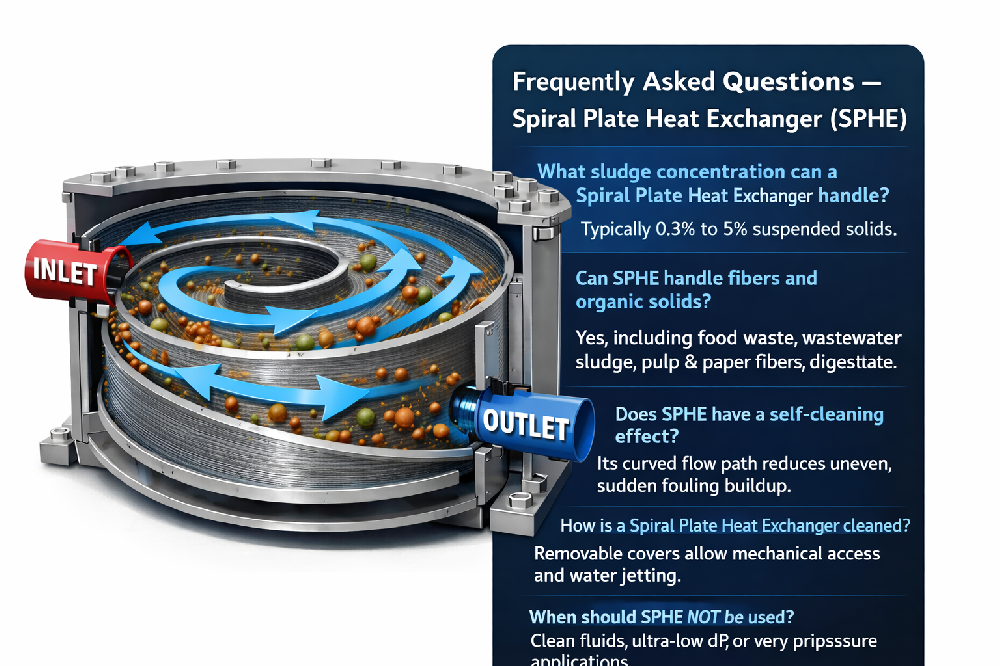
SPHE is commonly used for sludge concentrations ranging from 0.3% to 5% suspended solids. Higher concentrations may be possible depending on viscosity. Because SPHE uses a single continuous channel, it tolerates higher solids compared to narrow-channel plate exchangers.
Yes. SPHE is suitable for food waste sludge, municipal wastewater sludge, pulp & paper fibers, and biogas digestate. The absence of complex distribution zones reduces fiber bridging risk.
No heat exchanger is fully self-cleaning, but SPHE benefits from a curved spiral flow path, secondary flow patterns, and more uniform fouling behavior, which can slow deposit buildup compared to multi-channel designs.
Depending on design, removable covers allow mechanical cleaning, high-pressure water jetting, and full channel access—often simpler than disassembling large plate packs.
SPHE typically has a moderate pressure drop, with a more stable pressure-drop increase over time. In fouling service, pressure drop rise is often gradual rather than sudden. For reference, see gasketed plate heat exchangers .
In many sludge applications, SPHE can provide higher heat transfer coefficients than shell & tube, requires less footprint, and is easier to maintain. However, shell & tube may tolerate extremely abrasive solids better in certain cases. See shell & tube heat exchangers .
SPHE may not be ideal when the fluid is very clean and compactness is the only goal, when extremely high pressure exceeds SPHE design limits, or when ultra-low pressure drop is mandatory. In clean services, gasketed plate exchangers may offer better compactness.
Because the real KPI in sludge systems is operational stability. SPHE reduces the risk of sudden plugging, maintains stable heat recovery, and converts emergency maintenance into scheduled maintenance—especially under unstable flow conditions.
| Feature | SPHE | Free Flow Plate | Shell & Tube |
| Fiber Tolerance | Very High | Moderate | High |
| Fouling Behavior | Uniform | Channel-based | Tube-based |
| Compactness | High | High | Low |
| Cleaning | Mechanical access | Plate removal | Tube pulling |
| Stability | Excellent | Good | Good |