Design Guide
Sulphuric Acid Heat Exchanger – Complete Engineering Guide
Complete engineering guide to sulphuric acid heat exchangers, covering corrosion mechanisms, material selection, exchanger types, plate heat exchangers, spiral heat exchangers, and industrial acid cooling applications.
Original HEXNOVAS article
Sulphuric Acid Heat Exchanger guide
Sulphuric Acid Heat Exchanger Complete Engineering Guide
Complete pillar page about sulphuric acid heat exchangers covering corrosion mechanisms, material selection, heat exchanger types, plate heat exchangers, spiral heat exchangers, temperature control, acid cooling, acid dilution, and chemical process design.
Sulphuric Acid Heat Exchanger – Complete Engineering Guide
Sulphuric acid heat exchanger selection requires more than standard thermal sizing. In real chemical and mining applications, engineers must evaluate corrosion behavior, acid concentration, operating temperature, exchanger type, and alloy compatibility together. This pillar page explains how to select the right heat exchanger solution for sulphuric acid cooling, dilution, concentration, and other aggressive process duties.
What This Pillar Page Covers
1. What Is a Sulphuric Acid Heat Exchanger
A sulphuric acid heat exchanger is a specially selected or specially designed exchanger used to transfer heat in systems where sulphuric acid is present as the process fluid or one of the process streams. Unlike ordinary industrial heat exchangers, these units must resist aggressive corrosion, maintain stable thermal performance, and avoid premature leakage or material failure.
In practice, sulphuric acid service may involve acid cooling, acid dilution, heat recovery, acid concentration, or related chemical duties. Each case has different corrosion risks depending on acid concentration, temperature, velocity, contamination, and the presence of oxidizing species or chlorides.
2. Why Sulphuric Acid Is Highly Corrosive
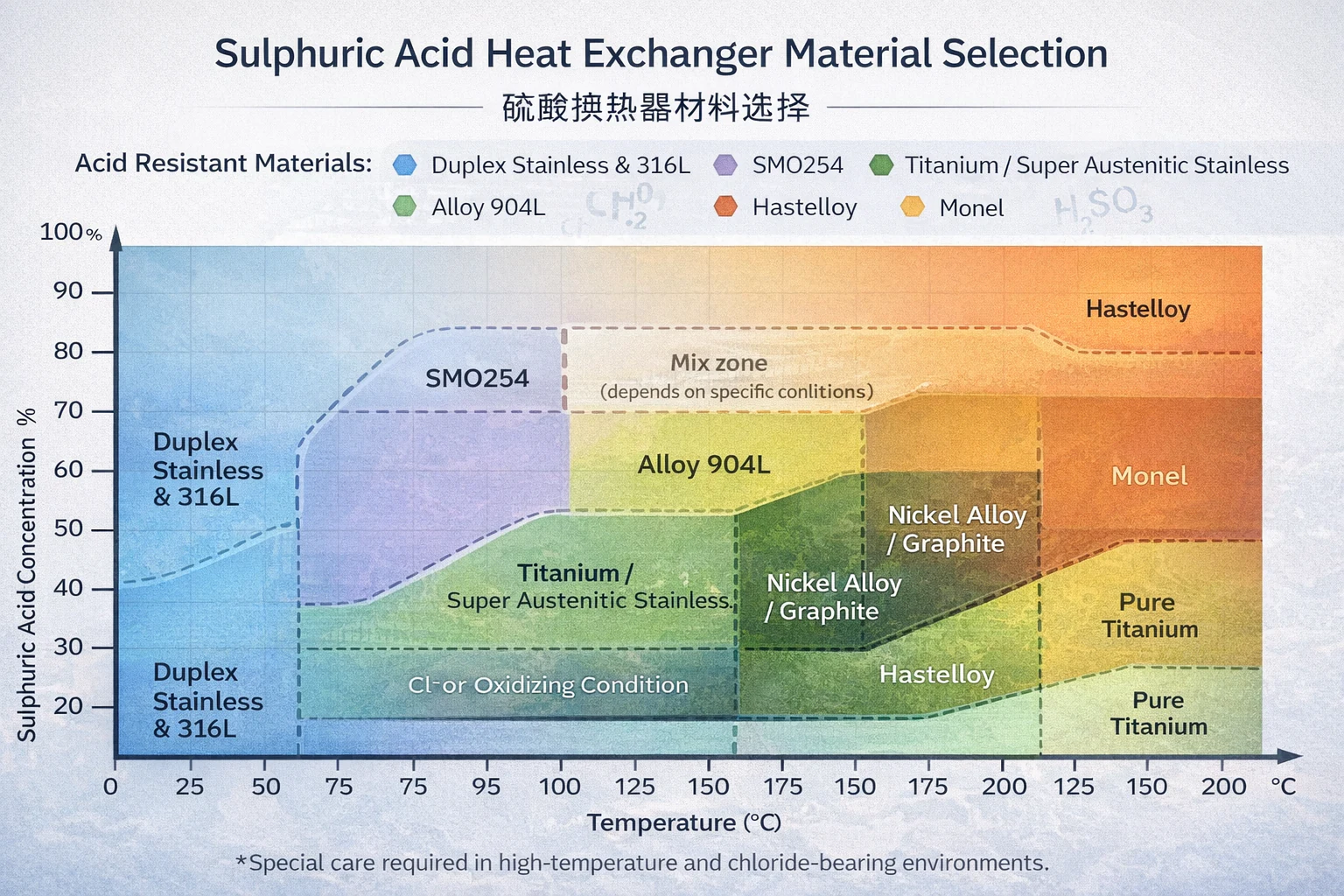
Sulphuric acid is not uniformly corrosive under all conditions. Its corrosion behavior changes dramatically depending on concentration and temperature. This is why exchanger design for sulphuric acid cannot rely on one simple rule such as “use stainless steel” or “use titanium.” The correct answer depends on where the process falls on the combined concentration-temperature map.
Additional variables such as flow velocity, chloride contamination, oxidizing conditions, scaling tendency, and startup or cleaning cycles can shift the acceptable material window even further. A material that performs acceptably in one acid concentration may fail quickly in another.
Dilute and concentrated sulphuric acid can behave very differently from a corrosion standpoint.
Higher temperatures generally accelerate corrosion and narrow the safe material range.
Chlorides and oxidizing compounds can dramatically increase corrosion risks for common alloys.
Startup, shutdown, dilution, and local hot spots can create more severe exposure than normal steady-state operation.
3. Heat Exchanger Types Used in Sulphuric Acid Systems
There is no single exchanger type that is universally best for every sulphuric acid application. The correct choice depends on the chemical duty, fouling level, maintenance strategy, pressure, temperature, and material requirements.
Plate Heat Exchangers for Sulphuric Acid
A Gasket Plate Heat Exchanger may be used in certain sulphuric acid cooling duties when the chemical window is appropriate and both plate material and gasket material are carefully selected. The main benefits are high thermal efficiency, compact footprint, and easier maintenance access.
Spiral Heat Exchangers for More Difficult Streams
A Spiral Heat Exchanger can be advantageous when the process stream is more difficult, such as acid service containing solids, sludge, or contamination. Its single-channel flow path can improve fouling tolerance in some cases.
4. Material Selection for Sulphuric Acid Heat Exchangers
Material selection is the core of sulphuric acid exchanger design. In most cases, the question is not simply whether a material is “acid resistant,” but whether it remains acceptable at the specific concentration, temperature, and contamination level of the actual process.
For broader alloy background, see our related guide: Heat Exchanger Material Selection Guide .
5. Sulphuric Acid Heat Exchanger Applications
Sulphuric acid heat exchangers are used across a wide range of industries. While the exact process conditions differ, the design objective is the same: maintain controlled temperature while ensuring corrosion resistance and long service life.
Acid handling and reaction temperature control are critical in sulfur-based fertilizer manufacturing systems.
Pickling, leaching, and refinery acid circuits require careful exchanger material selection.
Acid systems in mining may involve contaminated fluids, heat removal, and strong corrosion risk.
General chemical processes frequently use sulphuric acid in cooling, dilution, and concentration duties.
6. Key Design Considerations
A sulphuric acid heat exchanger should be engineered as a combined corrosion-and-thermal system, not merely as a duty calculation. The exchanger must safely transfer heat while maintaining material compatibility and operational reliability.
8. Conclusion
Sulphuric acid heat exchanger selection is an engineering decision that combines corrosion science, material selection, thermal duty, and process reliability. The correct solution is rarely determined by one factor alone. Instead, engineers must evaluate acid concentration, operating temperature, contamination, exchanger type, and service strategy together.
When built as a proper pillar page, this topic can support broader keyword authority for acid-resistant heat exchangers, chemical process cooling, material selection, and sulphuric acid applications across your entire Knowledge Center.
Build Stronger Topic Authority Around Acid-Resistant Heat Exchangers
Use this pillar page as the center of your sulphuric acid content cluster, then expand it with supporting pages about material selection, acid-service plate heat exchangers, spiral heat exchangers, and industry-specific cooling applications.
| Heat Exchanger Type | Typical Strength | Application Logic |
| Plate Heat Exchanger | High heat transfer efficiency, compact footprint | Suitable where high thermal efficiency and compact installation are important, provided compatible plates and sealing materials are available. |
| Spiral Heat Exchanger | Better handling of fouling or solids-bearing streams | Useful in chemical or mining duties where contaminated process fluid may create plugging or maintenance concerns. |
| Shell and Tube | Mechanical robustness and broad design flexibility | Often used for larger duty or more traditional acid cooling systems where alloy selection and mechanical margins are critical. |
| Graphite / Special Alloy Designs | Excellent corrosion resistance in selected acid duties | Applied in severe corrosive services where metallic options become limited or uneconomical. |
| Material | Selection Direction | Engineering Comment |
| 316L Stainless Steel | Only for relatively limited and less aggressive ranges | May be acceptable in some milder conditions, but often lacks corrosion margin in demanding sulphuric acid service. |
| 904L | Improved acid resistance versus conventional stainless steel | Often considered for chemical service where stronger corrosion resistance is needed. |
| 254SMO | Higher corrosion resistance in more aggressive environments | Can offer better performance where chloride contamination or more severe acidity must be addressed. |
| Titanium | Strong corrosion resistance in selected acid or chloride-related duties | Frequently used when common stainless alloys are not reliable enough, but must still be matched to the actual chemistry. |
| Hastelloy / Nickel Alloy | For severe chemical corrosion conditions | Higher cost, but often justified in demanding applications where service life and safety are critical. |
| Monel / Special Alloy | Case-by-case advanced selection | Should be evaluated according to the detailed process chemistry and corrosion data. |