
Heat Exchanger Technologies
What is a Compabloc Heat Exchanger? (Complete Guide)
Learn what a Compabloc heat exchanger is, how it works, its structure, advantages and industrial applications. Complete guide to welded plate heat exchangers for chemical and industrial processes.
Original HEXNOVAS article
What is a Compabloc Heat Exchanger?
What is a Compabloc Heat Exchanger? (Complete Guide)
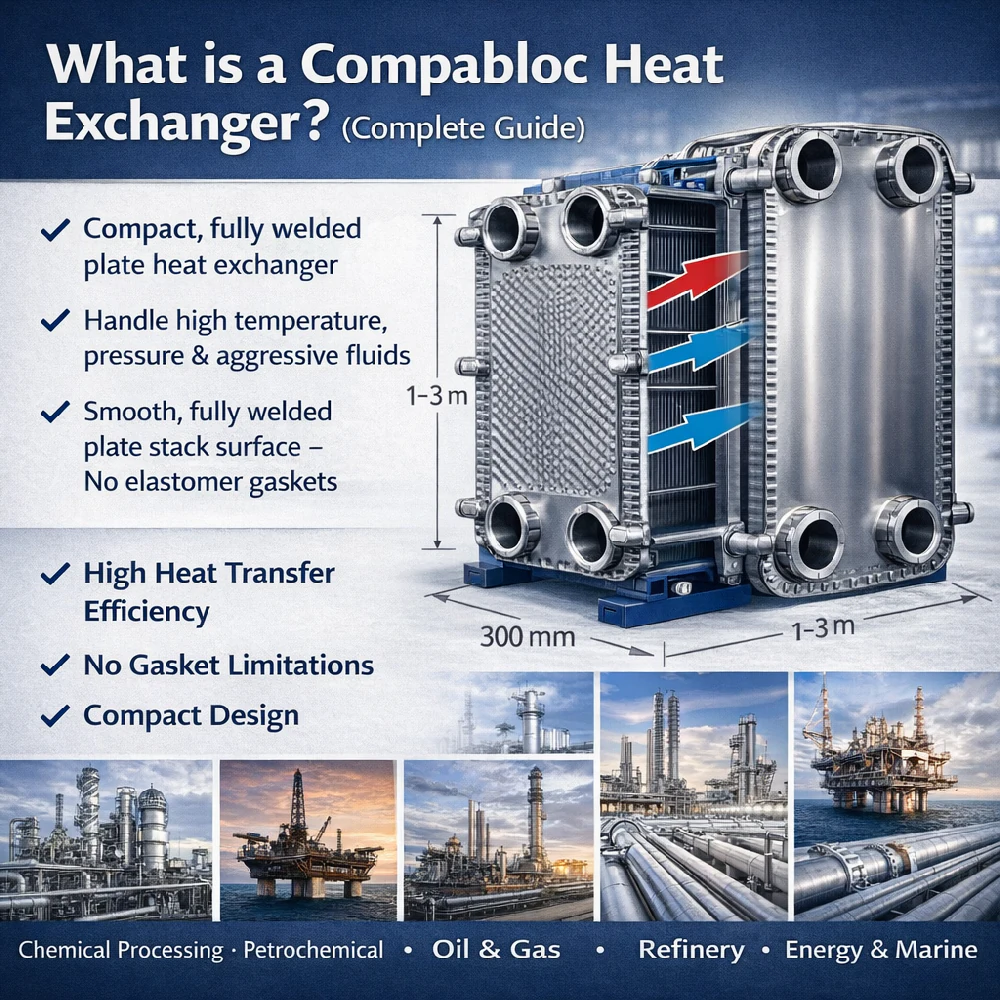
A Compabloc heat exchanger (also called a Compbloc welded heat exchanger or welded plate heat exchanger ) is a compact, fully welded heat exchanger designed for high temperature, high pressure, and aggressive fluid applications.
Unlike gasketed plate heat exchangers, a Compabloc heat exchanger uses fully welded corrugated plates instead of elastomer gaskets , allowing reliable operation in severe industrial environments such as chemical processing, petrochemical plants, and heat recovery systems.
This design combines:
- The high heat transfer efficiency of plate heat exchangers
- The mechanical strength of shell and tube heat exchangers
- A compact footprint with minimal installation space
Because of its performance and reliability, the Compabloc heat exchanger is widely used in demanding industrial processes where conventional heat exchangers may not be suitable.
How Does a Compabloc Heat Exchanger Work?
A Compabloc heat exchanger consists of a block of thin corrugated metal plates welded together to form sealed heat transfer channels.
Two fluids flow through alternating channels in a counter-current arrangement.
Heat transfer mechanism:
- Corrugated plates generate strong turbulence
- Thin metal walls reduce thermal resistance
- Counter-current flow maximizes temperature efficiency
- Fully welded channels prevent fluid leakage
This structure provides heat transfer performance typically 3–5 times higher than shell and tube heat exchangers .
Main Components of a Compabloc Heat Exchanger
Welded Plate Pack
The core heat transfer surface consists of thin corrugated plates welded together to form a compact block.
Key characteristics:
- No gaskets in the process area
- High mechanical strength
- Resistance to thermal shock
- Long service life
Compact Heat Exchanger Block
The plate pack forms a highly compact heat exchanger unit that reduces space requirements and improves energy efficiency.
Typical benefits include:
- Up to 70–90% space saving compared with shell and tube heat exchangers
- Lightweight structure
- Easy installation
Removable Covers
Most Compabloc heat exchangers include removable covers for mechanical cleaning, making them suitable for fouling or contaminated fluids.
Advantages of Compabloc Heat Exchangers
Extremely High Heat Transfer Efficiency
Strong turbulence and thin plates provide superior thermal performance.
No Gasket Limitations
Eliminates gasket aging, leakage, and chemical compatibility concerns.
High Reliability
Fully welded channels provide safe operation in aggressive media.
Compact Design
Requires significantly less space than traditional heat exchangers.
Lower Total Cost of Ownership
Long service life and reduced maintenance requirements lower lifecycle costs.
Typical Design Capabilities
Compabloc heat exchangers are designed for demanding operating conditions.
Typical design ranges include:
- Design pressure: up to 40–60 bar
- Design temperature: up to 350°C
- Minimum temperature approach: 3–5°C
- Materials: stainless steel 316L, 904L, titanium, nickel alloys
Actual limits depend on manufacturer and application.
Where Are Compabloc Heat Exchangers Used?
Compabloc heat exchangers are widely used in:
Chemical Industry
- Acid cooling
- Solvent recovery
- Reactor temperature control
Petrochemical and Oil & Gas
- Hydrocarbon cooling
- Amine systems
- Process heat recovery
Refinery Operations
- Interchangers
- Condensers
- Product cooling
Energy and Heat Recovery Systems
- Waste heat recovery
- Steam condensation
- District heating
Compabloc vs Other Heat Exchanger Types
Compared with other heat exchanger technologies:
- Higher efficiency than shell and tube heat exchangers
- Higher temperature capability than gasketed plate heat exchangers
- More compact than conventional designs
- Better chemical resistance in aggressive environments
When Should You Use a Compabloc Heat Exchanger?
A Compabloc heat exchanger is recommended when:
- The process fluid is aggressive or hazardous
- Operating temperature exceeds gasket limits
- High pressure conditions exist
- Space is limited
- High heat recovery efficiency is required
- Leak-free operation is critical
Learn More
- The difference between Compabloc and Shell & Tube heat exchanger
- Alfa Laval Compabloc Alternative