
Fundamentals
Why Small Temperature Difference Applications Require Long or Multi-Pass Plate Heat Exchangers
Learn why small temperature difference applications require long or multi-pass plate heat exchangers, and why shell and tube heat exchangers become inefficient when LMTD becomes very small. This article explains low delta T heat transfer, long plate design, multi-pass flow arrangement, and practical
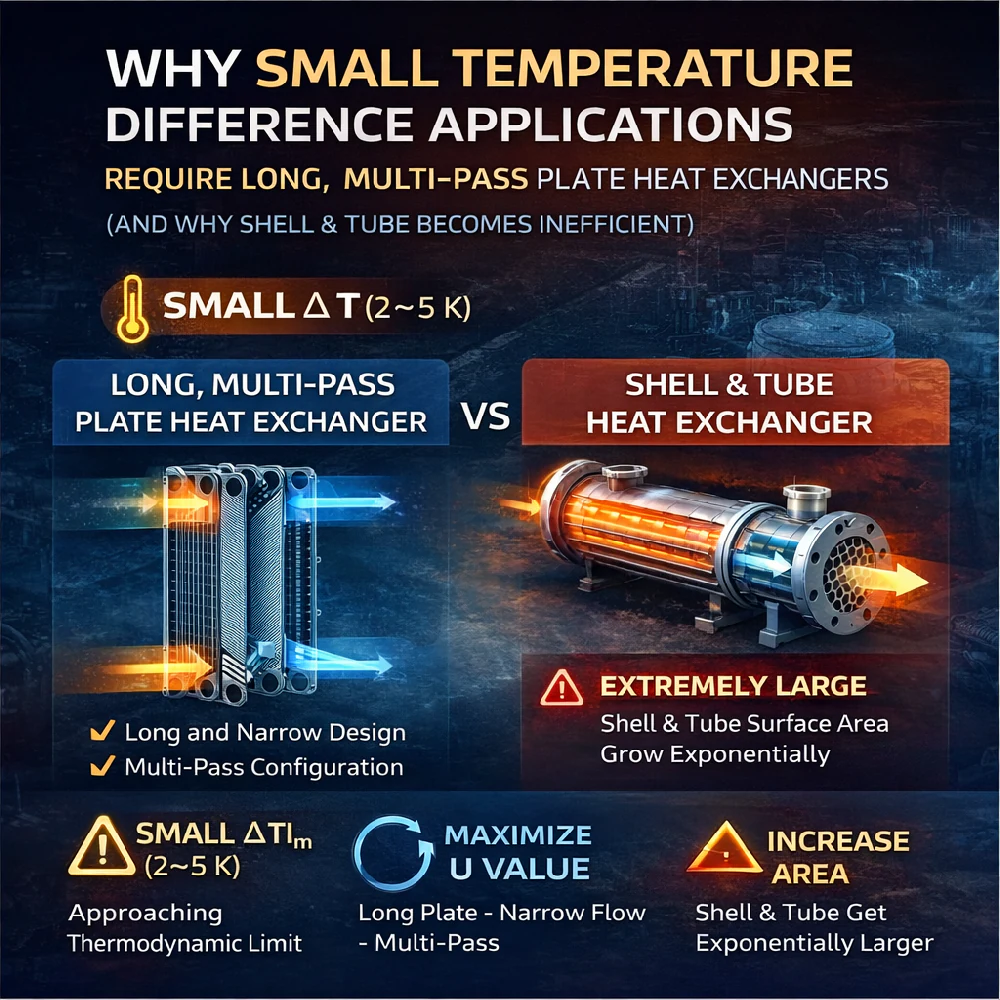
Original HEXNOVAS article
Why Small Temperature Difference Applications Require Long ( LB SERIES PHE) Plate Heat Exchangers
Why Small Temperature Difference Applications Require Long or Multi-Pass Plate Heat Exchangers
And why shell and tube heat exchangers become increasingly inefficient when the logarithmic mean temperature difference becomes very small.
Small temperature difference duty is one of the clearest examples of where exchanger geometry matters as much as exchanger type. When the available temperature driving force becomes very low, the system approaches the thermodynamic limit. Under these conditions, standard shell and tube exchangers quickly become very large, while plate heat exchangers can still remain practical by using high overall heat transfer coefficients, long flow paths, and multi-pass arrangements. This is exactly why low-grade heat recovery, close temperature approach duty, and energy-saving retrofits often require long plate heat exchangers ( ALFA LAVAL TL10B, TL6B ) or multi-pass plate heat exchangers rather than conventional shell and tube units.
The Thermodynamic Challenge of Small ΔT
In any heat exchanger, duty is governed by the basic relationship between heat load, overall heat transfer coefficient, surface area, and logarithmic mean temperature difference. Once the LMTD becomes very small, the available driving force collapses. At that point, the exchanger can no longer rely on temperature difference to move heat efficiently. It must compensate by raising U , increasing A , or both.
Consider a close approach example:
Temperature End Difference
ΔT 1 = 30 − 28 = 2 K
ΔT 2 = 10 − 8 = 2 K
LMTD Result
ΔT lm = 2 K
This is already very close to the practical thermodynamic limit.
Why Shell and Tube Becomes Extremely Large
Shell and tube heat exchangers work well in many traditional duties, especially when fouling tolerance, high pressure, or large nozzles are priorities. But they are not naturally optimized for very small temperature approach. Their typical overall heat transfer coefficient is much lower than that of a plate heat exchanger, and once LMTD drops below about 5 K, shell and tube must compensate almost entirely by adding more area.
At very low LMTD, the result is not a linear increase in size. It becomes a packaging and economics problem. The exchanger grows longer, heavier, and more expensive, while support structure, shell diameter, and installation footprint also increase. For low-grade heat recovery, this quickly becomes unattractive.
This is the main reason shell and tube often becomes impractical in close temperature approach applications such as waste heat recovery, water-to-water energy recovery, and low-grade process heat reuse.
Why Plate Heat Exchangers Can Still Operate
Plate heat exchangers are fundamentally better suited to very small ΔT duty because they generate much higher heat transfer coefficients. The corrugated plate pattern creates strong turbulence even at relatively modest flow rates, while the channels remain thin enough to keep the thermal boundary layer short. This lets the exchanger maintain a high U value where other technologies lose efficiency.
Why this happens
- Corrugated plates continuously disturb the flow.
- High shear micro-channels increase convective heat transfer.
- Thin thermal boundary layers reduce resistance on both sides.
- Countercurrent arrangement helps the exchanger stay effective even at close approach.
Why Long and Narrow Designs Are Required
Once the designer has chosen a plate heat exchanger for low ΔT duty, the next question is geometry. It is not enough to simply make the unit larger in any direction. If the exchanger is made wider instead of longer, flow velocity falls, turbulence weakens, and the heat transfer coefficient drops. That directly undermines the reason for using a PHE in the first place.
This is why LB series plate heat exchangers , long plate geometries, and similar extended-flow-path designs are preferred for small temperature difference applications. The idea is to keep the channel relatively narrow while increasing the effective flow length.
Wide and Short Design
- Lower velocity
- Weaker turbulence
- Reduced heat transfer coefficient
- Poor response in close approach duty
Long and Narrow Design
- Maintains velocity
- Preserves turbulence
- Supports higher U value
- Raises effective NTU
The longer flow path also improves the number of transfer units, which becomes increasingly important when the temperature difference is small and every bit of thermal contact length matters.
Why Multi-Pass Flow Is Often Used
In many close temperature approach applications, a single-pass plate heat exchanger is still not enough. Engineers then turn to multi-pass arrangements to push the exchanger closer to the required thermal duty. By forcing the fluid to change direction and pass through additional effective flow length, multi-pass design increases internal velocity and contact time simultaneously.
- Flow is redistributed through repeated pass sections.
- Local velocity increases compared with a wide single-pass layout.
- The fluid experiences a longer effective path inside the exchanger.
- Convective heat transfer improves under low driving-force conditions.
Engineering Summary
Final Conclusion
Small temperature difference is not a simple design inconvenience. It is a thermodynamic limitation. Once the driving force becomes very low, the exchanger must rely on geometry and fluid dynamics to stay effective.
Shell and tube exchangers usually respond by becoming very large. Plate heat exchangers respond by preserving turbulence, maintaining high heat transfer coefficients, and extending the effective thermal path. That is why long, narrow, multi-pass plate heat exchangers are not merely an optional design style in low ΔT duty. In many cases, they are the only practical engineering solution.
For applications involving close temperature approach, low-grade heat recovery, and compact high-efficiency thermal exchange, HEXNOVAS can help evaluate whether a gasketed plate heat exchanger , a dedicated long plate design, or a multi-pass configuration is the right choice.
FAQ
small temperature difference heat exchanger, long plate heat exchanger, LB series plate heat exchanger, multi-pass plate heat exchanger, low delta T plate heat exchanger, low grade heat recovery heat exchanger, shell and tube vs plate heat exchanger, close temperature approach heat exchanger, low LMTD heat exchanger, high efficiency plate heat exchanger
| Hot Side | Cold Side |
| 30 → 10°C | 8 → 28°C |
| Shell & Tube Parameter | Typical Value |
| U value | 300–800 W/m²·K |
| Minimum practical approach ΔT | 8–15 K |
| Plate Heat Exchanger Parameter | Typical Value |
| U value | 2000–6000 W/m²·K |
| Minimum practical approach ΔT | 1–3 K |
| Feature | Engineering Purpose |
| Long plate design | Increase NTU and effective heat path |
| Narrow flow channels | Maintain velocity and turbulence |
| Multi-pass arrangement | Raise U value performance under low ΔT duty |
| Higher pressure drop | Accepted as a trade-off for improved heat recovery |