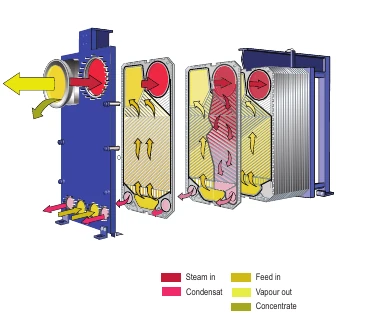
Heating steam condenses inside welded cassette channels while feed enters through two compact connections and evaporates in the gasketed channels. Vapour and concentrate leave through a large outlet, and condensate exits through the smaller outlets. The short residence time is well suited to heat-sensitive products.
Construction
Semi-welded cassette gasketed plate evaporator
Free channel
6 / 6.5 mm
Maximum design pressure
6 / 8 barg
Maximum design temperature
180°C / 356°F
Engineering explained
See what is happening inside the exchanger.
Product imagery is paired with technical context so buyers and engineers can understand construction, flow path and configuration—not just the exterior.
01
Separated steam and product evaporation circuits
Steam condenses in the welded cassette while feed evaporates through the gasketed product channel; vapour, concentrate and condensate leave through dedicated ports.
02
Purpose-built EC-series evaporator construction
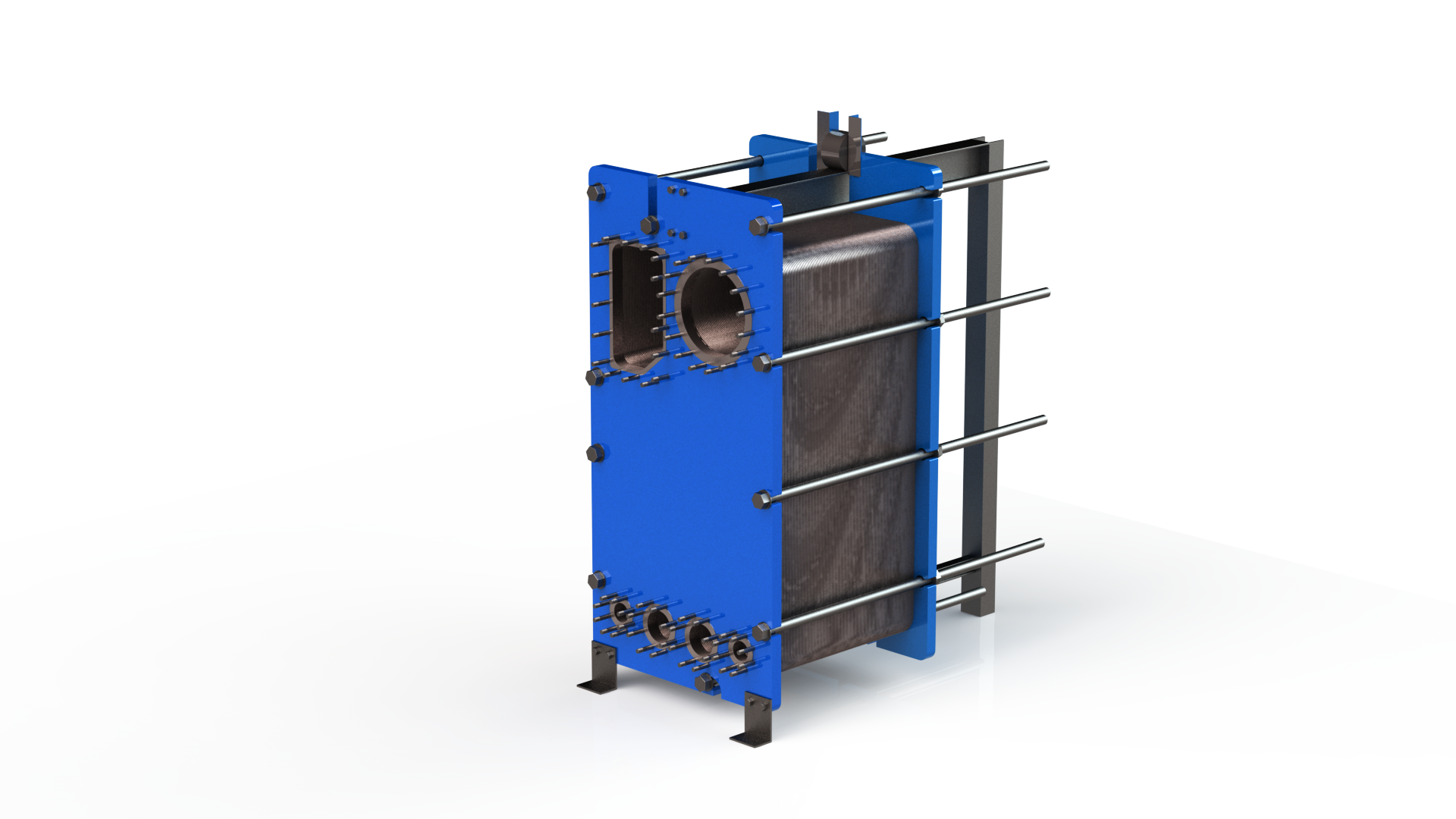
The EC-series frame combines a semi-welded cassette plate pack with dedicated large vapour, feed, concentrate and condensate connections for evaporation duties.
Models & technical data
Compare models and published specifications.
Compare the published model dimensions and technical values from the product datasheet.
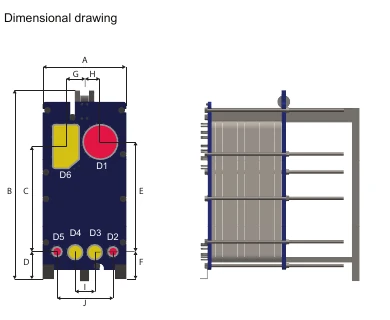
Published evaporator GPHE dimensions from the supplied technical datasheet. Extended pressure and temperature ratings may be available; final cassette count, metallurgy and nozzle arrangement require duty review.
Dimensions are for reference only. Final dimensions are subject to the approved order drawing. HEXNOVAS reserves the right of final interpretation.
Designed around performance, integrity and serviceability.
High turbulence supports close temperature approaches down to 3-4°C
Low hold-up volume reduces product exposure time and supports product quality
Compact surface area reduces expensive alloy requirements
Capacity can be changed by adding or removing cassettes
Product configuration
Structure and material options.
Available configurations
EC350, EC500 and EC650 platforms
TVR and MVR evaporation systems
Expandable semi-welded cassette pack
Large vapour outlet with dedicated feed and condensate ports
Material options
316 / 316L, 904L and 254 SMO plate options
C-276, nickel and titanium plate options
NBR or EPDM field gaskets; NBR, EPDM or FKM ring gaskets
Metal-lined stainless-steel, nickel or titanium flanges
Typical applications
Where this exchanger fits.
01
Biotechnology and pharmaceutical concentration
02
Chemical evaporation duties
03
Food and beverage concentration
04
Energy, utilities and wastewater evaporation systems
Selection information
What our engineers need from you.
Provide feed composition, solids concentration, viscosity curve, flow rate, evaporation rate, steam condition, operating pressure or vacuum, inlet and outlet temperatures, allowable pressure drop, cleaning method and required metallurgy.
Frequently asked questions
Key questions before product selection.
How does Evaporator Gasketed Plate Heat Exchangers work?
Heating steam condenses inside welded cassette channels while feed enters through two compact connections and evaporates in the gasketed channels. Vapour and concentrate leave through a large outlet, and condensate exits through the smaller outlets. The short residence time is well suited to heat-sensitive products.
What information is required to select the right product?
Provide feed composition, solids concentration, viscosity curve, flow rate, evaporation rate, steam condition, operating pressure or vacuum, inlet and outlet temperatures, allowable pressure drop, cleaning method and required metallurgy.
Which materials and configurations are available?
316 / 316L, 904L and 254 SMO plate options; C-276, nickel and titanium plate options; NBR or EPDM field gaskets; NBR, EPDM or FKM ring gaskets; Metal-lined stainless-steel, nickel or titanium flanges
How is the final product size confirmed?
The final size is confirmed by thermal calculation using flow rates, inlet and outlet temperatures, allowable pressure drop, design pressure and fluid properties.
Product documentation
Catalogue and technical downloads.
Use the published catalogue for product-range reference. Final dimensions, ratings and materials are confirmed for the selected model and operating duty.