Project Overview
The published project description explains that the installation serves a new production facility and uses two industrial ammonia heat pumps to produce +88°C hot water for process and cleaning requirements. It also states that the system was designed to optimize energy from the entire refrigeration cycle and create four stages of temperature productivity. In practical engineering terms, this means a multi-level heat recovery strategy rather than a single hot-water loop. The plant is not only producing hot water, but also extracting more value from compressor discharge heat, condensation energy, and intermediate heat sources that would otherwise be wasted.
For food manufacturing, this is a powerful concept. Plants often need heating for washdown, CIP, preheating, utility loops, and production support at different temperature levels. An ammonia heat pump system with a well-chosen heat exchanger arrangement can replace or reduce steam demand, improve total plant energy utilization, and create a more compact utility platform. In this case, the visible exchanger in the installation image makes the technological choice especially clear: the core heat transfer component appears to be a semi-welded plate heat exchanger, which is highly consistent with industrial R717 duty.
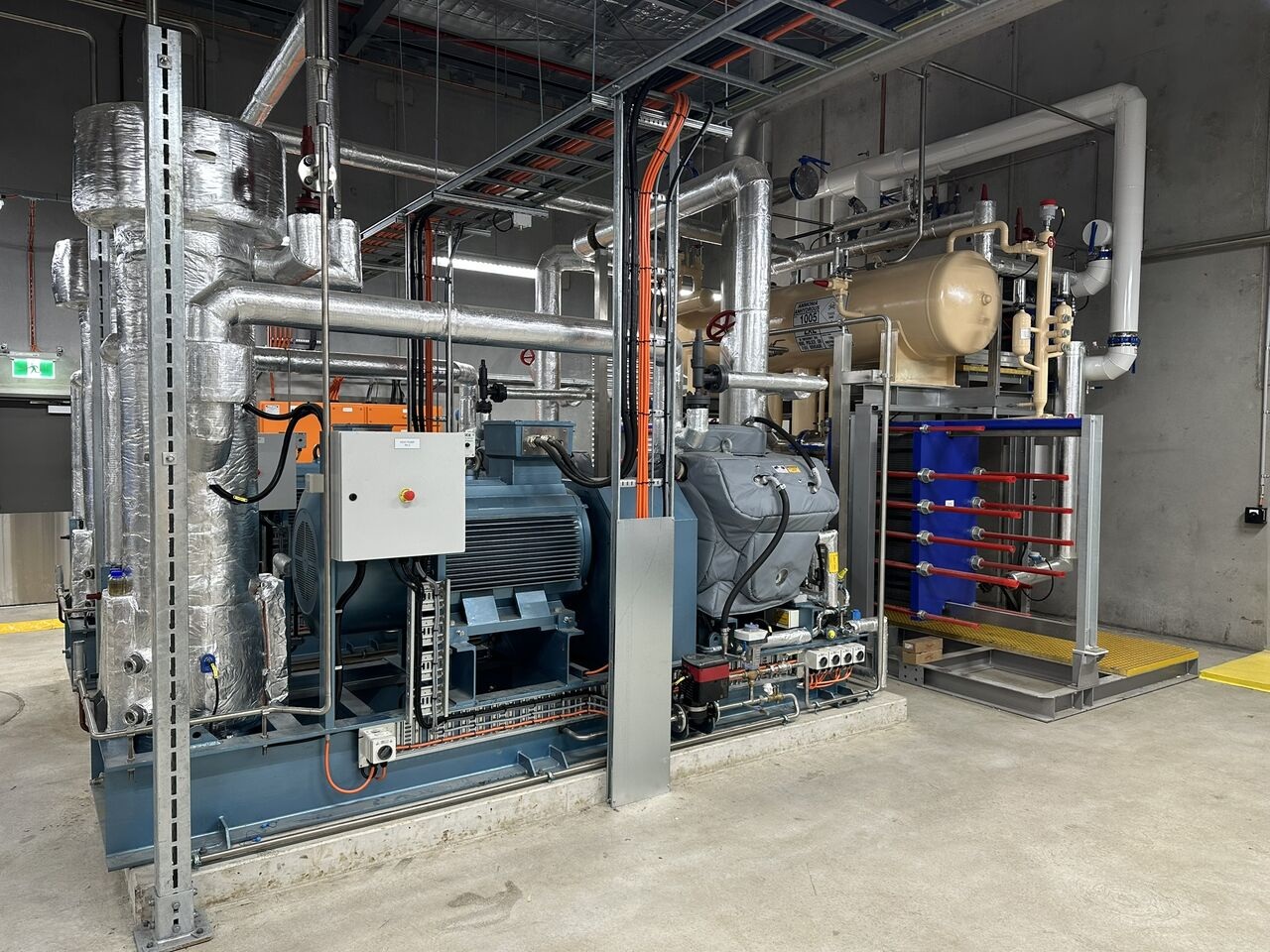
Suggested caption: Industrial ammonia heat pump skid installation with visible semi-welded plate heat exchanger on the right side, integrated with compressor package, insulated piping, and utility framework for food manufacturing heat recovery.
Why This Case Should Emphasize the Semi-Welded GPHE
In ammonia systems, the heat exchanger choice is never only about heat transfer efficiency. It also involves leakage risk, serviceability, pressure capability, cleaning requirements, and lifecycle maintenance. A standard fully gasketed plate heat exchanger is usually not the preferred choice on the ammonia side because refrigerant containment is more critical. At the same time, a fully welded unit is not always the best answer when easy inspection and side cleaning are important.
That is exactly where the semi-welded plate heat exchanger becomes highly attractive. By welding the refrigerant-side channels in plate cassettes while keeping the secondary side gasketed and serviceable, it creates a balanced solution for R717 ammonia heat pump applications. This design directly matches the practical needs of industrial food facilities, where uptime, compactness, performance, and maintenance access all matter.
Key interpretation from the image: the visible exchanger has a classic framed plate heat exchanger structure with grouped connections and the typical form factor associated with a semi-welded GPHE.
What Is Visible in the Installation
Semi-Welded Plate Heat Exchanger
On the right side of the skid, the blue framed exchanger with multiple nozzle connections is the clearest visible heat exchanger. Its form strongly aligns with a semi-welded gasketed plate heat exchanger used in ammonia duty, most likely acting as a condenser or main heat recovery interface to the hot water loop.
Industrial Compressor Package
The central machine package is the heart of the ammonia heat pump. This is where the compression work is added, enabling higher discharge temperatures and allowing the recovered energy to be upgraded into usable hot water for the plant.
Insulated Piping and Utility Integration
The extensive insulated pipework indicates controlled thermal routing and utility integration. In a food plant, this usually points to stable hot-water distribution, process loop connection, and a plant design that values energy retention and operational consistency.
The Role of the Semi-Welded Plate Heat Exchanger in This Ammonia Heat Pump System
In this type of skid, the semi-welded plate heat exchanger is typically the critical thermal interface between the ammonia circuit and the water side. It may operate as the condenser in the heat pump loop, transferring upgraded heat from the refrigerant into the process water circuit, or it may be part of a staged heat recovery arrangement depending on system architecture. Either way, its function is to achieve high heat transfer efficiency in a compact footprint while maintaining safe refrigerant containment.
This matters even more when the target output reaches around 88°C hot water. At that level, the exchanger must deliver reliable performance across a demanding thermal profile while supporting long-term plant operation. The semi-welded construction is especially useful because it combines the high turbulence and compactness of plate technology with a more secure refrigerant-side arrangement than a fully gasketed unit.
| Design Need | Why It Matters in This Case | How Semi-Welded GPHE Helps |
|---|
| Ammonia containment | R717 requires careful refrigerant-side safety and reliability | Welded cassettes improve sealing security on the ammonia side |
| Hot water generation up to 88°C | High-temperature output is needed for process and cleaning duties | Plate geometry supports efficient heat transfer in compact size |
| Food plant maintainability | Water side may need inspection, service, or cleaning access | Gasketed secondary side remains more service-friendly than fully welded units |
| Compact skid layout | Utility rooms often demand high capacity within limited floor space | Plate exchangers deliver high thermal density compared with bulkier alternatives |
| Energy recovery integration | Multi-stage temperature use improves total plant efficiency | Fast response and high transfer performance suit staged heat recovery loops |
Understanding the “Four Stages of Temperature Productivity”
The original case text refers to four stages of temperature productivity. That is an important phrase because it indicates the plant was not designed as a simple one-duty heat pump, but as an integrated utility system using multiple useful temperature levels. In industrial food plants, that can include preheating, medium-temperature process water, high-temperature washdown supply, and top-temperature cleaning loops. The exact configuration is not fully published, but the engineering logic is clear: use as much of the available refrigeration cycle energy as possible before rejecting any remaining heat.
This kind of architecture is where a semi-welded ammonia plate heat exchanger becomes highly valuable. Its compact size and high thermal effectiveness support staged heat recovery without forcing the skid to become oversized. That makes it a suitable component not only for one exchanger position, but for the broader logic of industrial heat recovery design.
- Lower temperature stage for energy capture and preheating
- Intermediate stage for utility water or process support
- Higher stage for main hot water production
- Top stage to support demanding cleaning or sanitary duties
Why Semi-Welded GPHE Is a Strong Choice for Food Manufacturing Heat Pumps
- Suitable for ammonia (R717) refrigerant-side duty
- High thermal efficiency in a compact utility room footprint
- Better serviceability on the secondary side than fully welded alternatives
- Useful for heat recovery, condensing, and hot-water production duties
- Supports industrial hygiene strategies by keeping utility design organized and compact
- Often more efficient and space-saving than shell and tube for clean service loops
For food production sites, the balance between performance and maintainability is especially important. Systems must run reliably, support cleaning protocols, and remain practical to service. A semi-welded GPHE fits this requirement well because it is not only an ammonia-capable exchanger technology, but also a plant-friendly one. It can help operators reach high utility temperatures without accepting the larger footprint and lower thermal compactness of older exchanger formats.
How HEXNOVAS Supports Similar Projects
HEXNOVAS can support industrial heat pump and refrigeration projects with compact heat exchanger solutions selected according to refrigerant type, maintenance strategy, pressure requirement, and process duty. For ammonia systems, the selection logic should prioritize safety, long-term serviceability, and true application fit rather than using a generic exchanger category for every project.
Gasketed Plate Heat Exchangers
Suitable for many clean liquid-to-liquid duties, utility water loops, and service-friendly applications where full gasketed construction is appropriate.
Semi-Welded Plate Heat Exchangers
Strong option for ammonia and similar duties where refrigerant-side sealing confidence and secondary-side serviceability both matter.
Application-Oriented Selection
The best exchanger is the one that matches the real duty. This case is a good example of why exchanger identification and application logic should drive the content direction.