Heat Exchanger Technologies
Dimple Plate Jacket vs Dimple Jacket Tank
Compare dimple plate jackets and dimple jacket tanks used for industrial temperature control. Learn their structure, heat transfer mechanism, and applications in chemical reactors, fermentation tanks, storage vessels, and process equipment.
Original HEXNOVAS article
Dimple Plate Jacket vs Dimple Jacket Tank
Dimple Plate Jacket vs Dimple Jacket Tank
Dimple plate heat transfer technology is widely used in industrial temperature control systems for reactors, storage tanks, fermentation vessels, and processing equipment. Two of the most common configurations are the Dimple Plate Jacket and the Dimple Jacket Tank . Although both use embossed plate channels to circulate heating or cooling media, they differ in structure, thermal coverage, retrofit flexibility, and application strategy.
Dimple Plate Jacket
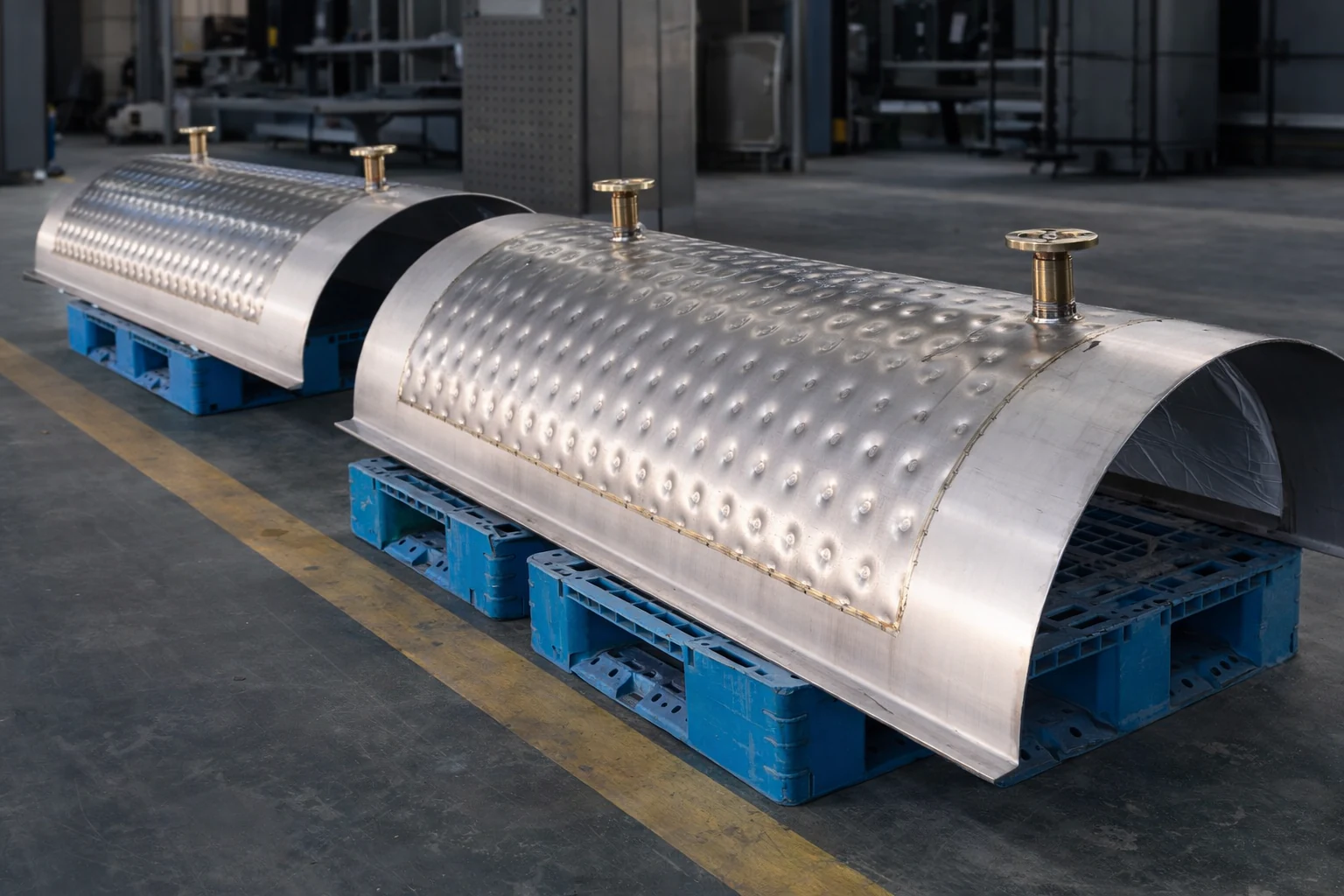
A dimple plate jacket is formed by welding embossed stainless steel plates onto the outside of an existing vessel shell. The welded dimples create flow passages between the jacket plate and the tank wall, allowing steam, hot water, thermal oil, chilled water, or glycol to circulate around the vessel.
Because the jacket is attached directly to the vessel wall, heat moves from the service medium through the jacket plate, across the vessel shell, and then into the product inside the tank. The embossed dimple pattern improves turbulence and helps reduce stagnant zones inside the jacket channel, which enhances overall thermal efficiency compared with many conventional external jackets.
How Heat Transfer Works
In a dimple plate jacket system, the heat transfer medium flows through the narrow embossed channels outside the vessel wall. The transfer mechanism is mainly:
Steam, hot water, thermal oil, or cooling liquid flows through the dimple channel and transfers heat to the vessel wall by convection.
Heat passes through the stainless steel jacket plate and vessel shell by conduction.
The stored or processed liquid inside the tank absorbs or releases heat, often assisted by mixing or agitation.
The embossed dimple geometry promotes better flow distribution and improves local heat transfer coefficients.
Typical Applications
- Chemical reactor temperature control
- Pharmaceutical processing vessels
- Food and beverage process tanks
- Thermal oil heated reactors
- Cooling or heating retrofits on existing tanks
- Batch vessels requiring localized side-wall heating or cooling
Dimple Jacket Tank
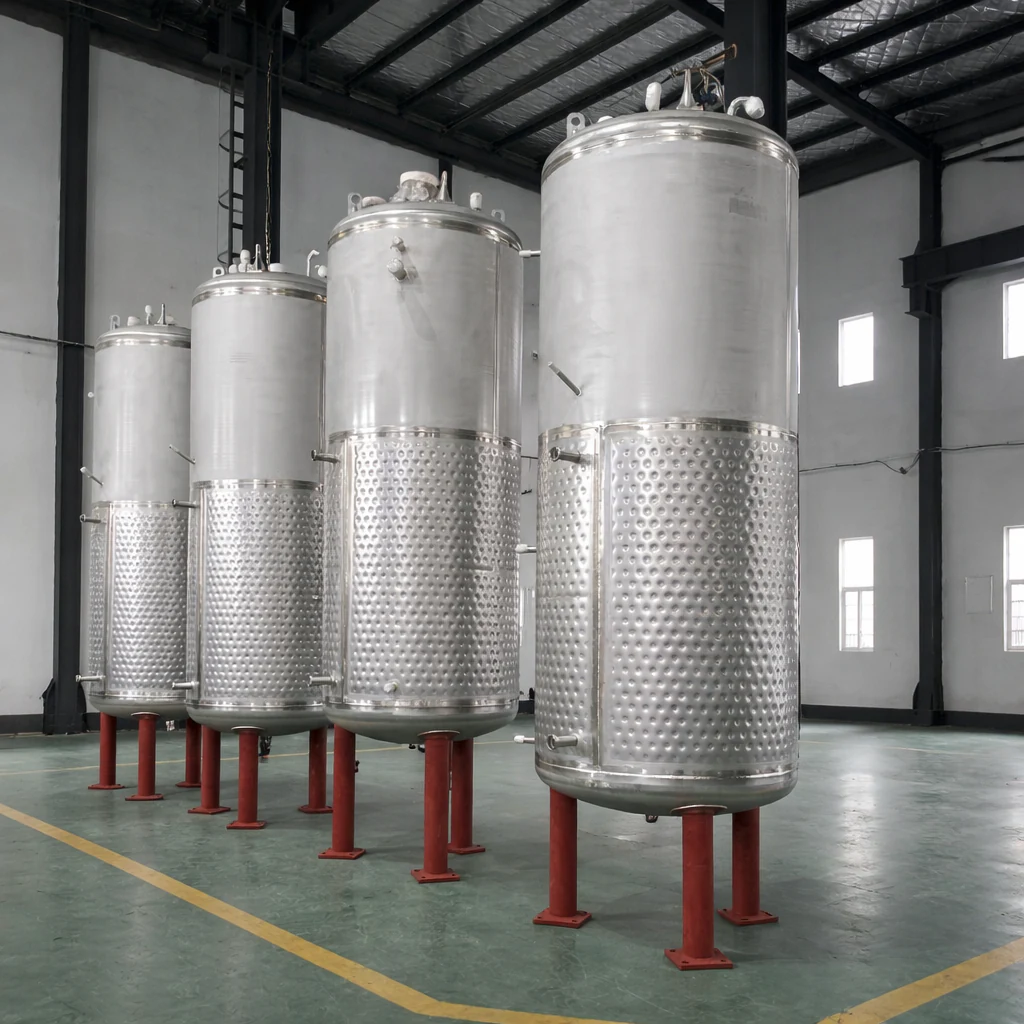
A dimple jacket tank is a complete vessel engineered with an integrated dimple heat transfer section as part of the tank body. Instead of adding a jacket later, the vessel is designed from the beginning with built-in heat transfer coverage for more uniform temperature control.
This configuration is widely used when the process requires stable product temperature, higher thermal contact area, and an integrated sanitary or industrial vessel design. Compared with a simple retrofit jacket, a dedicated dimple jacket tank can be optimized for geometry, media flow path, insulation arrangement, nozzle layout, and structural performance.
How Heat Transfer Works
A dimple jacket tank uses the same basic principles of convection and conduction, but the heat transfer surface is more intentionally integrated into the tank design. This usually delivers:
The heat transfer layer can be designed around a larger portion of the vessel body for more consistent thermal response.
Integrated jacket zoning helps reduce hot spots and cold spots during storage or processing.
Nozzle arrangement, drainage, insulation, and media circuits can be planned as part of one complete engineering package.
Particularly valuable for temperature-sensitive liquids, fermentation, dairy processing, and chemical storage.
Typical Applications
- Fermentation tanks
- Beer brewing systems
- Dairy milk cooling and storage tanks
- Chemical storage tanks with controlled temperature
- Thermal buffer and thermal storage vessels
- Process tanks requiring stable and uniform heating or cooling
Applications and Selection Logic
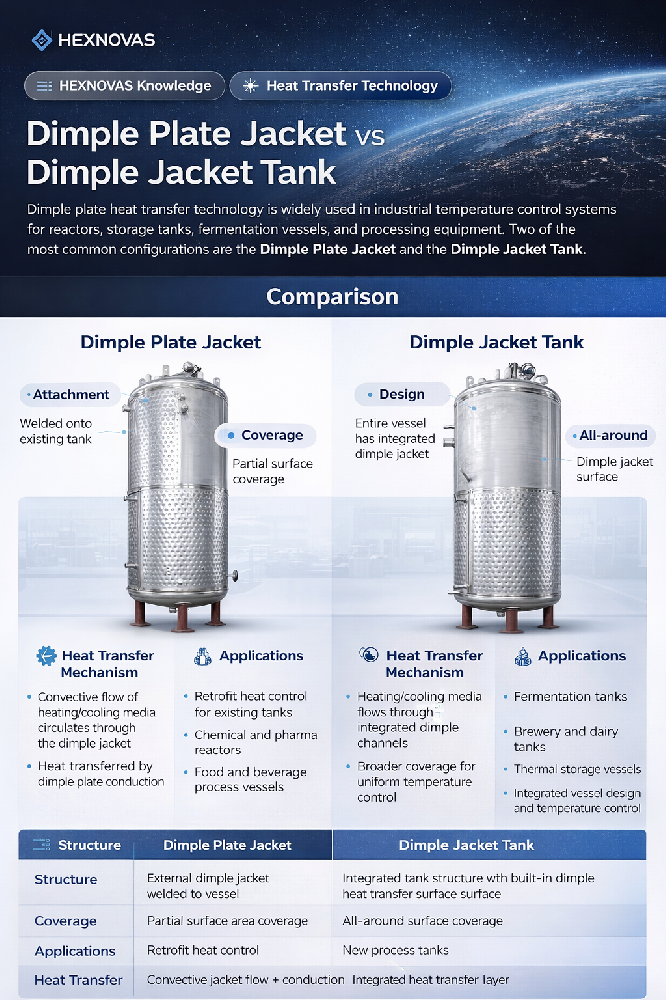
Both designs are used for industrial heating and cooling, but they serve slightly different engineering objectives. A dimple plate jacket is more flexible for retrofitting or upgrading an existing vessel, while a dimple jacket tank is more suitable when the entire vessel can be designed as one complete thermal system.
When to Choose a Dimple Plate Jacket
- When an existing tank or reactor needs additional heating or cooling capability
- When a partial jacket area is sufficient
- When retrofit cost and installation flexibility are important
- When process temperature control is needed mainly on the vessel side wall
When to Choose a Dimple Jacket Tank
- When building a new tank from the beginning
- When the process requires more uniform thermal coverage
- When hygienic design, insulation, and complete thermal integration matter
- When stable product temperature is critical during storage, reaction, or fermentation
Key Differences
| Feature | Dimple Plate Jacket | Dimple Jacket Tank |
| Structure | External dimple jacket welded onto a vessel | Integrated vessel with built-in dimple heat transfer section |
| Engineering Approach | Retrofit or add-on solution | Complete tank design solution |
| Heat Transfer Area | Usually partial or localized coverage | Can be designed for broader and more uniform coverage |
| Installation | Suitable for modifying existing tanks | Suitable for newly manufactured tanks |
| Temperature Control | Localized or sectional heating / cooling | More uniform temperature control across the vessel |
| Typical Industries | Chemical, pharma, general process retrofits | Brewing, dairy, fermentation, storage, integrated process systems |
| Heat Transfer Mechanism | Convective jacket flow + conduction through shell + product-side absorption | Same principle, but optimized through integrated tank layout and surface coverage |