
Design Guide
DX vs Flooded Evaporation in Plate Heat Exchangers
Technical comparison of DX and flooded evaporation in plate heat exchangers, covering efficiency, refrigerant charge, and industrial refrigeration applications.
Original HEXNOVAS article
DX vs Flooded Evaporation in Plate Heat Exchangers
DX vs Flooded Evaporation in Plate Heat Exchangers
Plate heat exchangers are widely used as evaporators in refrigeration systems. Two primary evaporation methods are commonly applied: Direct Expansion (DX) and Flooded Evaporation .
Each method offers distinct thermodynamic characteristics, efficiency levels, and system requirements. Choosing the correct configuration significantly impacts system performance, refrigerant charge, and operating stability.
What Is DX (Direct Expansion) Evaporation?
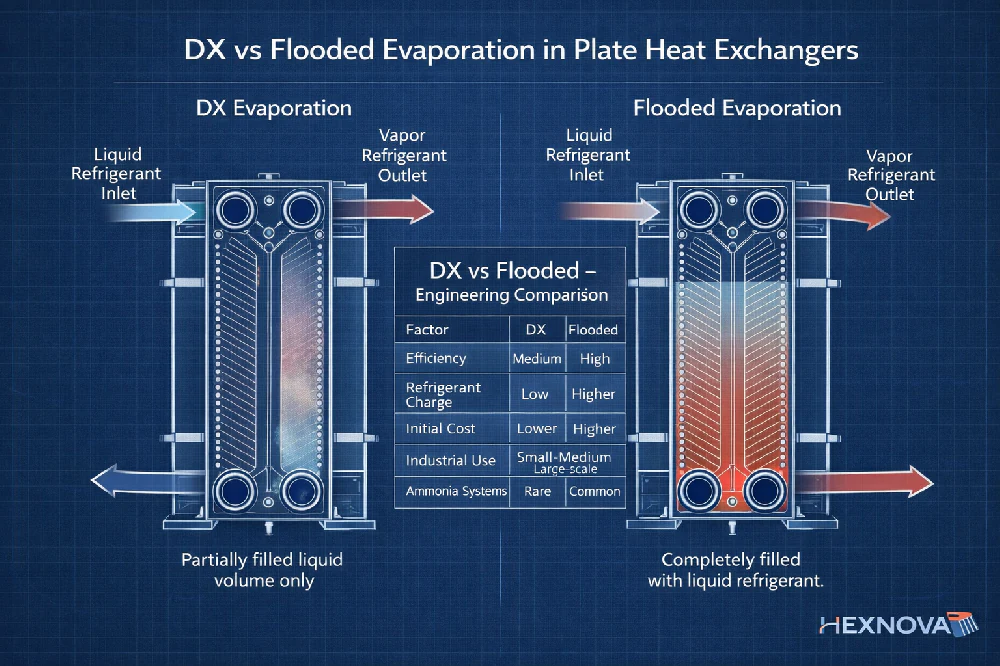
In a DX system, refrigerant enters the evaporator as a low-pressure liquid and partially evaporates while flowing through the heat exchanger.
Only a portion of the internal volume is filled with liquid refrigerant at any time. The refrigerant completely vaporizes before leaving the evaporator.
Characteristics of DX Evaporation:
- Lower refrigerant charge
- Simpler system design
- Requires precise superheat control
- More sensitive to load variation
- Slightly lower heat transfer efficiency compared to flooded systems
DX evaporators are commonly used in:
- HVAC systems
- Commercial refrigeration
- Small and medium-capacity chillers
What Is Flooded Evaporation?
In flooded systems, the evaporator is continuously filled with liquid refrigerant.
The plate heat exchanger operates with a high liquid level, and boiling occurs across the entire heat transfer surface. Excess liquid is separated and recirculated.
Characteristics of Flooded Evaporation:
- Higher heat transfer coefficient
- Lower approach temperature
- Improved evaporator efficiency
- Higher refrigerant charge
- Requires separator and recirculation control
Flooded systems are commonly used in:
- Industrial refrigeration
- Ammonia systems
- Large cold storage plants
- High-efficiency chiller systems
Efficiency Comparison
Because flooded evaporation maintains full wetting of heat transfer surfaces, it generally achieves:
- More uniform boiling
- Higher overall heat transfer coefficient
- Lower compressor energy consumption
However, DX systems:
- Use less refrigerant
- Have lower initial investment
- Are mechanically simpler
The selection depends on capacity, refrigerant type, efficiency targets, and safety considerations.
Engineering Considerations
When designing plate heat exchanger evaporators, engineers must consider:
- Refrigerant type (NH₃, CO₂, HFC, etc.)
- Required approach temperature
- Load stability
- Refrigerant charge limitations
- Oil return management
- Pressure drop constraints
In industrial ammonia systems, flooded plate evaporators are often preferred due to efficiency and thermal stability.
In commercial systems using HFC or HFO refrigerants, DX evaporators are more common due to simplicity and lower charge.
Conclusion
DX and flooded evaporation each offer advantages in plate heat exchanger applications.
DX systems provide simplicity and lower refrigerant inventory, while flooded systems deliver superior thermal efficiency and stable performance in large-scale refrigeration plants.
The optimal choice depends on system size, efficiency goals, refrigerant type, and safety requirements.
FAQ – DX vs Flooded Evaporation
Flooded evaporation is generally more thermally efficient because the heat transfer surface remains fully wetted with liquid refrigerant. This improves boiling performance and reduces compressor energy demand.
In DX systems, only a portion of the evaporator contains liquid refrigerant at any time. The refrigerant evaporates completely and exits as vapor, reducing total refrigerant inventory.
For large industrial systems, especially ammonia refrigeration, flooded evaporation often provides better performance and energy savings. However, it requires additional components such as separators and level controls.
DX systems typically contain lower refrigerant charge, which may be advantageous in applications with strict safety or regulatory requirements.
Yes. Plate heat exchangers can be designed for both DX and flooded evaporation. The internal channel configuration and distribution design must match the chosen evaporation method.
Yes. Oil return is generally more straightforward in DX systems. Flooded systems require careful oil separation and management to prevent oil accumulation in the evaporator.
DX systems typically have lower initial system cost due to fewer components and simpler control requirements.
| Item | DX (Direct Expansion) | Flooded Evaporation |
| Refrigerant fill | Partially filled; refrigerant fully vaporizes before outlet | Continuously filled with liquid level; boiling over full surface |
| Heat transfer | Slightly lower than flooded | Higher heat transfer coefficient; more uniform boiling |
| Approach temperature | Typically higher | Lower approach temperature |
| Refrigerant charge | Lower | Higher |
| Controls | Needs precise superheat control | Needs separator + level/recirculation control |
| Best fit | HVAC / commercial refrigeration / small-medium chillers | Industrial refrigeration / ammonia / large plants / high efficiency systems |