Materials & Corrosion
Gasket Testing and Manufacturing Control in Plate Heat Exchangers
Learn how gasket testing ensures reliable sealing in plate heat exchangers. Explore tensile strength, elongation, compression set and vulcanization control for long service life.
Original HEXNOVAS article
Gasket Testing and Manufacturing Control in Plate Heat Exchangers
Gasket Testing and Manufacturing Control in Gasketed Plate Heat Exchangers (GPHE)
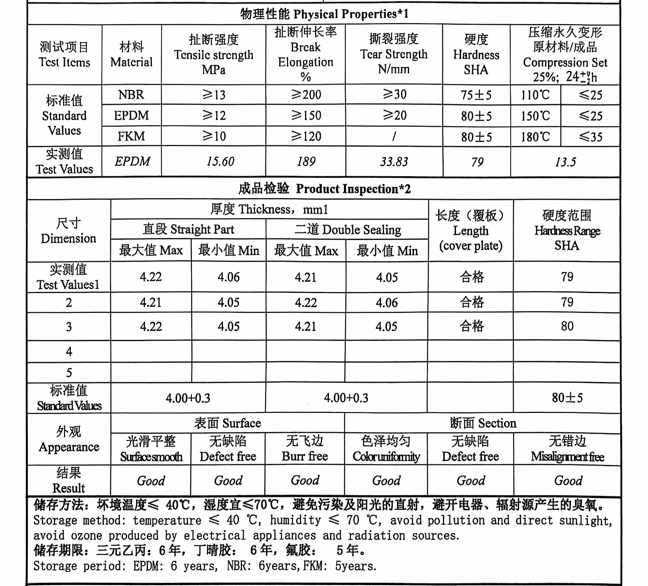
Mechanical properties in a gasket certificate are not just test numbers. They directly reflect compounding quality , filler dispersion , vulcanization accuracy , and molding precision —all of which determine long-term sealing reliability.
Why Gasket Reliability Determines GPHE Sealing Performance
In plate heat exchangers, gasket reliability directly determines sealing performance, operational safety, and service life.While EPDM , NBR , and FKM are commonly selected based on temperature and chemical compatibility, long-term performance depends equally on manufacturing control.
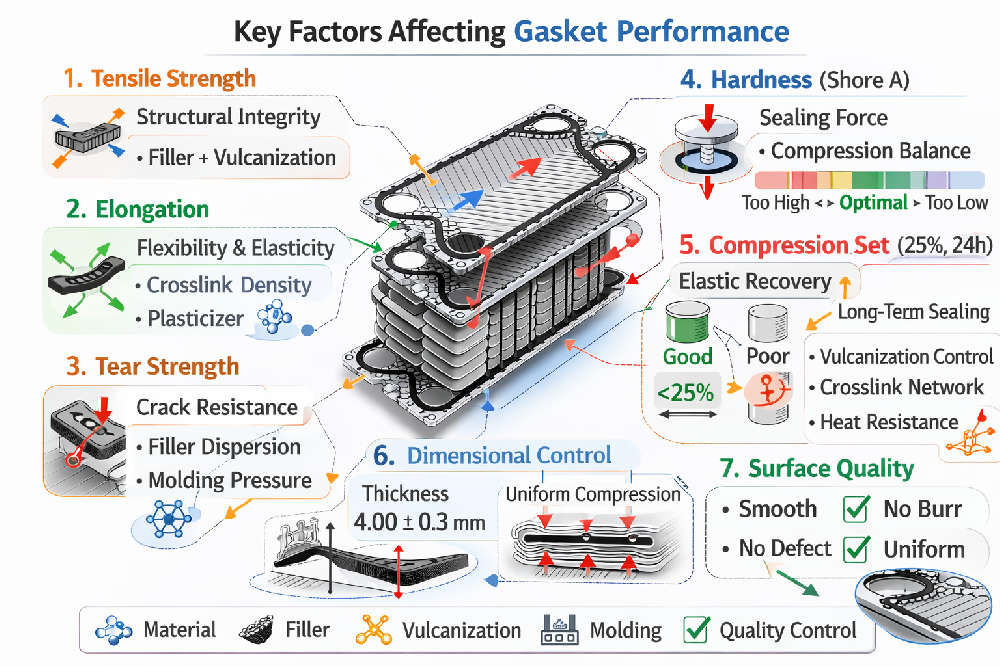
1. Key Mechanical Properties and Their Manufacturing Correlation
Tensile strength measures the maximum stress a gasket material can withstand before failure.
- Base polymer grade (EPDM/NBR/FKM quality)
- Carbon black and reinforcing filler content
- Mixing uniformity
- Vulcanization temperature and time
Under-curing reduces crosslink density → tensile drops and elastic recovery weakens. Over-curing makes rubber brittle → micro-cracks may form.
Elongation indicates material flexibility and ability to absorb deformation under compression and thermal cycling.
- Crosslink density
- Plasticizer formulation
- Filler proportion
Low elongation often signals over-curing or excessive filler loading. Excessively high elongation may indicate insufficient curing and low structural integrity.
Tear strength determines resistance to crack propagation, especially along sealing grooves.
- Polymer chain uniformity
- Filler dispersion
- Molding pressure
- Mold edge precision
Insufficient molding pressure or uneven filler distribution can create micro-voids that weaken tear resistance—critical for high-compression GPHE gaskets.
Hardness determines compression behavior and sealing force.
- Filler ratio
- Sulfur / curing agent dosage
- Crosslink density control
If hardness is too high, gaskets may not conform to plate surfaces. If too low, excessive compression and premature deformation may occur.
Compression set measures permanent deformation after compression and heat exposure—one of the best indicators of long-term sealing performance.
- Vulcanization uniformity
- Crosslink network structure
- Heat aging resistance
- Polymer formulation stability
Low compression set ensures long-term sealing integrity, stable contact pressure, and reduced leakage risk—often more decisive than tensile strength in real operation.
2. Dimensional Stability and Molding Control
Beyond mechanical testing, finished gasket dimensions must be tightly controlled.
- Mold precision
- Injection pressure
- Material flow behavior
- Temperature stability during curing
Thickness variation directly affects compression distribution, sealing uniformity, and plate load balance. Even small inconsistencies may lead to localized leakage or uneven stress.
3. Surface and Section Quality
Visual and sectional inspection ensures smooth surface finish, no burrs, no misalignment, and uniform coloration.
- Mold contamination
- Temperature fluctuation
- Improper demolding
- Inconsistent compound mixing
Although simple, surface quality significantly impacts early-stage sealing reliability and first-start leakage risk.
4. Material Comparison in Heat Exchanger Gaskets
Material selection should consider operating temperature, fluid chemistry, CIP cleaning procedures, and pressure cycling. However, correct material grade cannot compensate for poor production control.
5. Why Manufacturing Control Matters
Mechanical properties are direct indicators of production discipline:
- Compound formulation accuracy
- Filler dispersion quality
- Vulcanization precision
- Dimensional molding control
Consistent parameters ensure long-term sealing stability, reduced maintenance frequency, lower leakage risk, and improved equipment reliability.
Conclusion
In gasketed plate heat exchanger applications, gasket performance depends not only on material type but also on the integrity of the manufacturing process. Tensile strength, elongation, tear strength, hardness, and compression set are interconnected properties governed by formulation control, curing accuracy, and molding precision.
Properly controlled production ensures:
- Stable sealing performance
- Resistance to thermal and mechanical stress
- Extended service life
- Reduced operational risk
Frequently Asked Questions (FAQ)
Plate Heat Exchanger Gasket Testing & Quality Control
The most critical property is compression set , especially for long-term sealing reliability. Low compression set maintains elastic recovery after compression and temperature exposure, reducing leakage risk.
Tensile strength reflects material integrity and resistance to tearing during installation and operation. It must be balanced with elongation and hardness to ensure both durability and sealing flexibility.
Vulcanization determines crosslink density. Under-curing leads to low strength and poor recovery; over-curing causes brittleness and crack formation. Proper time/temperature control stabilizes mechanical properties.
Hardness (Shore A) controls compression behavior and sealing force. Too high = poor conformity; too low = excessive compression and premature deformation. Balanced hardness ensures uniform sealing.
Common causes include material incompatibility, poor vulcanization control, excessive compression set, molding defects, and thermal/pressure cycling fatigue. Many failures are linked to manufacturing control rather than material alone.
Small thickness inconsistencies cause uneven compression distribution, localized leakage, and plate misalignment. Precision molding and strict dimensional control are essential for stable performance.
Intervals depend on operating temperature, chemical exposure, pressure cycling frequency, and compression set behavior. In high-temperature or aggressive conditions, inspection during scheduled maintenance is recommended.
Not necessarily. EPDM is strong for water/steam; NBR is better for oil-based fluids; FKM is preferred for aggressive chemical environments. Selection must match operating conditions.
Surface defects (burrs, molding imperfections) can cause initial leakage, stress concentration, and early crack propagation. Visual inspection is simple but critical for quality assurance.
| Material | Temperature Resistance | Typical Application |
| NBR | up to 110°C | HVAC and oil systems |
| EPDM | up to 150°C | Water, steam, food |
| FKM | up to 180°C | Chemical and aggressive media |