Heat Exchanger Technologies
SPIRAL PLATE HEAT EXCHANGER (SPHE)
SPHE provides reliable heat transfer in sludge, wastewater, heavy oil and scaling services. Single-channel spiral design ensures stable operation, reduced plugging and easy mechanical cleaning.
Original HEXNOVAS article
Why Choose a Spiral Plate Heat Exchanger for Fouling Services
SPIRAL PLATE HEAT EXCHANGER (SPHE)
Spiral Plate Heat Exchangers (SPHE) are often labeled as “less efficient” when compared with gasketed plate heat exchangers or compact welded plate designs. In reality, SPHE is not designed to win on peak heat-transfer coefficient—it is designed to keep working when other exchangers cannot .
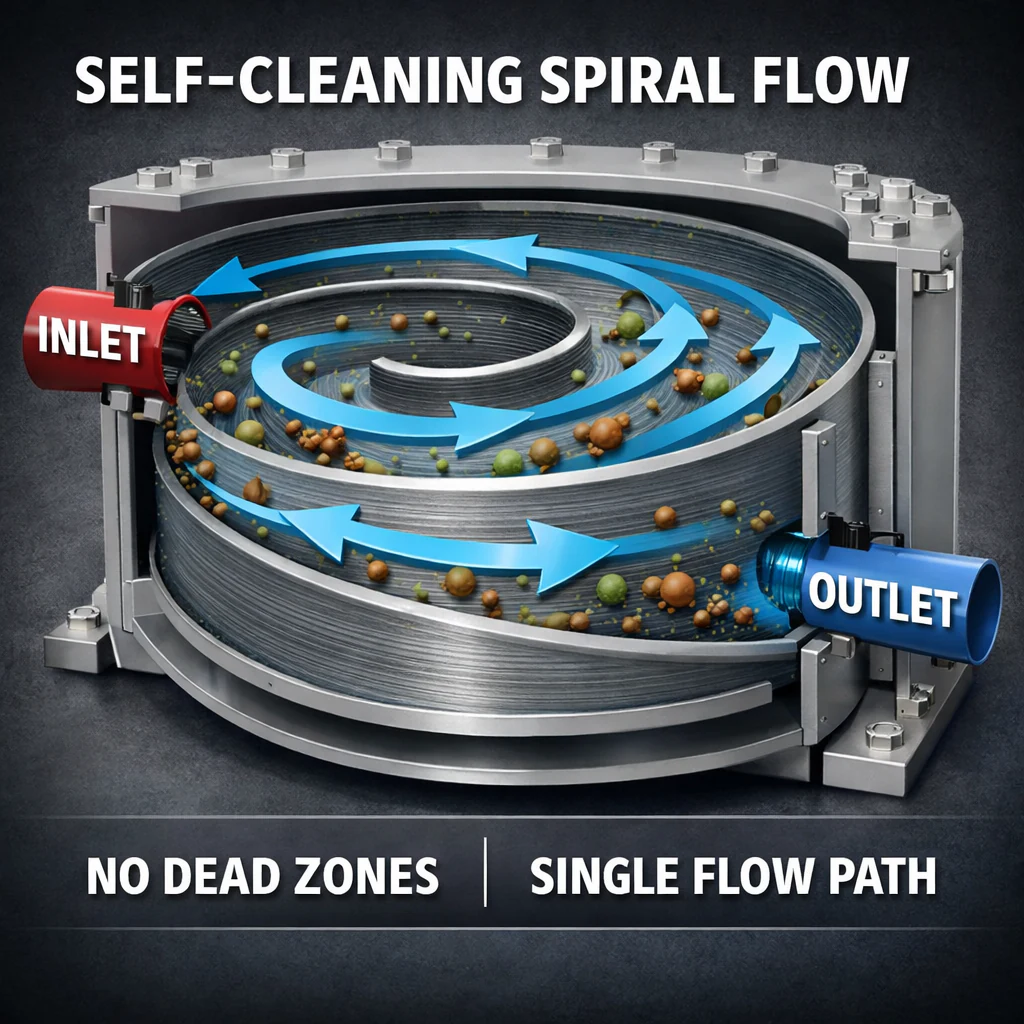
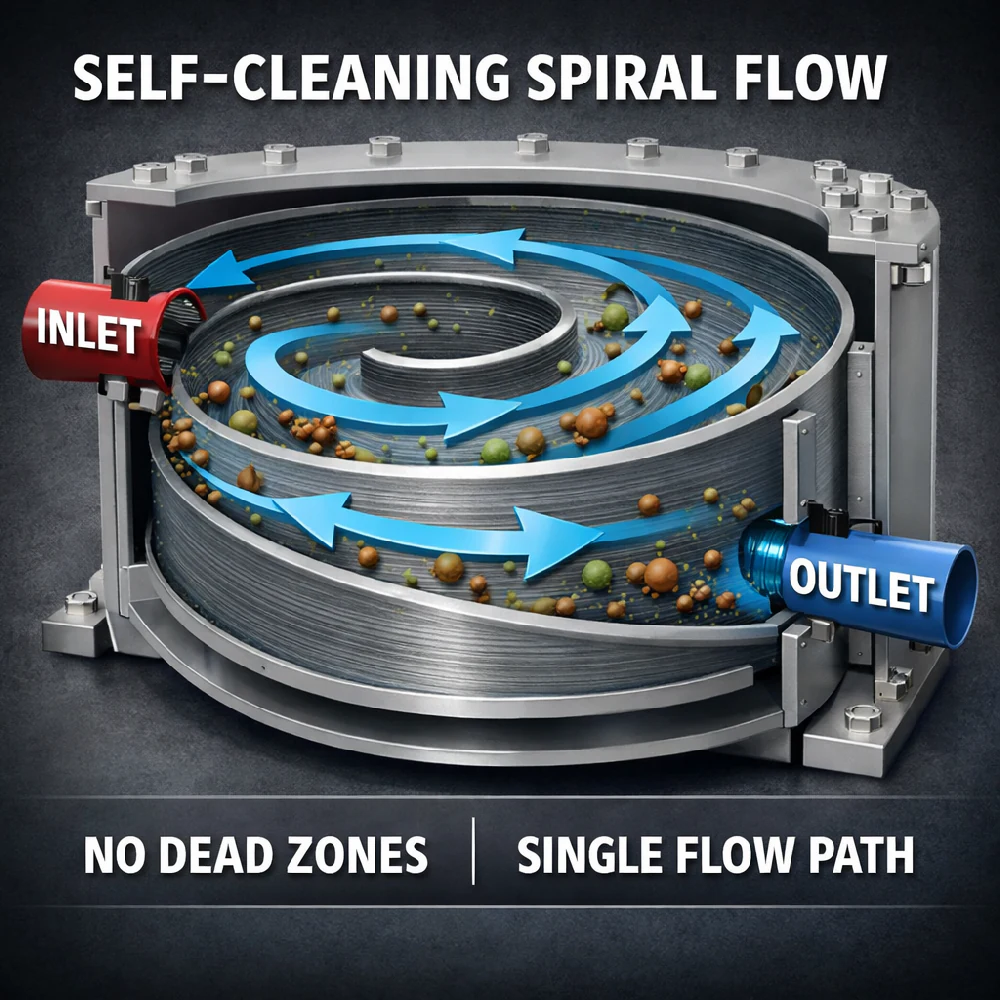
SPHE uses a single, continuous spiral channel on each side. This geometry avoids parallel micro-channels and complex distribution zones that are sensitive to fouling and plugging. For dirty, fibrous, viscous, or solids-laden fluids, the most important KPI is not “highest U-value”, but stable operation with minimal unplanned shutdowns .
Key reasons to choose SPHE:
- High fouling tolerance : one continuous channel reduces maldistribution and “partial blockage failure”.
- Self-scouring flow pattern : spiral curvature encourages secondary flow, helping prevent stable deposits.
- Handles solids & fibers better than many compact plate designs.
- Mechanical cleaning friendly (for removable-cover designs): full access for water jetting and manual cleaning.
- Reliable under unstable conditions : frequent start/stop, flow fluctuations, and variable properties.
Where SPHE is commonly used:
- Wastewater / sludge heat recovery
- Pulp & paper stock / fiber-laden streams
- Heavy oil, bitumen, tar, and high-viscosity fluids
- Crystallizing / scaling services
- Chemical processes with polymerizing tendencies
When SPHE may NOT be the best choice:
- Very clean fluids where maximum compactness and high U-value are priorities
- Extremely high pressure requirements beyond typical SPHE design ranges
- Applications requiring ultra-low pressure drop with high flow velocity simultaneously
Application Story — SPHE for Sludge/Wastewater Heat Recovery
In sludge and wastewater services, the “best” heat exchanger is rarely the one with the highest theoretical U-value. The real challenge is fouling stability : solids, fibers, bio-film, grease, and scale quickly destroy performance in exchangers that rely on precise distribution.
SPHE solves this by forcing the entire stream through one continuous path . Even when fouling occurs, it tends to be more uniform and predictable, allowing the system to remain operational longer. Maintenance becomes planned rather than emergency-driven.
What SPHE solves that others struggle with:
- Prevents early “channel-by-channel death” common in multi-pass compact plate designs
- Reduces risk of sudden plugging from debris and fibers
- Enables mechanical cleaning without full replacement or complex disassembly
- Keeps heat recovery running reliably in real-world dirty conditions
Spiral Plate Heat Exchanger (SPHE) – Q&A
Is SPHE less efficient than gasketed plate heat exchangers ?
From a purely theoretical heat-transfer coefficient (U-value) standpoint:
Yes — SPHE typically has a lower peak U-value compared to gasketed plate heat exchangers or compact welded plate designs.
However, in dirty service:
The effective long-term performance of SPHE is often superior because it:
- Maintains stable flow
- Avoids localized blockage
- Reduces emergency shutdowns
- Preserves recoverable heat over time
SPHE is optimized for operational stability, not laboratory performance.
Why does SPHE perform better in fouling environments?
SPHE geometry provides several anti-fouling advantages:
1. Single continuous channel
No parallel passages that can individually plug.
2. Self-scouring effect
The curved spiral path generates secondary flow patterns that disturb deposit formation.
3. Uniform fouling behavior
Deposits tend to build evenly instead of causing sudden “channel death.”
This significantly improves predictability in sludge and wastewater services.
What types of fluids are suitable for SPHE?
SPHE is commonly used for:
- Wastewater and sludge heat recovery
- Pulp & paper stock (fiber-laden streams)
- Heavy oil, bitumen, tar
- High-viscosity fluids
- Crystallizing or scaling services
- Polymerizing chemical streams
- Grease- or biofilm-containing fluids
It handles solids and fibers better than many compact plate designs.
What does SPHE solve that other heat exchangers struggle with?
SPHE prevents:
- Early “channel-by-channel failure” seen in compact multi-pass plate exchangers
- Sudden plugging caused by debris
- Maldistribution from uneven inlet flow
- Rapid performance degradation under unstable process conditions
It keeps heat recovery systems running in real-world dirty environments.
Can SPHE be mechanically cleaned?
Yes — especially in removable-cover designs.
Maintenance advantages include:
- Full access to spiral channel
- Water jetting capability
- Manual scraping if necessary
- No need for full plate pack disassembly
This makes SPHE highly maintenance-friendly in sludge and scaling services.
How does SPHE perform under unstable operating conditions?
SPHE is highly tolerant of:
- Frequent start/stop cycles
- Flow fluctuations
- Variable fluid properties
- Solids concentration changes
The single-channel design minimizes sensitivity to distribution imbalance.
When is SPHE NOT the best choice?
SPHE may not be ideal when:
- The fluid is very clean and maximum compactness is required
- Extremely high design pressure exceeds typical SPHE limits
- Ultra-low pressure drop and high flow velocity must be achieved simultaneously
- Space constraints demand very high surface density
In clean-service heat recovery, gasketed or welded plate exchangers may outperform SPHE in compactness.
What industries rely heavily on SPHE?
- Municipal wastewater treatment
- Industrial sludge processing
- Pulp & paper
- Oil & heavy hydrocarbon processing
- Chemical manufacturing
- Biogas systems
Why is SPHE preferred in sludge heat recovery?
In sludge systems, theoretical U-value is not the primary KPI.
The real KPI is:
Operational stability.
SPHE forces the entire sludge stream through one continuous path, ensuring:
- Predictable fouling behavior
- Longer runtime between cleanings
- Reduced emergency shutdown
- Easier maintenance planning
It turns reactive maintenance into scheduled maintenance.