
Heat Exchanger Technologies
What is the Difference Between Compabloc and Shell and Tube Heat Exchangers
Compare Compabloc and shell and tube heat exchangers including efficiency, size, performance and industrial applications. Engineering selection guide for heat exchangers.
Original HEXNOVAS article
What is the Difference Between Compabloc and Shell and Tube Heat Exchangers
What is the Difference Between Compabloc and Shell and Tube Heat Exchangers ?
A Compabloc heat exchanger is a compact welded plate heat exchanger that uses corrugated plates for high heat transfer efficiency, while a shell and tube heat exchanger uses tubes inside a cylindrical shell for heat exchange between fluids.
Both technologies are widely used in industrial heat transfer applications, but they differ significantly in efficiency, size, maintenance requirements, and operating conditions.
Understanding the differences helps engineers select the most suitable heat exchanger for specific process requirements.
Working Principle Comparison
Compabloc Heat Exchanger
- Fully welded corrugated plate pack
- Counter-current flow arrangement
- Strong turbulence for high heat transfer
- Compact heat transfer surface
Heat transfer occurs through thin metal plates, producing very high thermal efficiency.
Shell and Tube Heat Exchanger
- Bundle of tubes inside a cylindrical shell
- One fluid flows inside tubes
- Second fluid flows around tubes
- Lower turbulence compared with plate designs
This design provides strong mechanical reliability but lower heat transfer efficiency.
Performance Comparison
Heat Transfer Efficiency
Compabloc:
- Very high heat transfer coefficient
- Typically 3–5× higher than shell and tube
- Small temperature approach possible
Shell and Tube:
- Lower heat transfer efficiency
- Larger heat transfer area required
Size and Footprint
Compabloc:
- Extremely compact design
- 70–90% space saving
- Lightweight installation
Shell and Tube:
- Large footprint
- Heavy structure
- Higher installation space requirement
Pressure and Temperature Capability
Compabloc:
- High temperature capability
- High pressure operation
- Suitable for aggressive fluids
Shell and Tube:
- Extremely high pressure capability
- Suitable for very high temperature service
- Strong mechanical construction
Shell and tube units typically handle the most extreme mechanical conditions.
Fouling and Maintenance
Compabloc:
- High turbulence reduces fouling
- Mechanical cleaning possible
- Compact maintenance access
Shell and Tube:
- Better for heavy fouling services
- Easier mechanical cleaning of tubes
- More tolerant of dirty fluids
Cost and Lifecycle
Compabloc:
- Higher initial cost
- Lower operating cost
- Higher energy efficiency
Shell and Tube:
- Lower initial cost
- Larger operating footprint
- Lower thermal efficiency
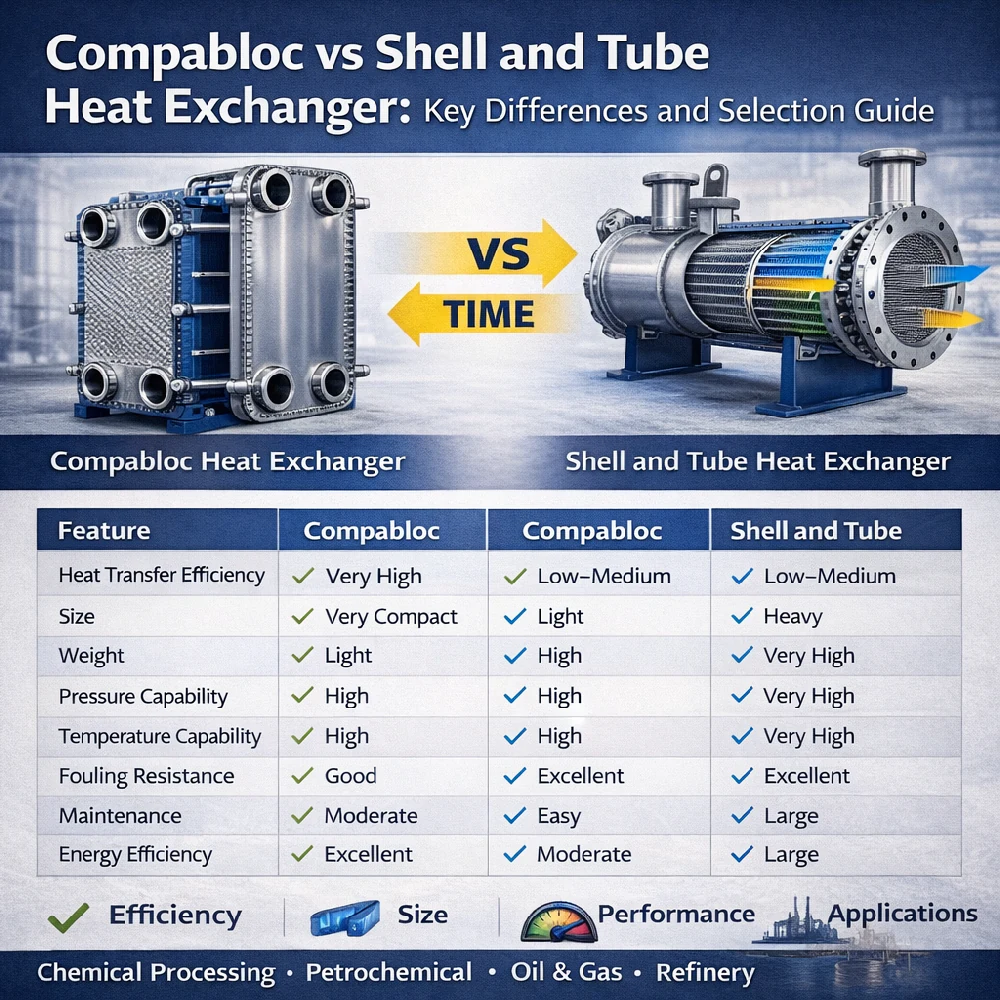
Comparison Table
When to Choose a Compabloc Heat Exchanger
A Compabloc heat exchanger is recommended when:
- High heat transfer efficiency is required
- Installation space is limited
- Energy efficiency is critical
- Aggressive chemicals are present
- High temperature approach performance is needed
- Compact process equipment is preferred
Typical industries include chemical processing, petrochemical plants, and heat recovery systems.
When to Choose a Shell and Tube Heat Exchanger
Shell and tube heat exchangers are preferred when:
- Fluids contain heavy fouling or solids
- Extremely high pressure operation is required
- Mechanical durability is the primary concern
- Very large flow rates are present
- Simple maintenance is required
They are commonly used in oil and gas, power generation, and heavy industrial applications.
Industrial Selection Summary
Compabloc heat exchangers provide superior thermal efficiency and compact design, while shell and tube heat exchangers provide maximum mechanical robustness and fouling tolerance.
The final selection depends on process conditions, thermal performance requirements, and plant design constraints.
Learn More
- What is a Compabloc Heat Exchanger
- Alfa Laval Compabloc Alternative
- Welded Plate Heat Exchanger Working Principle
| Feature | Compabloc Heat Exchanger | Shell and Tube Heat Exchanger |
| Heat Transfer Efficiency | Very High | Low–Medium |
| Size | Very Compact | Large |
| Weight | Light | Heavy |
| Pressure Capability | High | Very High |
| Temperature Capability | High | Very High |
| Fouling Resistance | Good | Excellent |
| Maintenance | Moderate | Easy |
| Energy Efficiency | Excellent | Moderate |
| Installation Space | Minimal | Large |