Fullly welded heat exchanger for Rice Bran Oil processing.
Rice bran oil heating heat recovery cooling system, fully welded plate and block heat exchanger, high temperature oil economizer, plate and block heat exchanger for edible oil processing, compabloc plate heat exchanger, heat recovery in rice bran oil process, high temperature oil heat exchanger case study, HEXNOVAS rice bran oil application.
HEXNOVAS SOLUTION
Rice Bran Oil Heating, Heat Recovery and Cooling System Based on Fully Welded Plate & Block Heat Exchangers in Thailand
A practical engineering case for edible oil processing where high operating temperature, stable product handling, and low lifecycle maintenance drive the selection of fully welded heat exchangers.
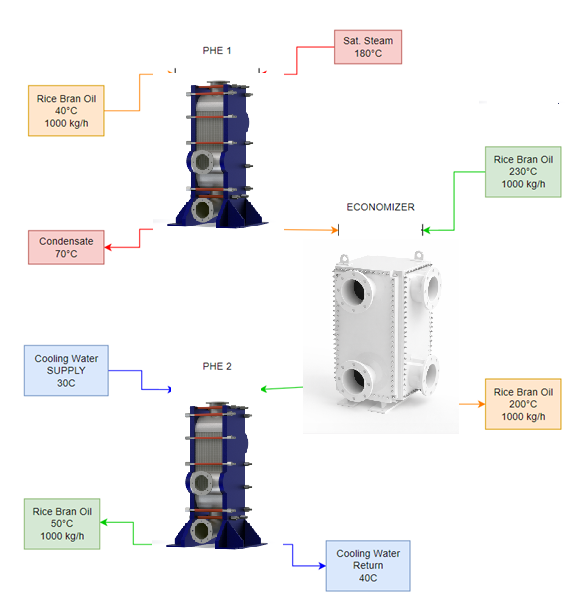
In rice bran oil processing, the heating, heat recovery, and cooling stages must work together as one integrated thermal system. This application is not only about transferring heat efficiently; it is also about selecting the right exchanger structure for long-term operation at elevated temperature. In the case shown below, the process includes steam heating, high-temperature heat recovery through an economizer, and final cooling. Because the economizer duty operates above 200°C and the oil side reaches up to 230°C, the customer selected a fully welded plate and block heat exchanger for the high-temperature section. This choice improves reliability, avoids gasket-aging concerns in hot oil service, and supports a more stable operating strategy for continuous edible oil production.
230°CMaximum rice bran oil temperature in the recovery section.
180°CSaturated steam heating source for the first heating stage.
200°C+Economizer duty where fully welded construction becomes critical.
Low MaintenanceNo routine gasket replacement in the high-temperature section.
Process Overview: Why the System Uses Heating, Heat Recovery, and Cooling in Sequence
The process follows a logical thermal path. First, the incoming rice bran oil is heated by steam in the initial exchanger. Then the hot oil stream passes through an economizer, where part of its thermal energy is transferred to another oil stream, reducing total external energy demand. After heat recovery, the product is cooled to the required downstream process temperature. This configuration improves energy utilization while keeping the oil temperature profile under control.
.
In this case, the process diagram clearly shows why equipment selection cannot be based only on compact size or initial cost. The thermal profile includes a hot oil stream of approximately 230°C, an economizer section above 200°C, and a final cooling stage down toward 50°C. Under these conditions, the design philosophy focuses on thermal stability, mechanical integrity, and maintenance predictability over long production cycles.
Engineering Selection Logic for This Rice Bran Oil Application
This project is a good example of application-based selection rather than catalog-based selection. The customer did not simply choose one exchanger type for convenience. Instead, the thermal system was reviewed according to real operating temperature, fluid characteristics, and expected service life.
High-temperature oil service: the economizer section runs above 200°C, which places much higher demands on sealing reliability and plate structure.
Continuous production logic: edible oil processes value stable operation and reduced unplanned shutdowns, so maintenance intervals matter as much as thermal efficiency.
Lifecycle cost focus: in high-temperature duty, reducing gasket replacement and minimizing service intervention can be more valuable than a lower initial equipment price.
Selection conclusion: for the high-temperature heat recovery section, a fully welded plate and block heat exchanger is the more suitable engineering choice because it avoids the long-term durability concerns associated with gasket materials in hot oil service.
System Breakdown by Section
Section 1
Steam Heating Stage
In the first stage, rice bran oil enters at approximately 40°C and is heated by saturated steam at 180°C. This section raises the product temperature efficiently and prepares the oil for the subsequent high-temperature process steps. The purpose here is fast and controllable heat input, with condensate leaving around 70°C.
For edible oil applications, this stage must maintain stable heat transfer without creating unnecessary thermal stress on the product. Proper channel design and temperature control help support product consistency while ensuring reliable utility-side performance.
Section 2
Economizer Heat Recovery Stage
This is the most important section in the system. Hot rice bran oil at around 230°C transfers part of its thermal energy through the economizer, reducing the load on the heating utility and improving total system efficiency. The oil leaves this section at around 200°C, meaning a large amount of useful energy is recovered before the final cooling stage.
Because this duty operates above 200°C, the exchanger type matters greatly. The customer selected a fully welded plate and block heat exchanger rather than a gasketed structure. In this temperature range, gasket service life becomes a practical concern, especially for long-term hot oil operation. A fully welded design avoids that limitation and provides a more robust long-run solution.
Why Fully Welded Here
No gasket aging risk in the core high-temperature section.
Better suited for continuous duty in hot edible oil systems.
Stronger structural confidence under elevated temperature.
Lower lifecycle maintenance requirements.
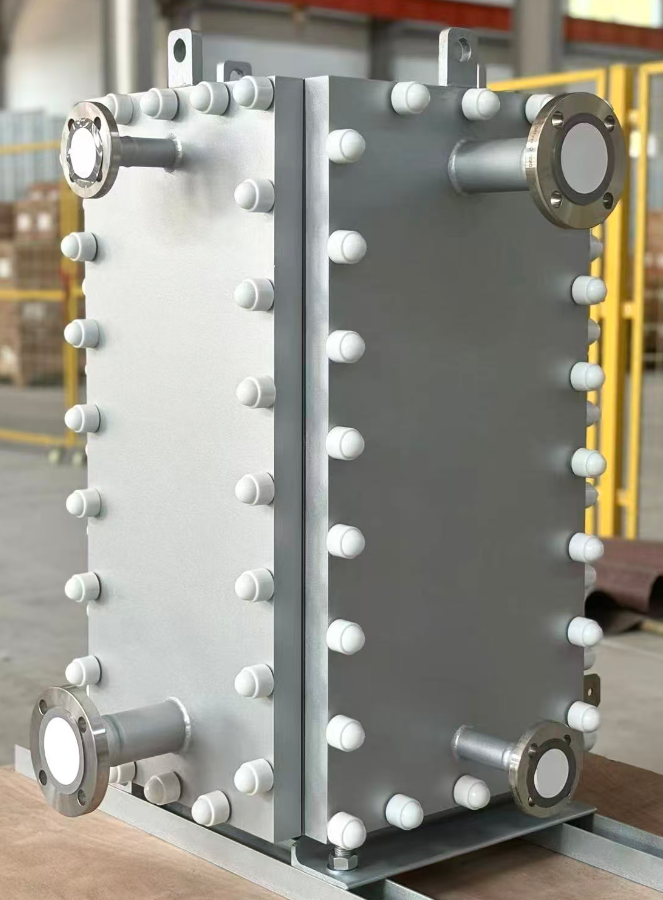
Compabloc welded heat exchanger
Section 3
Final Cooling Stage
After heat recovery, the oil is further cooled to approximately 50°C. Cooling water enters at around 30°C and returns at about 40°C. This final stage allows the process to reach the target outlet condition required for the next production step or storage condition.
The cooling stage is essential not only for heat removal, but also for overall product handling. A well-controlled final cooler helps stabilize the outlet temperature, reduce thermal fluctuation, and support more consistent downstream operation.
In many edible oil plants, high-temperature service eventually shifts the engineering discussion from simple heat-transfer efficiency to long-term mechanical and sealing reliability. That is exactly what happens in this rice bran oil system. Once the economizer duty exceeds 200°C, the thermal system enters a range where exchanger construction type becomes a major design decision.
Temperature capability: fully welded construction eliminates the need for elastomer gaskets in the core high-temperature zone.
Mechanical confidence: plate and block structures are suitable for demanding thermal duty where process stability matters.
Maintenance reduction: without gasket replacement planning in the hot section, routine service cost can be reduced significantly.
Operational consistency: for continuous plants, fewer sealing concerns mean fewer interruptions and more predictable uptime.
In short, this was not a branding-driven choice. It was a process-driven selection based on actual temperature exposure, expected service interval, and the practical economics of plant operation.
Practical Benefits for the Customer
Energy and Process Benefits
Recovered heat reduces steam demand in the overall system.
Multi-stage temperature control improves product handling.
Compact heat transfer arrangement supports efficient plant layout.
Better use of process heat improves thermal economy.
Maintenance and Lifecycle Benefits
Fully welded economizer lowers long-term service intervention.
Reduced dependence on gasket replacement in hot oil service.
Better fit for applications where uptime is more valuable than minimum first cost.
More suitable for customers seeking a durable high-temperature process solution.
Equipment Selection Summary
Process Section
Thermal Duty
Key Operating Data
Selection Logic
Recommended HEXNOVAS Direction
Steam Heating
Initial oil heating
Oil: 40°C inlet Steam: 180°C Condensate: 70°C
Efficient heat input and stable upstream temperature control
Configured according to utility and hygiene requirements
Economizer
Heat recovery from hot oil
Hot oil: 230°C to 200°C
High-temperature section where gasket life becomes a concern
Fully Welded Plate & Block Heat Exchanger
Final Cooling
Product temperature reduction
Oil outlet: 50°C Cooling water: 30°C to 40°C
Stable final outlet control for downstream processing
Selected according to cleanliness, utility, and layout conditions
Project Photo Area for Real Installation Images
To make this solution page more credible and more useful for customers, it is strongly recommended to place one real project photo here. Suitable options include the installed economizer, the skid or pipe connection area, the heating line, or the final cooling section. Real equipment images always help readers connect the process diagram with an actual operating system.
Frequently Asked Questions
Why is the economizer the key section in this application?
Because it recovers useful thermal energy from the hottest oil stream before final cooling. This directly improves system efficiency and reduces the heating utility required upstream.
Why is a fully welded design preferred in the high-temperature section?
The economizer operates above 200°C, so long-term gasket durability becomes a practical concern. A fully welded plate and block structure is better aligned with that operating envelope and helps reduce maintenance over time.
Can this design philosophy also apply to other edible oil or thermal oil systems?
Yes. The same selection logic can apply to other high-temperature oil duties where heat recovery, reduced maintenance, and reliable sealing performance are important design priorities.