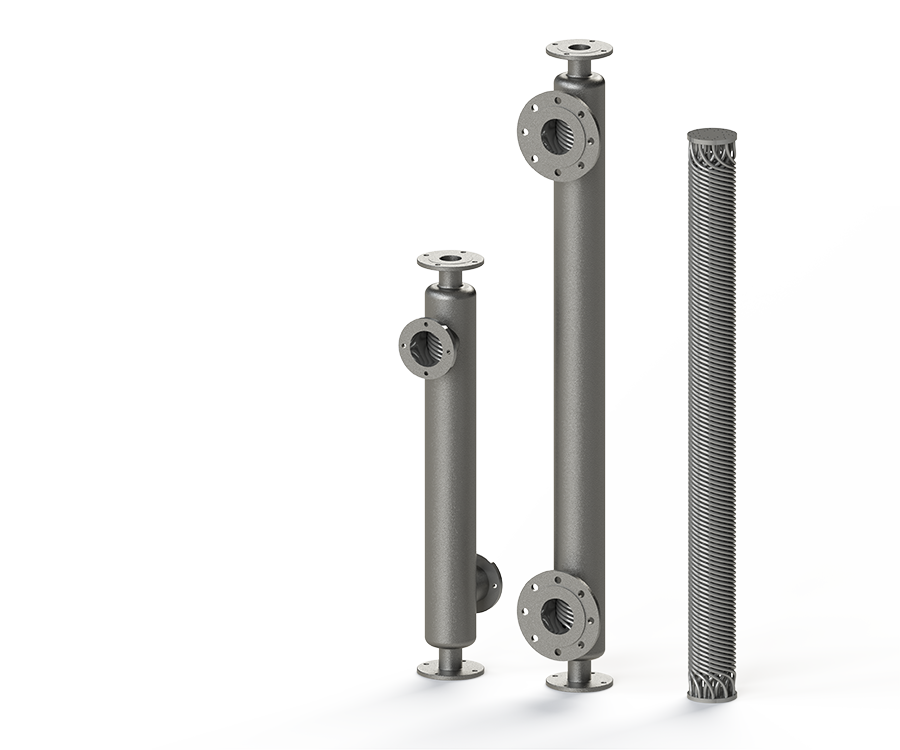
It is a pressure-shell heat exchanger in which the heat transfer surface is formed by spiral or helical coil tubes rather than straight tubes or corrugated plates.
In a Shell & Coil Heat Exchanger (spiral tube heat exchanger), one fluid flows through the internal helical coil while the other fluid flows through the surrounding shell side. Heat is transferred through the tube wall between the two fluids.
The helical tube arrangement provides a long heat transfer path inside a compact cylindrical body. This structure helps improve turbulence, reduce equipment footprint and maintain stable performance in heating, cooling, steam condensing and process heat transfer applications.
Compared with a traditional shell and tube exchanger, the shell and coil design is generally more compact. Compared with a gasketed plate heat exchanger, it offers a welded structure without plate gaskets.
The exchanger separates two fluids by a metallic tube wall. Thermal energy passes from the hot fluid to the cold fluid while both circuits remain fully isolated.
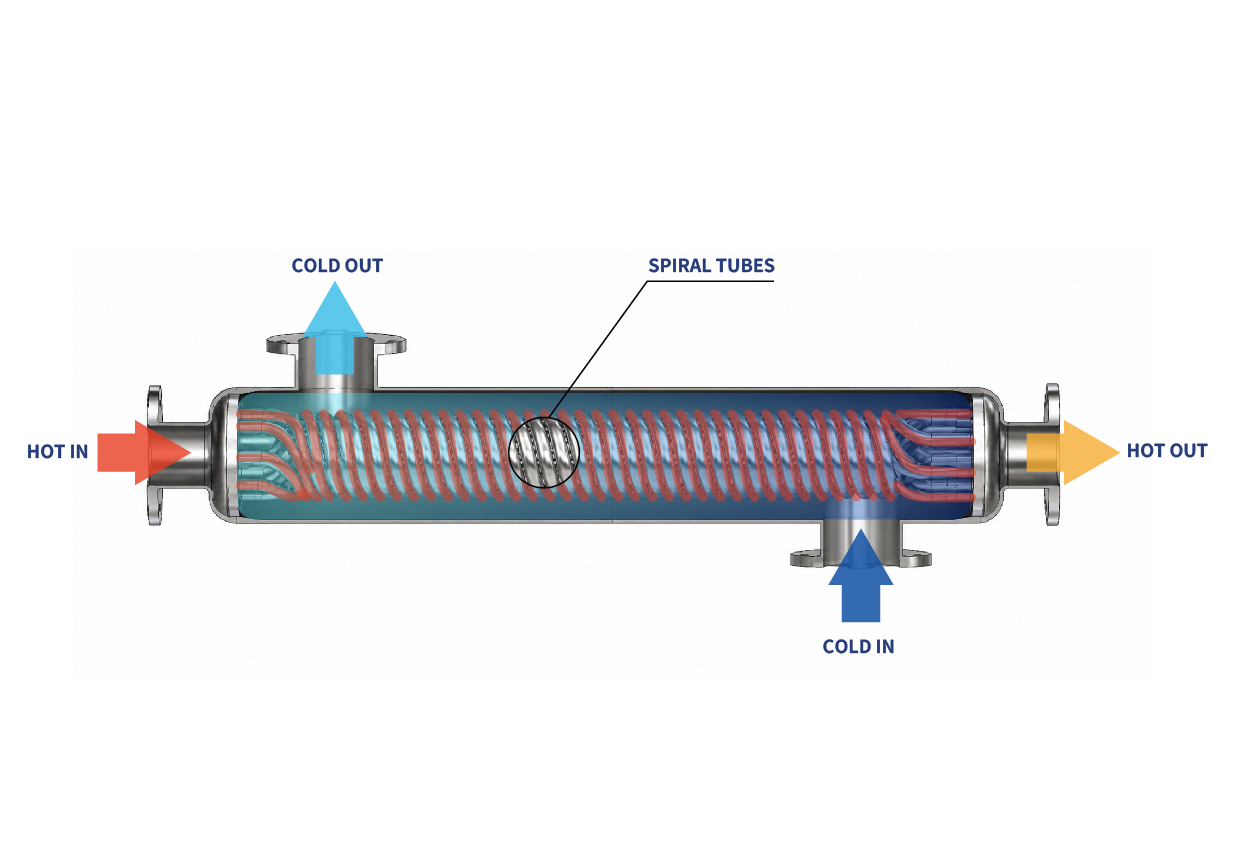
The coil-side medium enters the helical tube bundle and travels through a controlled spiral path.
The shell-side medium flows around the coil bundle. The internal geometry can be optimized to improve flow distribution.
Heat is transferred through the tube wall. The unit can be arranged for counter-current or optimized flow configuration.
The value of this product is the balance between compact size, welded reliability and practical adaptability.
The helical coil places a long heat transfer tube length inside a short shell.
The welded structure avoids plate gasket ageing and gasket compatibility concerns.
The curved coil path increases fluid disturbance and supports efficient heat transfer.
The robust welded body can be designed for steam-to-water heating.
Stainless steel and titanium options allow adaptation for water, glycol, seawater and pool water.
Connection type, shell size, coil geometry and pressure rating can be customized.
This design is suitable for compact thermal systems where space, durability and stable operation are important.
Domestic hot water, boiler loops, heating modules and glycol heating.
Steam-to-water heating, condensate heat recovery and industrial hot water preparation.
Heating substations, heat interface units and centralized building heating systems.
Seawater heating, swimming pool heating and onboard hot water systems.
Process water heating, CIP heating, heat recovery and cooling loops.
Each unit is selected according to thermal duty, fluid properties, allowable pressure drop, design pressure and material requirements.
| Product Type | Shell & Coil Heat Exchanger / Helical Coil Heat Exchanger |
|---|---|
| Structure | Welded pressure shell with internal helical coil tube bundle |
| Material Options | SS304, SS316L, Titanium and other project-specific materials upon request |
| Connection Type | Threaded, flanged, welded nozzle or customized connection design |
| Installation | Horizontal or vertical installation according to process layout |
| Typical Media | Water, glycol solution, steam, condensate, seawater, pool water and selected industrial fluids |
| Selection Data Required | Fluid name, flow rate, inlet/outlet temperature, operating pressure, design pressure, pressure drop limit, material requirement and connection standard |
The manufacturing process focuses on coil dimensional accuracy, welding quality, pressure integrity and final inspection.
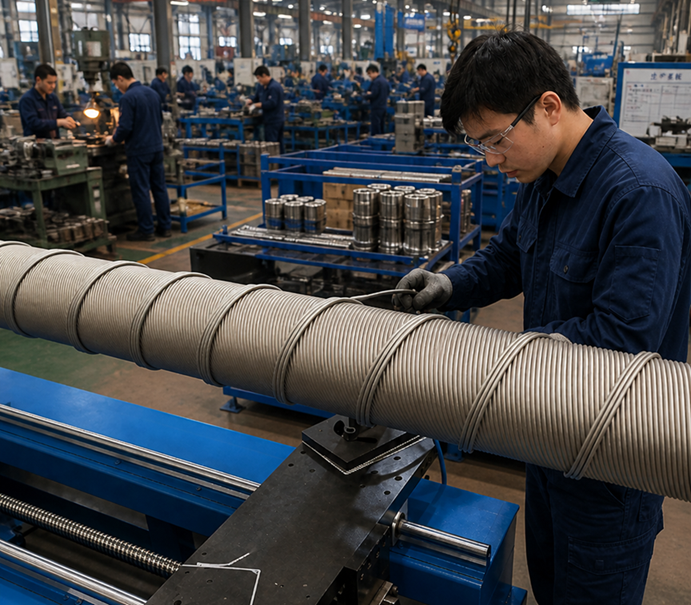
The tube is formed into a controlled helical coil.
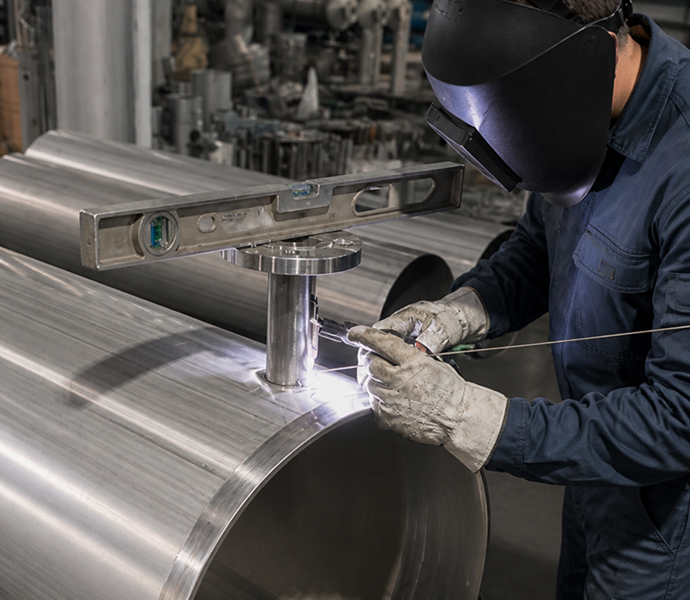
The shell body, end covers and nozzles are prepared.
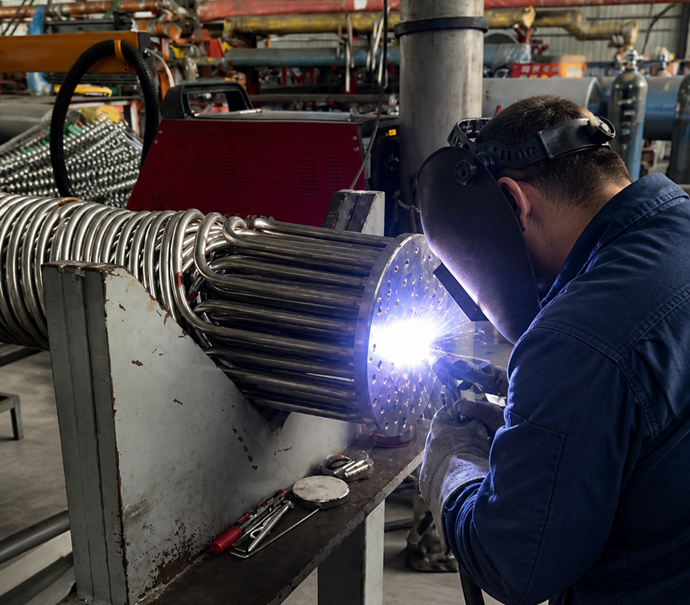
The coil bundle is installed inside the shell and welded.
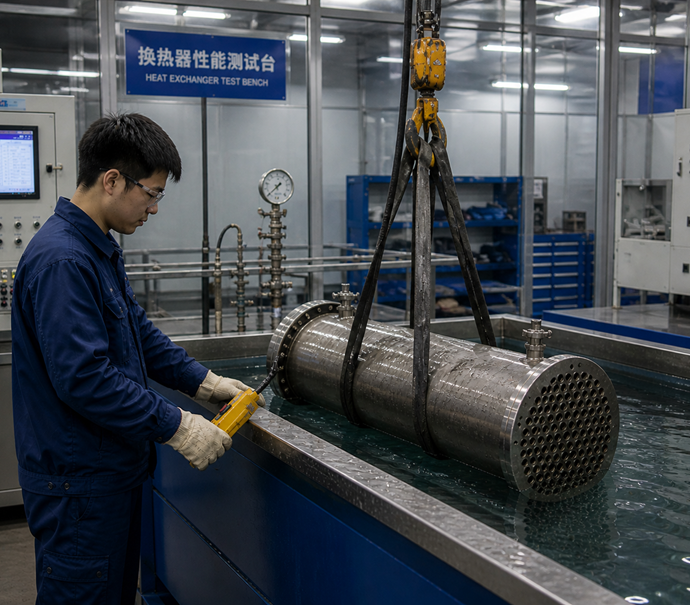
The finished unit is checked for welding quality and pressure integrity.
No. Both have shell-side and tube-side flow paths, but a shell & coil heat exchanger uses helical coil tubes instead of straight tubes.
It is suitable when a welded structure is preferred or when plate gaskets may not be suitable.
Yes. Shell & coil heat exchangers can be designed for steam-to-water heating and condensate heat recovery.