Materials & Corrosion
How to Select Gaskets for Gasketed Plate Heat Exchangers
Learn how to select gaskets for gasketed plate heat exchangers based on temperature limits, chemical compatibility, operating pressure, CIP cleaning conditions, and service life. This engineering guide explains EPDM, NBR, FKM, and silicone gasket selection for GPHE applications.
Original HEXNOVAS article
How to Select Gaskets for Gasketed Plate Heat Exchangers
How to Select Gaskets for Gasketed Plate Heat Exchangers
A practical engineering guide to gasket material selection based on temperature, chemical compatibility, pressure, cleaning conditions, and maintenance requirements.
In a gasketed plate heat exchanger, the gasket is not just a sealing accessory. It is a critical component that determines leakage performance, chemical resistance, temperature capability, maintenance workload, and ultimately the service life of the exchanger itself. Improper gasket selection can lead to swelling, hardening, premature aging, chemical attack, or early leakage. For that reason, gasket selection should always be based on operating conditions rather than initial price alone.
Overview
The gasket in a GPHE performs several functions at the same time. It seals the flow channels, prevents external leakage, separates the two media, guides the flow path through alternating channels, and accommodates pressure fluctuation and thermal expansion during operation.
- Sealing the flow channels to prevent fluid mixing
- Preventing external leakage
- Guiding the fluid through the intended plate path
- Absorbing thermal expansion and pressure variation
When the wrong gasket is used, the failure is often not immediate. The system may run for a period and then deteriorate through swelling, embrittlement, loss of elasticity, or chemical attack. That is why gasket selection needs an engineering approach rather than a generic “universal material” assumption.
Operating Temperature — The Most Critical Factor
Different elastomers have very different temperature limits. In many cases, temperature is the first filter in gasket selection because a material that cannot survive the thermal condition is eliminated immediately, even if its chemical compatibility looks acceptable.
Quick Temperature Rules
- Above 120°C, NBR is often no longer suitable
- Steam duty generally favors EPDM
- High-temperature chemical service often requires FKM
Practical Safety Logic
In industrial projects, it is good practice to keep a reasonable temperature margin rather than selecting a gasket that is already operating close to its limit.
Chemical Compatibility
After temperature, chemical compatibility is the next decisive factor. A gasket must be compatible with the actual process fluid, not just the general service label. This includes cleaning chemicals, additives, trace contaminants, and intermittent media exposure during operation or shutdown.
Operating Pressure and Mechanical Strength
The gasket must not only resist media and temperature. It must also survive compression load, system pressure, and repeated thermal cycling. In higher-pressure systems, gasket hardness, elasticity, and resistance to mechanical fatigue become increasingly important.
In higher-pressure service, HNBR, FKM, and high-hardness EPDM are commonly considered depending on the media and temperature combination.
Compression Set Resistance
Compression set is one of the most important long-term sealing properties. A good gasket should recover after compression, maintain elasticity, and resist permanent deformation over extended operating time.
If compression set is poor, sealing force drops over time and leakage risk rises even if the gasket initially performed well after installation.
CIP and Cleaning Conditions
In many industrial systems, the gasket is exposed not only to process media but also to cleaning chemistry. Caustic soda, acidic cleaning solutions, sterilization cycles, and high-temperature CIP all place additional stress on the elastomer.
- Caustic soda cleaning
- Acid cleaning solutions
- High-temperature sterilization
If the cleaning condition is ignored during gasket selection, the gasket may fail much earlier than expected even though it appears chemically compatible with the process fluid itself.
Common Gasket Materials and Typical Applications
EPDM — The Most Widely Used Choice
EPDM is the most common gasket material in GPHE service and is often suitable for more than half of industrial applications. It performs well in water-based systems and is commonly selected for HVAC, district heating, hot water, steam, food processing, and many chemical water solutions.
- Advantages: good temperature resistance, good aging resistance, long service life, reasonable cost
- Limitation: generally not suitable for oils or fuels
NBR — Oil Service Specialist
NBR is typically chosen for lubricating oil coolers, hydraulic oil systems, and fuel-related service. Its biggest strength is oil resistance.
- Advantages: excellent oil resistance, economical
- Limitations: limited temperature capability, weak steam resistance
FKM / Viton — Severe Service Material
FKM is usually the premium choice for high-temperature and chemically aggressive service. It is widely used where thermal stability and chemical resistance matter more than cost.
- Advantages: excellent temperature resistance, strong chemical resistance
- Limitation: high cost, often several times the cost of EPDM
Silicone — Food and Pharmaceutical Direction
Silicone is typically chosen when hygiene, non-toxicity, and wide temperature capability are important, especially in food and pharmaceutical systems.
Gasket Attachment Methods
Besides material choice, the way the gasket is fixed to the plate also affects maintenance effort, replacement speed, and long-term operating convenience.
Clip-On Gaskets
- Fast replacement
- No adhesive contamination
- Easier maintenance
- Preferred industrial solution in many applications
Typical use: HVAC and general industrial service
Glue-On Gaskets
- Lower initial cost
- Harder to replace
- Cleaning is more time-consuming
- Higher maintenance effort over lifecycle
Factors Affecting Gasket Service Life
Even the correct gasket material will age faster if operating conditions are severe. The most common life-reducing factors include temperature cycling, unsuitable cleaning chemistry, ultraviolet exposure during storage, excessive compression, and media contamination.
- Frequent temperature cycling
- Incorrect cleaning chemicals
- UV exposure
- Excessive compression
- Oil contamination, especially harmful to EPDM
Standard Engineering Selection Procedure
A practical gasket selection workflow should be structured and repeatable. In most industrial cases, the selection logic can be simplified into the following sequence:
Practical Quick Selection Guide
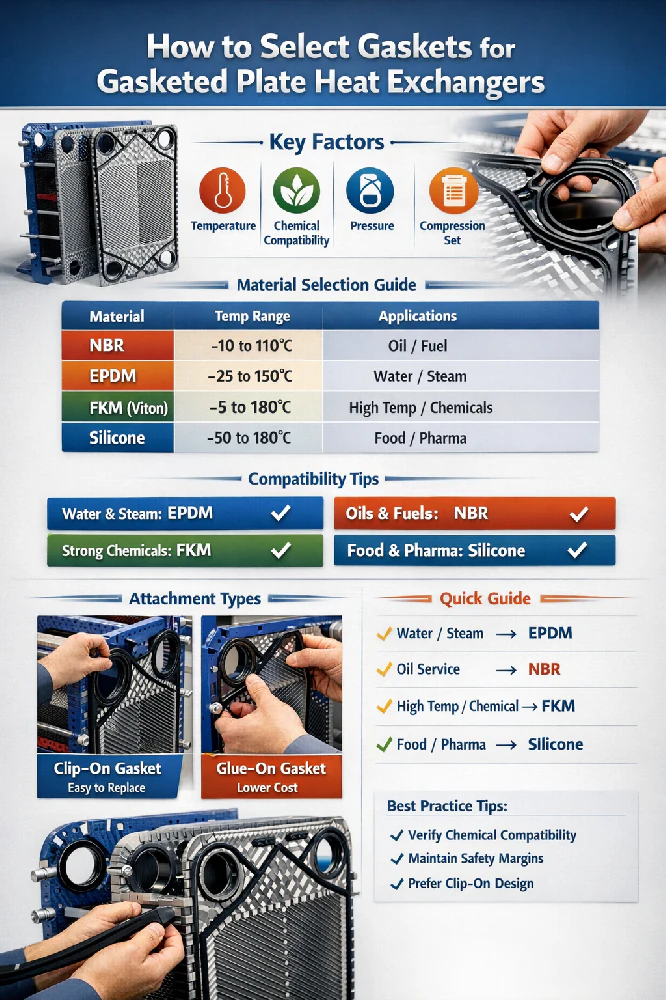
For a large number of projects, a simple first-pass material direction can be made from the service type:
This quick rule covers most common applications, but final selection should still be checked against the actual operating temperature, pressure, cleaning chemistry, and maintenance expectations.
Engineering Recommendations
- Always verify chemical compatibility before anything else
- Avoid relying on “universal” gasket materials
- Keep a reasonable safety margin below the material temperature limit
- For CIP systems, EPDM or FKM are often the better direction
- Prefer clip-on gasket systems where maintenance efficiency matters
Read More:
Different type of gasket fixing system in GPHE
FAQ
how to select gaskets for gasketed plate heat exchangers, GPHE gasket selection, plate heat exchanger gasket material, EPDM gasket, NBR gasket, FKM gasket, Viton gasket for plate heat exchanger, clip-on gasket, glue-on gasket, plate heat exchanger gasket service life
| Material | Continuous Temperature | Peak Temperature | Typical Characteristics |
| NBR (Nitrile Rubber) | -10 to 110°C | 130°C | Excellent for oil service |
| EPDM | -25 to 150°C | 170°C | Water, steam, chemicals |
| FKM / Viton | -5 to 180°C | 200°C | High temperature and aggressive media |
| HNBR | -20 to 140°C | 160°C | Enhanced oil and heat resistance |
| Silicone | -50 to 180°C | 200°C | Food and pharmaceutical applications |
| Service | Recommended Direction | ||
| Water / Cooling Water / Hot Water | EPDM is typically preferred | ||
| Oils / Fuel / Lubricants | NBR is preferred; EPDM should generally be avoided | ||
| Weak Acids / Weak Alkalis | EPDM is commonly suitable | ||
| Strong Corrosive Media | FKM is often required | ||
| HFC Refrigerants | NBR or FKM depending on condition | ||
| Organic Solvents | FKM is generally the safer direction | ||
| Food / Pharmaceutical Media | FDA-grade EPDM or Silicone | ||
| Operating Condition | Typical Recommendation | ||
| ≤ 16 bar | Standard gasket is usually sufficient | ||
| 16–25 bar | Reinforced or higher-grade gasket should be considered | ||
| Frequent thermal cycling | Prefer higher elasticity and fatigue-resistant materials | ||
| Operating Environment | Typical Lifetime | ||
| HVAC systems | 5–10 years | ||
| Chemical industry | 2–5 years | ||
| High-temperature steam | 1–3 years |