
Chemical Processing
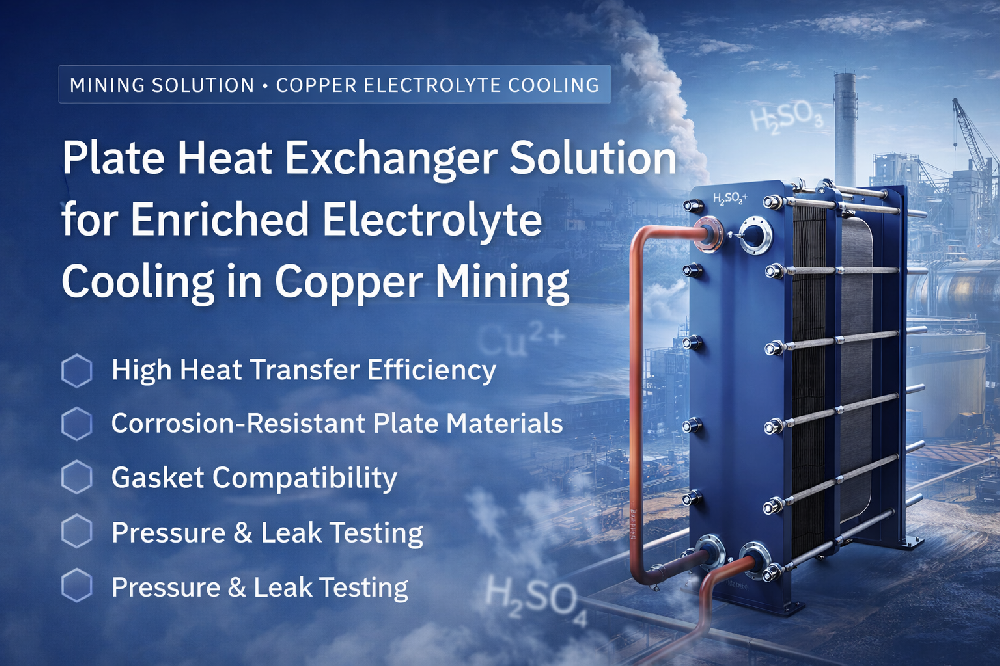
Plate Heat Exchanger Solution for Enriched Electrolyte Cooling in Copper Mining
HEXNOVAS provides plate heat exchanger solutions for copper mining electrolyte cooling, covering exchanger type selection, corrosion-resistant materials, gasket compatibility, and testing control.
Original HEXNOVAS article
Solution for Enriched Electrolyte Cooling
Copper Mining Heat Exchanger Solution
Plate heat exchanger for enriched electrolyte cooling in copper mining. Learn how to choose heat exchanger type, plate material, gasket material, and quality control strategy for corrosive mining electrolyte service.
Plate Heat Exchanger Solution for Enriched Electrolyte Cooling in Copper Mining
In copper mining and refining applications, enriched electrolyte cooling is not simply a heat transfer task. The exchanger must combine high thermal efficiency, corrosion resistance, gasket compatibility, and dependable testing standards. For this type of duty, the engineering decision should be evaluated from three key perspectives: heat exchanger type selection, plate and gasket material selection, and manufacturing quality control.
Why This Application Requires More Than a Standard Cooling Design
In enriched electrolyte service, the working fluid can contain copper ions, acid, trace chlorides, and other aggressive contaminants. That means exchanger selection cannot be based only on duty and temperature. The design must also address corrosion risk, sealing reliability, serviceability, and long-term operating stability.
Heat Exchanger Type
Choose a configuration that delivers high thermal efficiency while still allowing maintenance access and adaptation to plant operating conditions.
Material Selection
Select the correct plate alloy and gasket elastomer according to acidity, chloride level, temperature, and cleaning requirements.
Quality Control
Control production quality with pressure testing, leak inspection, gasket verification, and dimensional consistency throughout manufacturing.
1. Heat Exchanger Type Selection
For copper mining electrolyte cooling, a Gasket Plate Heat Exchanger is often a highly practical choice when the fluid remains pumpable and the maintenance team needs access for inspection and cleaning. Compared with bulkier exchanger types, a gasketed plate design provides high overall heat transfer performance, compact footprint, and easier capacity adjustment through plate count changes.
This is especially valuable in industrial mining systems where process conditions may evolve after commissioning. If fouling tendency, duty, or temperature approach changes, a gasketed unit offers more flexibility than many fixed-core exchanger designs.
2. Plate and Gasket Material Selection
Material selection is one of the most critical engineering steps in this application. A plate heat exchanger may have the correct thermal design, but if the alloy and gasket are not compatible with the electrolyte chemistry, service life can be shortened dramatically.
Plate Material Selection
Plate material should be selected according to acidity, chloride content, oxidizing tendency, operating temperature, and expected cleaning method. In aggressive mining electrolyte service, standard stainless materials may not always be sufficient. Depending on the actual composition, upgraded materials such as 254 SMO , titanium, or even higher alloys may be justified.
Gasket Material Selection
Gasket selection should be treated as a chemical compatibility decision, not just a temperature decision. In enriched electrolyte systems, the gasket must resist chemical attack, compression set, swelling, and long-term sealing deterioration. The wrong elastomer can become the weak point of the entire exchanger even if the plate alloy is correctly selected.
In practice, final plate and gasket decisions should always be made against the actual fluid analysis, operating temperature, chloride level, pH range, and CIP or cleaning chemistry.
3. Quality Control and Testing Strategy
In corrosive industrial cooling systems, exchanger reliability is not determined only by design drawings. It also depends on manufacturing consistency and testing discipline. For copper mining electrolyte cooling, leakage risk, gasket failure, and dimensional inconsistency can all create serious operating consequences.
Pressure Integrity
Hydrostatic or equivalent pressure testing helps verify the mechanical integrity of the frame, plate pack, and sealing interface before delivery.
Leak Prevention
Leak inspection, gasket seating verification, and assembly control reduce the risk of cross-contamination and external leakage on site.
Consistency Control
Dimensional accuracy, plate pressing quality, gasket groove integrity, and material traceability all affect long-term exchanger performance.
For this type of application, the message is simple: a suitable exchanger is not defined only by heat duty. It is defined by the combination of correct type selection, correct plate and gasket material selection, and correct manufacturing and testing control .
Need Help Selecting a Plate Heat Exchanger for Mining Electrolyte Cooling?
HEXNOVAS can support exchanger selection based on process duty, fluid corrosiveness, temperature range, gasket compatibility, and manufacturing quality requirements for demanding industrial applications.
| Selection Focus | Why It Matters in Copper Electrolyte Cooling | |
| Thermal efficiency | Helps reduce exchanger size while handling process cooling with close temperature approaches. | |
| Openable design | Important where inspection, washing, or plate pack adjustment may be required during plant operation. | |
| Future flexibility | Plate count can often be adapted if duty changes during scale-up or process optimization. | |
| Operating reliability | The design should maintain sealing performance while resisting vibration, thermal cycling, and chemical exposure. | |
| Plate Material | Typical Decision Logic | Comment |
| 316L | For milder water-based duties with lower chloride and lower corrosion risk. | Economical, but not always enough for aggressive electrolyte service. |
| 904L | For stronger chemical resistance than conventional stainless grades. | Can be considered where corrosion margin must be improved. |
| 254 SMO | For chloride-bearing and more corrosive industrial media. | Common upgrade path when standard stainless is not reliable enough. |
| Titanium | For highly corrosive water or chloride-rich conditions where stainless alloys may be at risk. | Excellent corrosion resistance, but requires correct economic and chemical justification. |
| Hastelloy / special alloy | For especially aggressive chemical conditions beyond normal industrial ranges. | Used when corrosion risk is severe and alloy upgrade is unavoidable. |
| Gasket Material | Typical Use Direction | Selection Concern |
| NBR | Often used in oil-related duties and some general industrial services. | Not automatically suitable for aggressive acidic chemical exposure. |
| EPDM | Common for hot water, glycol, and many water-based process duties. | Needs confirmation against the real electrolyte chemistry and cleaning agents. |
| FKM / Viton | Often considered where higher temperature or stronger chemical resistance is needed. | Higher cost, but may provide a better chemical compatibility margin in some services. |
| Control Area | Why It Is Important | |
| Incoming material verification | Confirms that plate alloy and gasket material match the specified corrosion and temperature requirements. | |
| Plate forming quality | Stable pressing quality helps maintain channel geometry, heat transfer performance, and gasket fit. | |
| Gasket installation control | Improper seating can lead to early leakage, bypass flow, or reduced sealing life. | |
| Pressure and leakage testing | Essential to validate exchanger integrity before shipment and site commissioning. | |
| Final assembly inspection | Ensures plate pack alignment, tightening dimensions, and delivery condition are controlled. |