Heat Exchanger Technologies
Why Fully Stainless Steel Hygienic Heat Exchangers Are Required in Food and Pharmaceutical Applications
Technical guide explaining why hygienic heat exchangers must use 316L stainless steel, FDA-certified gaskets and fully stainless steel fusion bonding in food and pharmaceutical applications.
Original HEXNOVAS article
Why Fully Stainless Steel Hygienic Heat Exchangers Are Required in Food and Pharmaceutical Applicati
Why Fully Stainless Steel Hygienic Heat Exchangers Are Required in Food and Pharmaceutical Applications
In the food and pharmaceutical industries, hygiene, contamination control, and regulatory compliance are non-negotiable requirements. Heat exchangers used in these sectors must meet strict sanitary standards to ensure product safety, process integrity, and long-term reliability.
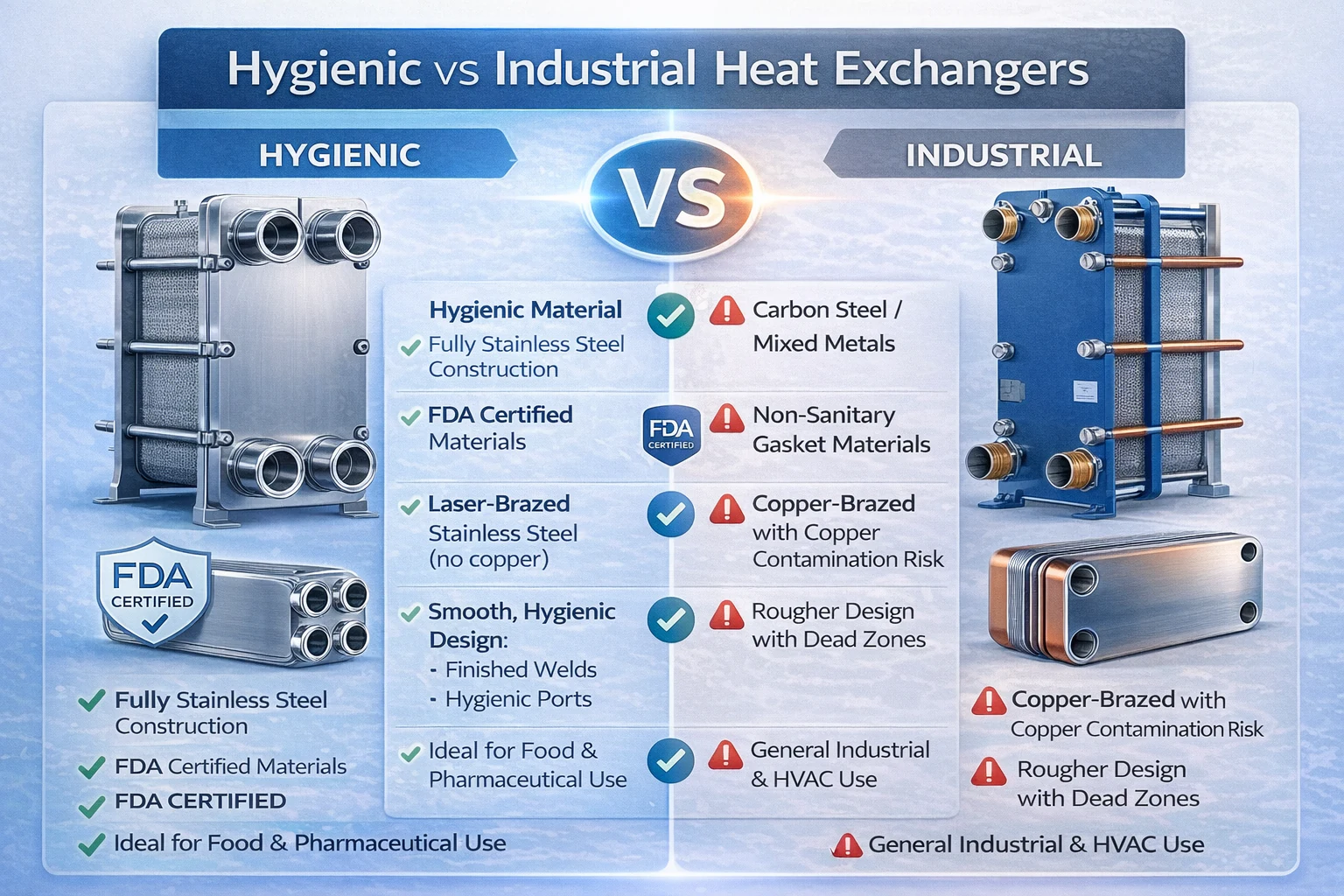
For this reason, fully stainless steel hygienic heat exchangers are the standard solution: gasketed units require stainless wetted parts with FDA-certified gaskets; brazed units should be fully stainless steel fusion-bonded designs.
1️⃣ Contamination Prevention and Product Safety
Food and pharmaceutical processes involve direct contact with consumable or injectable products. Any contamination from materials can lead to:
- Product recalls
- Regulatory violations
- Severe health risks
- Brand damage
Copper, carbon steel, or mixed-metal components may release ions or corrode under cleaning conditions. Fully stainless steel construction eliminates the risk of metallic contamination.
- AISI 316L (preferred)
- AISI 304 (non-critical zones)
Superior corrosion resistance + low carbon content helps minimize carbide precipitation and reduces sensitization risk during welding.
2️⃣ Resistance to CIP and SIP Processes
Food and pharmaceutical systems undergo regular:
- CIP (Clean-in-Place)
- SIP (Sterilize-in-Place)
These processes involve:
- High temperature
- Strong alkaline solutions
- Acid cleaning agents
- Steam sterilization
Materials must resist:
- Chemical corrosion
- Thermal cycling
- Surface degradation
Fully stainless steel heat exchangers provide stable performance under repeated cleaning and sterilization cycles.
3️⃣ Hygienic Design and Surface Requirements
Sanitary heat exchangers typically require:
- Smooth surface finish (Ra ≤ 0.8 μm typical)
- No dead zones
- No crevices
- Easy drainage
- Fully welded hygienic ports
Mixed-material brazed heat exchangers (such as copper brazed) are not suitable because:
- Copper is not accepted in pharmaceutical-grade systems
- Brazing filler metals may create contamination risk
- Internal inspection is impossible
4️⃣ Why Gasketed Units Must Use FDA-Certified Gaskets
For gasketed plate heat exchangers used in food or pharma, all gaskets must be:
- FDA compliant
- EU 1935/2004 compliant (if exporting to Europe)
- Suitable for food contact
- EPDM (FDA grade)
- NBR (food grade)
- FKM (special applications)
- Leach plasticizers
- Absorb product
- Degrade under CIP conditions
- Create microbiological risks
Therefore, all wetted components must be stainless steel + FDA-certified gasket materials.
5️⃣ Why Brazed Units Must Be Fully Stainless Steel (Fusion Bonded)
Traditional brazed plate heat exchangers use:
- Copper brazing filler
- Nickel brazing filler
These are not recommended for hygienic applications because:
- Copper can contaminate product
- Nickel alloys may not meet pharmaceutical standards
- Brazed joints cannot be inspected internally
Fully stainless steel fusion-bonded heat exchangers (laser welded or vacuum welded) eliminate filler metals and provide:
- Pure stainless steel wetted surface
- High structural integrity
- Compliance with hygienic standards
- No cross-contamination risk
6️⃣ Regulatory and Certification Requirements
Food and pharmaceutical heat exchangers must comply with:
- FDA (USA)
- 3-A Sanitary Standards
- EHEDG (Europe)
- GMP regulations
- ASME BPE (pharmaceutical piping standard)
Using non-sanitary materials can result in:
- Audit failure
- Production shutdown
- Certification loss
7️⃣ Long-Term Reliability and Cleanability
Hygienic heat exchangers must:
- Drain completely
- Avoid product entrapment
- Withstand frequent disassembly (for gasketed types)
- Maintain surface integrity after years of cleaning
Fully stainless steel construction ensures:
- No galvanic corrosion
- No material mismatch
- Stable long-term operation
Conclusion
In food and pharmaceutical industries, material selection is not only about corrosion resistance — it is about compliance, safety, and liability control.
- ✔ Gasketed heat exchangers must be fully stainless steel with FDA-certified gaskets.
- ✔ Brazed units must be fully stainless steel fusion-bonded (no copper filler).
- ✔ Surface finish and hygienic design must meet sanitary standards.
Choosing the correct hygienic heat exchanger protects product quality, regulatory compliance, and brand reputation.
Frequently Asked Questions (FAQ)
Hygienic heat exchanger material selection must prioritize stainless steel construction, FDA-certified gaskets, and fusion-bonded design to ensure compliance with food and pharmaceutical regulations.