
What is a shell and plate heat exchanger?
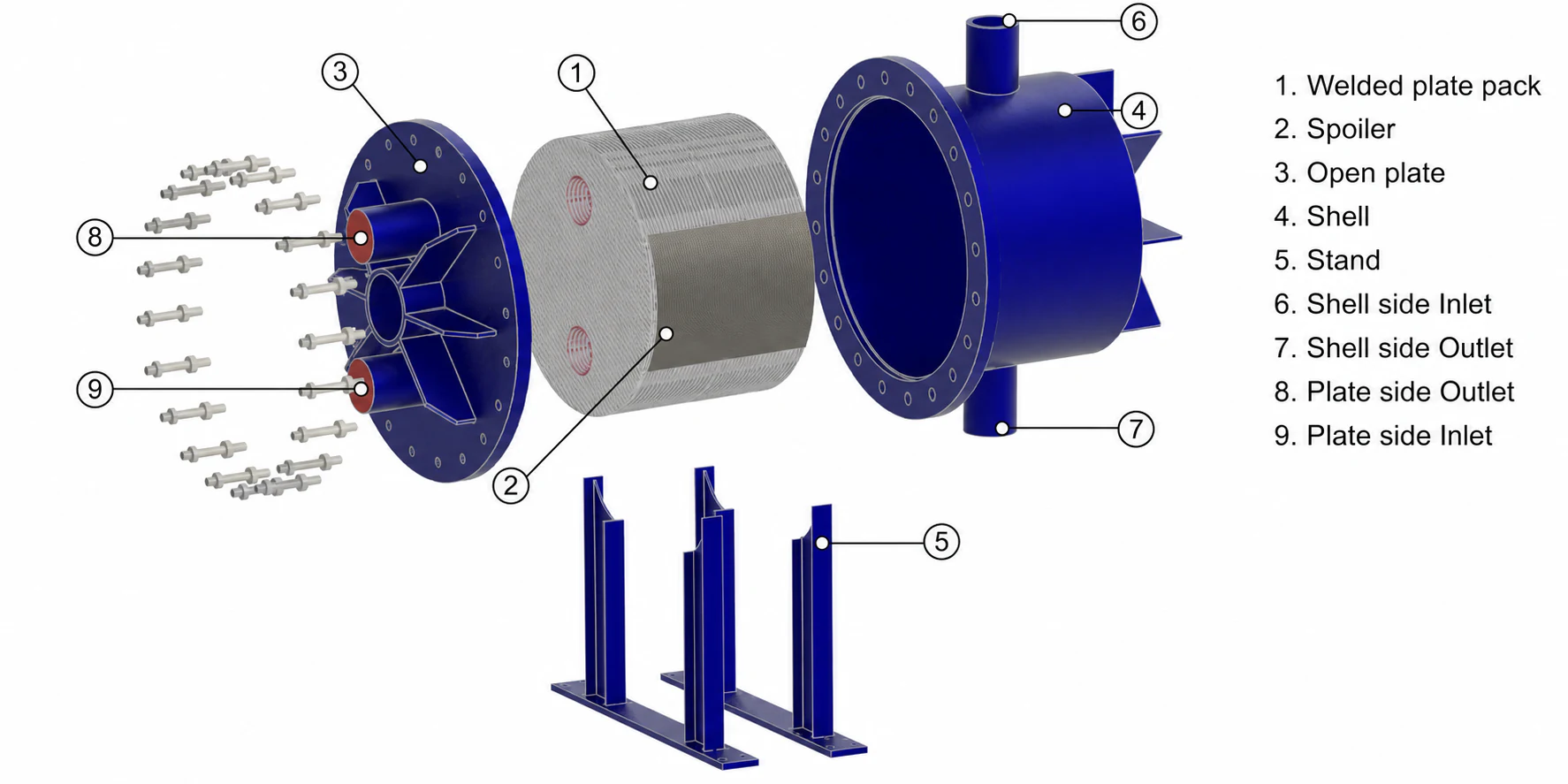
A shell and plate heat exchanger, also called a plate and shell heat exchanger, combines a welded plate pack with a pressure-containing shell. The plates provide the heat-transfer surface while the shell contains the second flow path. HEXNOVAS supplies BPS plate and shell heat exchangers selected for the specified operating duty.
How does a plate and shell heat exchanger work?
One fluid passes through the welded plate channels and the other passes through the surrounding shell-side passages. Heat crosses the plate walls while the two fluids remain separated. Plate geometry, connection positions and the internal flow arrangement determine distribution, heat transfer and pressure drop. The final flow direction and number of passes must be checked against the project drawing.
Condensation, evaporation and sensible heat transfer
Plate and shell equipment can be selected for liquid heating or cooling, heat recovery, condensation and evaporation. A liquid-to-liquid duty needs flow rates, temperatures and fluid properties on both sides. A condensing or evaporating duty also needs the operating pressure, phase condition, required outlet state and any non-condensable gas or oil content. Suitability must be confirmed for the actual media and operating range.
Welded construction and cleaning access
Welded plate channels do not use inter-plate gaskets. This does not mean every connection or cover is gasket-free. Available inspection and mechanical-cleaning access depends on the specific construction. Confirm whether the selected unit permits opening or plate-pack removal and which surfaces can be reached. Where mechanical access is limited, assess cleaning-in-place chemistry, circulation, drainage and deposit removal before choosing the exchanger.
What information is needed for sizing?
Provide fluid names and concentrations, mass or volume flow rates, inlet and target outlet temperatures, required heat duty, allowable pressure drop on each side, and operating and design pressures and temperatures. Include viscosity or solids information, fouling tendency, corrosion concerns, material requirements, connection sizes and installation space. For two-phase service, include the phase conditions and control requirements.
How to compare a proposed design
Check the thermal calculation, pressure drop, material compatibility, design limits, nozzle arrangement and maintenance access together. Maximum catalogue pressure and temperature values do not automatically apply simultaneously to every material or model. Review performance at minimum and maximum operating loads as well as the normal design point. An existing shell-and-tube duty requires a fresh thermal and mechanical review rather than a size-only substitution.
Review HEXNOVAS BPS models and request selection
Use the plate and shell heat exchanger product page to review the BPS model information and construction options. Send the operating data and any existing equipment drawing to HEXNOVAS for project selection. Final materials, pressure and temperature ratings, connections and cleaning provisions should be confirmed in the project documentation.