
Evaporator / Cooling Interface
Used where refrigerant exchanges heat with liquid loops or packaged cooling modules. Compact BPHE and selected welded solutions can be effective depending on refrigerant type and duty structure.
commercial refrigeration heat exchanger, supermarket refrigeration heat exchanger, CO2 refrigeration heat exchanger, cascade heat exchanger, plate and shell heat exchanger for refrigeration, commercial refrigeration heat recovery, supermarket heat reclaim heat exchanger, CO2 BPHE, plate heat exchanger for supermarket refrigeration, secondary loop refrigeration heat exchanger
Commercial refrigeration systems in supermarkets rely on multiple heat exchange duties across evaporating, condensing, cascade transfer, subcooling, and heat recovery sections. As the sector moves toward higher efficiency, lower emissions, and wider adoption of CO2 systems, exchanger selection becomes more critical—not only for capacity and footprint, but also for pressure resistance, long-term reliability, and energy recovery potential.
Supermarket refrigeration is not a single heat exchanger application. It is a system architecture made of several critical thermal positions.
In a typical supermarket or food retail installation, heat exchangers may appear in compact condensing units, secondary glycol loops, cascade systems, subcooling circuits, and heat recovery sections. In modern CO2 systems, heat reclaim and high-pressure duties become especially important, while cascade heat exchangers remain a key interface in some low-temperature architectures.
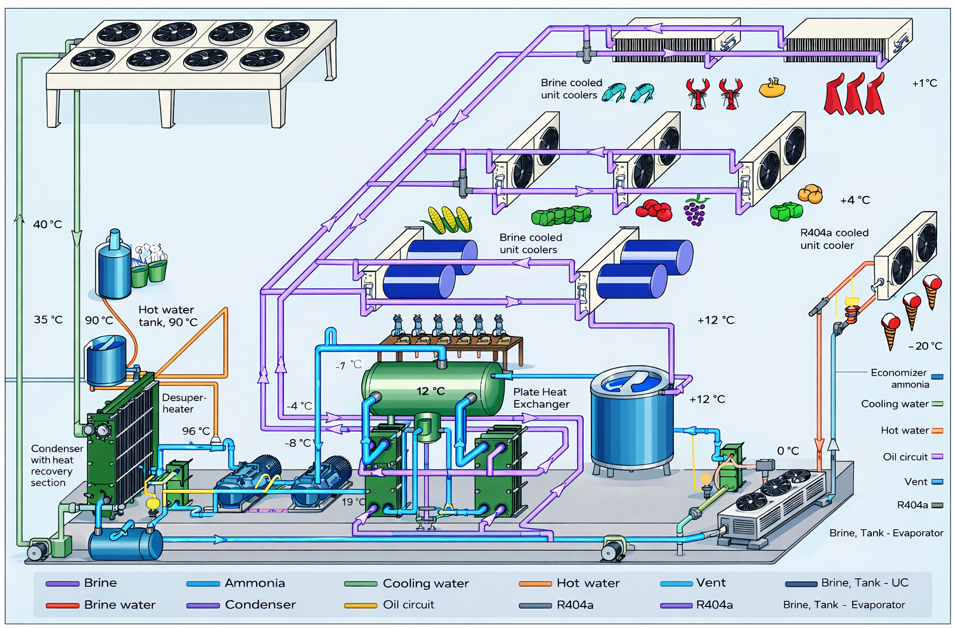
Typical supermarket refrigeration architecture: refrigeration rack, cascade or condensing duty, heat recovery section, and secondary loop interfaces.
The best exchanger is selected by position and duty, not by product category alone. Compact packaged duties may favor BPHE, large serviceable loops may favor GPHE, while critical high-pressure or high-value duties often justify Plate & Shell solutions.
Used where refrigerant exchanges heat with liquid loops or packaged cooling modules. Compact BPHE and selected welded solutions can be effective depending on refrigerant type and duty structure.
Applied where heat is rejected to water loops, utility circuits, or reclaim systems. BPHE, Plate & Shell, and in some cases shell & tube solutions are all relevant depending on pressure and scale.
One of the most important duties in multi-refrigerant low-temperature systems, where one refrigerant evaporates while another condenses across the same exchanger. This is a strong application for compact, pressure-capable plate technologies.
Supermarket refrigeration rejects a large amount of useful heat that can be recovered for space heating or hot water. In transcritical CO2 systems, reclaim exchangers may be installed before the gas cooler.
| System Position | Main Heat Exchanger Options | Typical Selection Logic | HEXNOVAS Priority |
|---|---|---|---|
| Compact refrigeration duty | BPHE / CO2 BPHE | Compact size, strong thermal performance, packaged system integration | Core product |
| Cascade heat exchanger | Plate & Shell / BPHE / Semi-Welded | Critical transfer duty with pressure and reliability requirements | Main focus |
| Secondary glycol or brine loop | GPHE / BPHE | Maintainability, serviceability, scalable capacity | Core product |
| CO2 heat recovery | Plate & Shell / CO2 BPHE / BPHE | High pressure, high efficiency, reclaim useful energy | Main focus |
| Natural refrigerant special duty | Semi-Welded / Plate & Shell | Suitable for more demanding refrigerants and critical duty points | Strategic product |
Plate & Shell should not be treated as an optional add-on in this sector. It is one of the most valuable solutions for refrigeration duties that require the efficiency of plate technology together with the strength and robustness traditionally associated with shell-type construction.
Plate & Shell is especially attractive when the duty is too demanding to be treated as a simple standard compact exchanger position, but the project still demands a more efficient and more compact alternative than older bulkier shell-type solutions.
In practical terms, this often means cascade systems, high-value CO2 duties, and heat reclaim sections in larger or more advanced supermarket refrigeration systems.
CO2 systems have become a defining trend in supermarket refrigeration, especially where operators want lower-GWP architectures and stronger sustainability positioning. This shift changes exchanger requirements. Instead of selecting only for compactness, engineers increasingly need to consider pressure level, reclaim temperature, reliability, control stability, and system integration with heating demand.
That is why a page for supermarket refrigeration should explicitly discuss CO2 BPHE and Plate & Shell, not only conventional compact exchangers.
Best positioned for compact high-pressure CO2 duties, subcooling, and smaller or modular transcritical system functions where footprint matters.
Best positioned for more critical or larger-value duties where structural strength, premium reliability, and efficient heat transfer are all required.
Heat recovery is one of the strongest commercial arguments for advanced refrigeration exchanger design. CO2 refrigeration systems can reclaim useful heat for store heating, domestic hot water, or adjacent building energy integration.
Plate & Shell is a strong premium option for larger or more critical reclaim duties, while CO2 BPHE and other BPHE formats are well suited to compact reclaim packages and transcritical supermarket systems.
Not every supermarket refrigeration system is fully direct expansion across the whole architecture. Secondary glycol, brine, or chilled liquid loops are often used to improve layout flexibility, safety, or service strategy. In those cases, exchanger selection tends to emphasize maintainability and flow-side service access as well as thermal performance.
Well suited to larger secondary loop duties where maintainability, plate service, and capacity flexibility are important.
Well suited to smaller packaged loops, compact skids, and refrigeration modules where space savings and simplified integration are priorities.
For commercial refrigeration and supermarket applications, HEXNOVAS should position its product range in a layered way rather than treating all exchanger types as interchangeable.
Main recommendation for cascade heat exchangers, critical CO2 duties, and premium heat recovery applications.
Core recommendation for compact refrigeration systems, subcooling, condensing, reclaim modules, and CO2 packaged duty.
Strong recommendation for secondary loops, glycol circuits, and larger maintainable utility-side refrigeration interfaces.
Strategic solution for more demanding refrigerants and specialized refrigeration duties where welded plate construction is beneficial.
It depends on the duty position. CO2 BPHE is often ideal for compact high-pressure duties, while Plate & Shell is a stronger premium option for critical or larger-value functions such as cascade and heat reclaim.
Because it can deliver high plate-type efficiency in a more robust shell-based construction, making it highly suitable for demanding refrigeration duty where pressure, reliability, and compactness all matter.
It is the exchanger that thermally links two refrigeration stages or refrigerants, where one side condenses while the other side evaporates. It is a critical duty point in many cascade systems.
Yes. Modern supermarket refrigeration systems, especially CO2 architectures, can reclaim heat for store heating and hot water applications.
GPHE is typically most attractive in larger secondary loops or glycol systems where serviceability and capacity flexibility are major priorities.
Whether you are designing a CO2 supermarket rack, a cascade refrigeration system, a reclaim loop, or a secondary cooling interface, HEXNOVAS can help match the right heat exchanger to each duty position.


