
Chiller vs Heat Pump: What’s the Real Difference?
At first glance, chillers and heat pumps look similar because both rely on a compressor, evaporator, condenser, and expansion valve. The real difference is not in the refrigeration cycle itself, but in how the system uses thermal energy.
In industrial and commercial thermal systems, the terms chiller and heat pump are often used side by side. Both are built around the same core refrigeration principle, yet they serve very different energy strategies. A chiller is mainly designed to remove unwanted heat from a process and reject it to the environment. A heat pump, by contrast, is designed to recover that heat and reuse it as a valuable energy source.
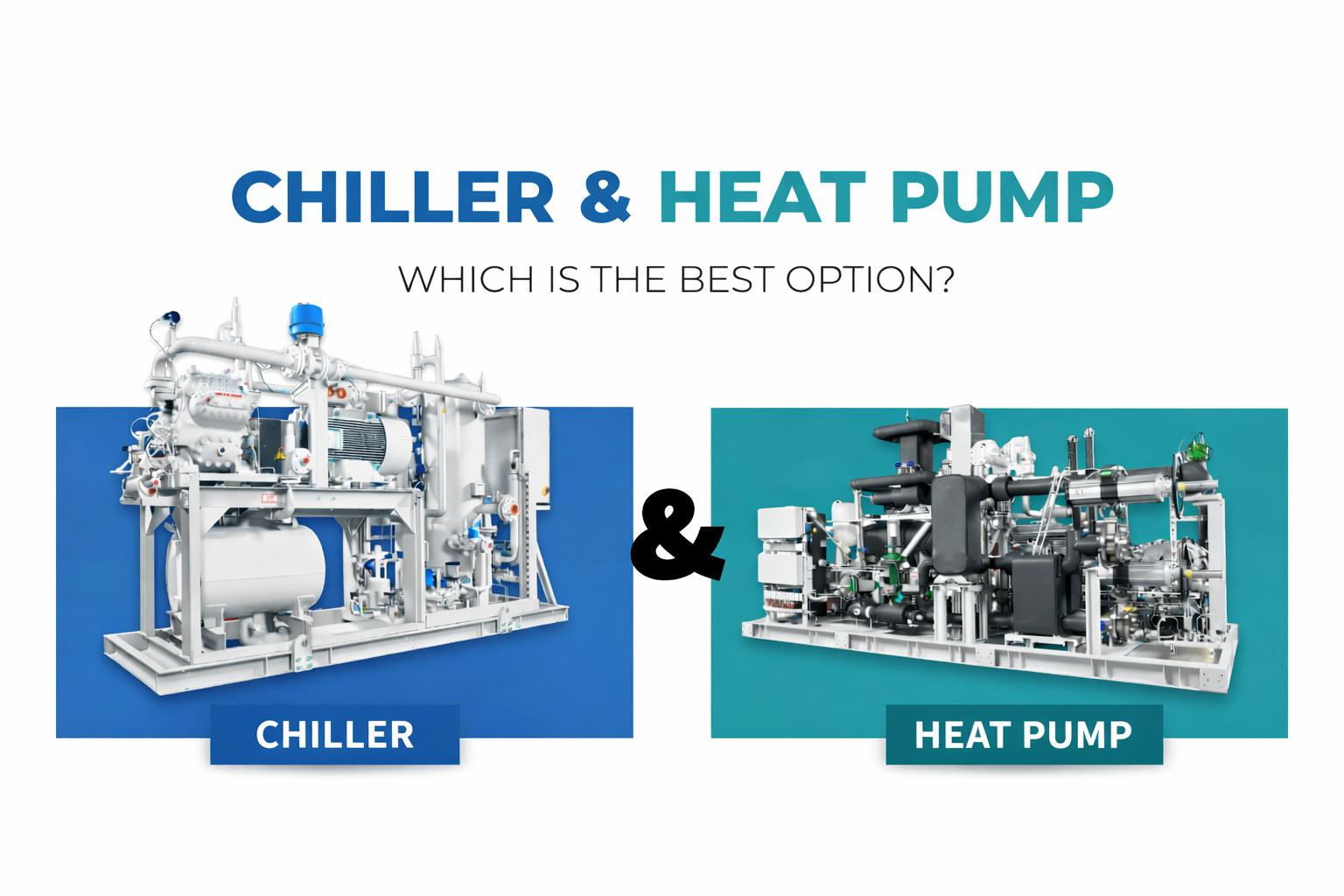
This distinction matters because it affects system efficiency, energy cost, emissions, and equipment selection. For facilities that need both cooling and heating, a heat pump can often replace a conventional chiller + boiler arrangement with one integrated solution.
They Share the Same Basic Refrigeration Cycle
From a mechanical point of view, both systems use the same four essential components:
- Compressor — raises refrigerant pressure and temperature
- Evaporator — absorbs heat from the cold side or process side
- Condenser — releases heat to another medium
- Expansion valve — reduces refrigerant pressure before the next cycle
That is why many people assume a chiller and a heat pump are basically the same machine. Technically, they are closely related. Operationally, however, their priorities are different.
Chiller Priority
Deliver stable cooling to a process, building, or production system, while rejecting the absorbed heat to air, cooling water, or a cooling tower.
Heat Pump Priority
Upgrade and recover thermal energy so the heat rejected by the refrigeration cycle becomes useful hot water, process heat, or space heating.
How a Chiller Works
A chiller is fundamentally a cooling machine. Its job is to extract heat from a colder loop and move that heat somewhere else. In most installations, the rejected heat is not treated as a valuable resource. It is simply discharged to the surrounding environment.
Typical chiller energy path
- The evaporator absorbs heat from chilled water, glycol, or a process loop.
- The compressor increases refrigerant pressure and temperature.
- The condenser rejects that heat to ambient air or cooling water.
- The expansion valve lowers refrigerant pressure and restarts the cycle.
The purpose of a chiller is therefore straightforward: maintain a reliable cold-side temperature for process control or comfort cooling.
Common chiller applications
- Industrial process cooling
- Plastic injection molding
- Food processing temperature control
- HVAC chilled water systems
- Data center cooling infrastructure
If your main requirement is cooling and there is no practical use for the rejected heat, a chiller remains a logical solution.
How a Heat Pump Works
A heat pump uses the same refrigeration cycle, but the condenser side becomes the star of the system. Instead of viewing condenser heat as waste, the heat pump captures and upgrades it for useful heating duty.
Typical heat pump energy path
- The evaporator absorbs heat from a low-temperature source.
- The compressor raises the refrigerant to a higher pressure and temperature.
- The condenser transfers useful heat to water or another heating loop.
- The expansion valve reduces refrigerant pressure for continuous circulation.
In practice, this means a heat pump can cool one part of a process while simultaneously heating another. That dual function is the reason heat pumps are often described as having “double efficiency” in applications where both cooling and heating are needed.
Common heat pump applications
- Domestic or commercial hot water generation
- Industrial process water heating
- Heat recovery from refrigeration systems
- Low-carbon heating retrofits
- Integrated cooling and heating plants
Chiller vs Heat Pump: Side-by-Side Comparison
| Item | Chiller | Heat Pump |
|---|---|---|
| Main objective | Provide cooling | Provide useful heating, often while also delivering cooling |
| Heat rejection | Usually rejected to ambient air or water | Recovered and reused as valuable heat |
| System value of condenser heat | Often treated as waste | Treated as a primary energy output |
| Typical system pairing | Often combined with a separate boiler if heating is needed | Can replace a chiller + boiler combination in suitable applications |
| Efficiency opportunity | Cooling efficiency only | Cooling + heating benefit within one cycle |
| Best fit | Processes needing only cooling | Facilities needing both heating and cooling or heat recovery |
Why Heat Pumps Can Deliver Higher Overall Efficiency
A conventional plant often uses one machine to create cooling and another to create heat. For example, the cooling load may be handled by a chiller, while hot water or process heating is produced by a gas boiler or electric heater.
A heat pump changes that logic. Because it moves heat instead of creating heat directly from combustion, it can turn low-grade thermal energy into useful heating output with much lower energy input than a conventional boiler in many scenarios.
The advantage becomes especially strong when the site simultaneously requires:
- cooling for one loop or process
- heating for another loop, tank, or water circuit
- lower CO₂ emissions
- reduced operating cost over time
The Role of Heat Exchangers in Both Systems
Whether the system is configured as a chiller or a heat pump, heat exchangers are among the most important components. They directly influence thermal efficiency, pressure drop, footprint, refrigerant charge, serviceability, and long-term reliability.
In many modern systems, brazed plate heat exchangers are selected for compact chillers and compact heat pumps because they provide high heat transfer performance in a very small footprint. For larger industrial duties, gasket plate heat exchangers and shell and plate heat exchangers can offer strong performance with better flexibility for cleaning, maintenance, or demanding operating conditions.
Why plate heat exchangers matter
- High heat transfer coefficient
- Compact equipment footprint
- Fast thermal response
- Potential reduction in refrigerant charge
- Improved system efficiency in optimized designs
This is why thermal equipment selection should never stop at “chiller or heat pump.” The exchanger technology behind the evaporator and condenser also has a major impact on system performance.
When to Choose a Chiller
A chiller is usually the right choice when the application is centered on cooling only, or when the rejected heat has little or no economic value.
- The process only needs stable cold-side temperature control
- There is no nearby heating demand to absorb recovered heat
- The project prioritizes cooling simplicity
- Site layout makes heat recovery impractical
In these cases, the design goal is usually to maximize reliable cooling performance, often within a broader HVAC or refrigeration system.
When to Choose a Heat Pump
A heat pump becomes highly attractive when the plant has both a cooling demand and a useful heating demand. Instead of rejecting condenser heat to the atmosphere, the system can send that energy to hot water storage, process heating loops, or building heating circuits.
- The facility needs both cooling and heating
- Waste heat recovery can reduce boiler load
- Energy efficiency and decarbonization are key targets
- Process integration makes heat reuse feasible
- The plant is rethinking long-term thermal strategy
This is increasingly relevant in industrial manufacturing, food processing, commercial buildings, and advanced refrigeration projects.
Industrial Trend: From Heat Rejection to Heat Recovery
The broader market trend is clear: many facilities no longer want to waste recoverable heat. Rising energy prices, carbon reduction goals, and more sophisticated thermal integration are pushing projects away from simple heat rejection and toward heat recovery.
Instead of dumping condenser heat outdoors, plants increasingly reuse it for:
- process water preheating
- hot water production
- washing and cleaning systems
- space heating support
- integrated process energy optimization
For that reason, the discussion is no longer just “Which machine is better?” The real engineering question is: Should the heat be rejected, or should it be recovered and reused?
Conclusion
Chillers and heat pumps may look similar because they share the same refrigeration architecture, but they are designed around different energy philosophies. A chiller focuses on cooling and rejects heat. A heat pump focuses on energy recovery and turns that heat into value.
If your application only needs cooling, a chiller may be the right answer. If your facility needs both cooling and heating, a heat pump can often provide a more efficient and lower-carbon alternative to a separate chiller and boiler arrangement.
In both cases, selecting the right heat exchanger technology is essential for system performance, service life, and overall efficiency.


