Brazed plate heat exchangers (BPHE) rely on a filler metal to permanently bond stainless-steel plates together under vacuum or controlled atmosphere. The choice of brazing material determines the exchanger’s temperature resistance, corrosion behavior, and application suitability.
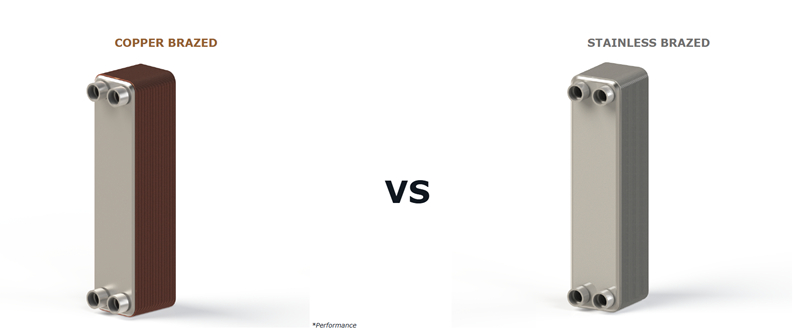
| Aspect | Copper Brazing | Stainless-Steel (Nickel) Brazing |
|---|---|---|
| Typical filler | Pure copper or Cu-based alloy | Nickel-based or iron-nickel alloy |
| Brazing temperature | ~1080°C | 1100–1200°C |
| Base material | AISI 304/316L | AISI 316L, duplex, or high-alloy steels |
| Corrosion resistance | Good for neutral/non-aggressive media | Excellent for corrosive or chloride-rich fluids |
| Mechanical strength | Moderate; limited in higher-temperature duty | Higher; stable in higher-temperature duty |
| Thermal conductivity | Very high (Cu ≈ 390 W/m·K) | Lower (Ni ≈ 90 W/m·K) but reliable at higher temperature |
| Cost | Economical | Higher due to alloy + process complexity |
| Copper-Brazed Units | Nickel-Brazed Units |
|---|---|
| Heat pumps & chillers | Ammonia evaporators & condensers |
| Domestic water heating | Seawater coolers & brine systems |
| Oil coolers & compressor intercoolers | Chemical & food process equipment |
| Refrigeration systems (R410A, R134a) | HFO refrigeration systems |
Copper and stainless-steel (nickel) brazing each solve different engineering problems. Copper brazing is efficient and economical for standard HVAC duty, while nickel/stainless brazing improves reliability under aggressive chemistry and higher temperature. The best choice is the one that matches your real medium, operating envelope, and lifecycle cost target.
No. Copper may react with ammonia and can degrade over time. For ammonia systems, nickel-brazed heat exchangers are typically recommended.
Yes, especially at higher temperatures. Nickel-based brazing alloys maintain mechanical stability better under elevated temperature conditions.
Copper has higher thermal conductivity (≈390 W/m·K) than nickel alloys (≈90 W/m·K). However, overall performance also depends on plate design and flow conditions—not only filler material.
Nickel-brazed heat exchangers are generally preferred because chlorides can accelerate corrosion risk for copper-brazed units in marine service.
Yes. Nickel alloy filler materials and higher process complexity increase cost. In corrosive or high-risk services, longer service life often justifies the investment.
Pressure capability depends on plate thickness and construction, not only brazing material. Always confirm the rating for the exact model and conditions.
Not exactly. Nickel-brazed BPHE uses stainless-steel plates bonded by a nickel-based alloy. Diffusion-bonded or fusion-bonded exchangers are different technologies.