Design, Advantages and Applications in High-Fouling Industries.
Free Flow Plate Heat Exchangers are engineered for high-viscosity fluids, fiber-containing media, and fouling-prone process streams.
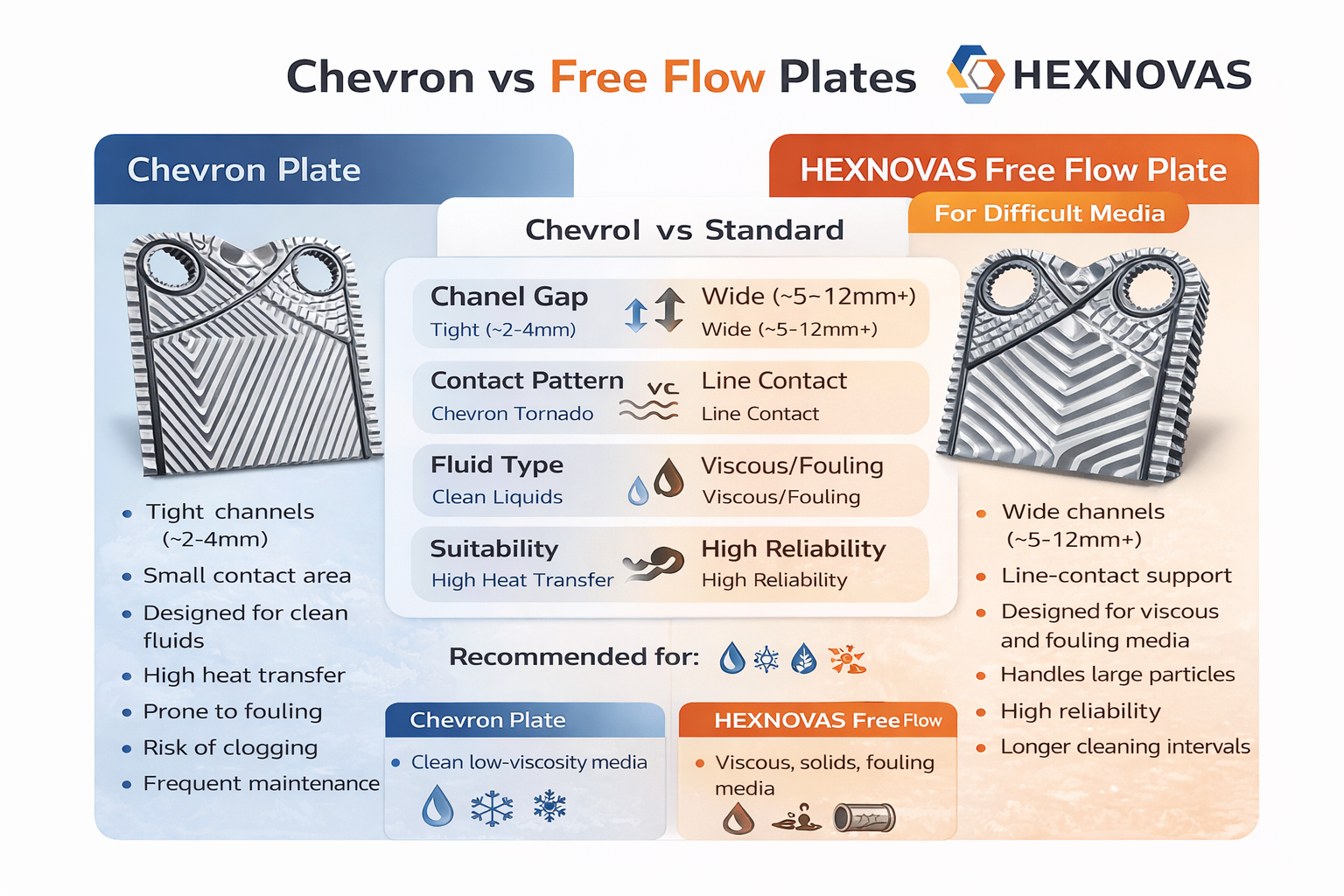
Compared with conventional chevron (herringbone) plates, Free Flow plates provide wide and open channels to reduce clogging risk while maintaining reliable heat transfer.
What Is a Free Flow Plate Heat Exchanger?
A Free Flow Plate Heat Exchanger is typically a gasketed plate heat exchanger
or a semi-welded plate heat exchanger using a special plate geometry that:
Creates wide flow channels (wide gap / wide channel designs)
compatible with common wide-gap references such as ALFA LAVAL
MA30S, MA30W, T20S, T35S, Wide Gap 100S / 200S / 300S
Best fit: sludge, wastewater, pulp & paper stock, fruit pulp, syrup, digestate, and other high-fouling media.
Typical Applications
Free Flow Plate Heat Exchangers are widely used in:
Edible oil cooling and heating
Pulp & paper industry (stock / fiber)
Wastewater treatment and sludge heating
Sugar processing (syrup / molasses)
Biogas systems (digestate)
Marine oil systems (viscous fluids)
Design Parameters to Consider
When selecting a Free Flow heat exchanger, engineers should evaluate:
Fluid viscosity at operating temperature
Solid particle size and concentration
Fouling tendency
Acceptable pressure drop
Cleaning method (CIP or mechanical opening)
Note: incorrect material selection or underestimating fouling characteristics may lead to premature corrosion or pitting.
Why Free Flow Plate Heat Exchangers Matter
In high-fouling environments, the wrong plate pattern can dramatically shorten equipment lifetime. A Free Flow (wide gap) plate design helps maintain stable thermal performance, reduce downtime, and optimize lifecycle cost.
Free Flow Plate Heat Exchanger FAQ
What kind of fluids can Free Flow heat exchangers handle?
Free Flow PHEs are suitable for dirty or particle-containing fluids, such as fruit pulp and juice with fibers, sugar syrup and molasses, wastewater and sludge, pulp and paper stock, biogas digestate, slurry with soft solids, and other high-viscosity liquids.
What is the difference between Free Flow and standard plate heat exchangers?
Feature
Free Flow PHE (Wide Gap)
Standard PHE
Channel gap
Wide
Narrow
Solid handling
Excellent
Limited
Fouling resistance
High
Moderate
Heat transfer coefficient
Slightly lower
Higher
Pressure drop
Lower
Higher
Application
Dirty / viscous fluids
Clean fluids
Free Flow prioritizes anti-clogging performance, while standard PHE maximizes compact heat transfer.
What particle size can a Free Flow plate heat exchanger handle?
Channel gap determines allowable particle size. Typical guidance: 5 mm gap → particles up to ~3–4 mm; 8 mm gap → up to ~6 mm; 10–12 mm gap → soft solids and fibrous materials. Hard or abrasive particles require reinforcement and wear evaluation.
What is the maximum solids content allowed?
Typical handling: 2–5% suspended solids for standard cases; up to ~8–10% soft organic solids depending on viscosity and fiber behavior. Mineral solids or sand significantly increase wear and must be evaluated carefully.
How does viscosity affect Free Flow heat exchanger selection?
Higher viscosity fluids require larger channel gaps, reduced flow velocity, increased heat transfer area, and optimized port diameter. For fluids above ~500 cP, calculations must account for reduced turbulence and heat transfer coefficient.
Does Free Flow mean lower efficiency?
Compared to narrow-gap high-chevron plates, heat transfer coefficient may be slightly lower, but pressure drop is reduced and fouling resistance is significantly improved. In real dirty-service operation, overall long-term performance is often superior.
What materials are available for Free Flow plates?
Common materials include 304 stainless steel, 316L stainless steel, titanium, SMO 254, and Hastelloy. Selection depends on chloride concentration, pH, temperature, and corrosion risk.
What are the typical pressure and temperature limits?
For gasketed Free Flow PHE, typical design pressure is 10–16 bar and maximum temperature up to ~180°C (depending on gasket). Higher pressure designs require reinforced frames and should be confirmed by model specification.
How is cleaning performed?
Cleaning methods include CIP (clean-in-place), manual opening with high-pressure washing, and chemical cleaning. Pressure drop monitoring is a primary indicator for when cleaning is needed.
When should I choose Free Flow instead of Shell & Tube?
Aspect
Free Flow
Shell & Tube
Footprint
Compact
Larger
Maintenance
Easy opening
Tube cleaning required
Heat transfer coefficient
Higher (typical)
Lower
Fouling tolerance
Moderate–High
Very High
Best for
Fibrous / soft solids
Heavy solids / high pressure
What industries commonly use Free Flow PHE?
Common industries include food & beverage, sugar, pulp & paper, wastewater treatment, biogas processing, and chemical processing where fouling or fibers are present.
Can Free Flow heat exchangers be customized?
Yes. Options may include mixed plate packs (Free Flow + standard plates), reinforced frame, special port sizes, double gasket systems, and hybrid configurations to improve application flexibility.