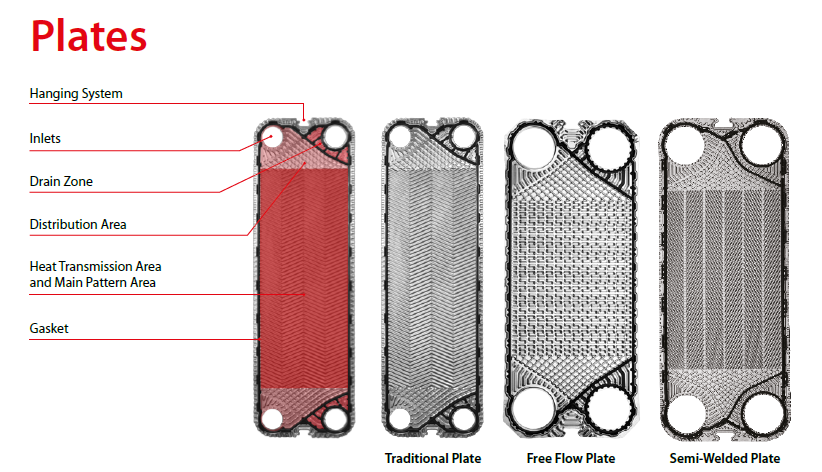
In a Gasketed Plate Heat Exchanger (GPHE), the gasket is a critical component that determines sealing performance, chemical resistance, temperature capability, and overall service life.
The primary functions of gaskets include:
Sealing the flow channels to prevent mixing of fluids
Preventing external leakage
Guiding the fluid flow path
Accommodating thermal expansion and pressure variation
Improper gasket selection may result in:
Premature aging
Leakage
Swelling or hardening
Chemical degradation
Significantly reduced service life
Therefore, gasket selection must always be based on operating conditions rather than cost considerations.
Different elastomer materials have significantly different temperature limits.
| Material | Continuous Temperature | Peak Temperature | Characteristics |
|---|---|---|---|
| NBR (Nitrile Rubber) | -10 to 110°C | 130°C | Excellent for oil service |
| EPDM (Ethylene Propylene) | -25 to 150°C | 170°C | Water, steam, chemicals |
| FKM / Viton | -5 to 180°C | 200°C | High temperature and aggressive media |
| HNBR | -20 to 140°C | 160°C | Enhanced oil and heat resistance |
| Silicone | -50 to 180°C | 200°C | Food and pharmaceutical applications |
Temperature >120°C → NBR is typically not suitable
Steam service → EPDM is preferred
High-temperature chemical service → FKM recommended
The gasket must be chemically compatible with the process fluid.
✅ EPDM (preferred)
✅ NBR
❌ EPDM (may swell)
Weak acids/alkalis → EPDM
Strong corrosive media → FKM
HFC refrigerants → NBR or FKM
Organic solvents → FKM
FDA-grade EPDM
Silicone
Always evaluate chemical compatibility first, then temperature limits.
Gaskets must withstand:
Plate compression forces
System pressure
Thermal cycling fatigue
Typical recommendations:
| Operating Condition | Recommendation |
|---|---|
| ≤16 bar | Standard gasket |
| 16–25 bar | Reinforced gasket |
| Frequent thermal cycling | High elasticity materials |
For high-pressure systems, preferred materials include:
HNBR
FKM
High-hardness EPDM
Compression set determines long-term sealing capability.
A good gasket should:
Maintain elasticity
Resist permanent deformation
Provide stable sealing performance over time
Typical performance ranking:
FKM > EPDM > HNBR > NBR
Many industrial systems use:
Caustic soda (NaOH)
Acid cleaning solutions
High-temperature sterilization
It is essential to verify gasket compatibility with cleaning chemicals.
Otherwise, gasket failure may occur within a short period.
Suitable for:
HVAC systems
District heating
Hot water service
Steam applications
Food processing
Chemical water solutions
Advantages:
Excellent temperature resistance
Good aging resistance
Low cost
Long service life
Limitations:
Not suitable for oils or fuels
Suitable for:
Lubricating oil cooling
Hydraulic oil systems
Fuel applications
Advantages:
Excellent oil resistance
Economical
Limitations:
Limited temperature capability
Poor steam resistance
Suitable for:
High temperature (>150°C)
Strong chemical media
Organic solvents
Advantages:
Exceptional temperature resistance
Superior chemical resistance
Limitations:
High cost (typically 3–5 times EPDM)
Characteristics:
Non-toxic
Wide temperature range
High hygiene standard
Besides material selection, gasket fixing method also affects performance and maintenance.
Advantages:
Quick replacement
No adhesive contamination
Easy maintenance
Industry standard solution
Typical applications:
HVAC
General industrial service
Advantages:
Lower initial cost
Disadvantages:
Difficult replacement
Time-consuming cleaning
Higher maintenance effort
The most critical factors affecting gasket life are:
Frequent temperature cycling
Incorrect cleaning chemicals
UV exposure
Excessive compression
Oil contamination (especially harmful to EPDM)
Typical service life:
| Operating Environment | Typical Lifetime |
|---|---|
| HVAC systems | 5–10 years |
| Chemical industry | 2–5 years |
| High-temperature steam | 1–3 years |
Typical industrial selection workflow:
1. Identify process media2. Confirm operating temperature3. Determine system pressure4. Evaluate cleaning conditions5. Check food or sanitary requirements6. Select appropriate gasket material
For most applications:
Water or steam → EPDM
Oil service → NBR
High-temperature chemicals → FKM
Food or pharmaceutical → Silicone
This covers approximately 90% of industrial cases.
For industrial projects, it is recommended to:
Always verify chemical compatibility
Avoid using “universal” gasket materials
Maintain at least a 20°C safety margin for temperature limits
Prioritize EPDM or FKM for CIP systems
Prefer clip-on gasket designs for easier maintenance
Read More: