
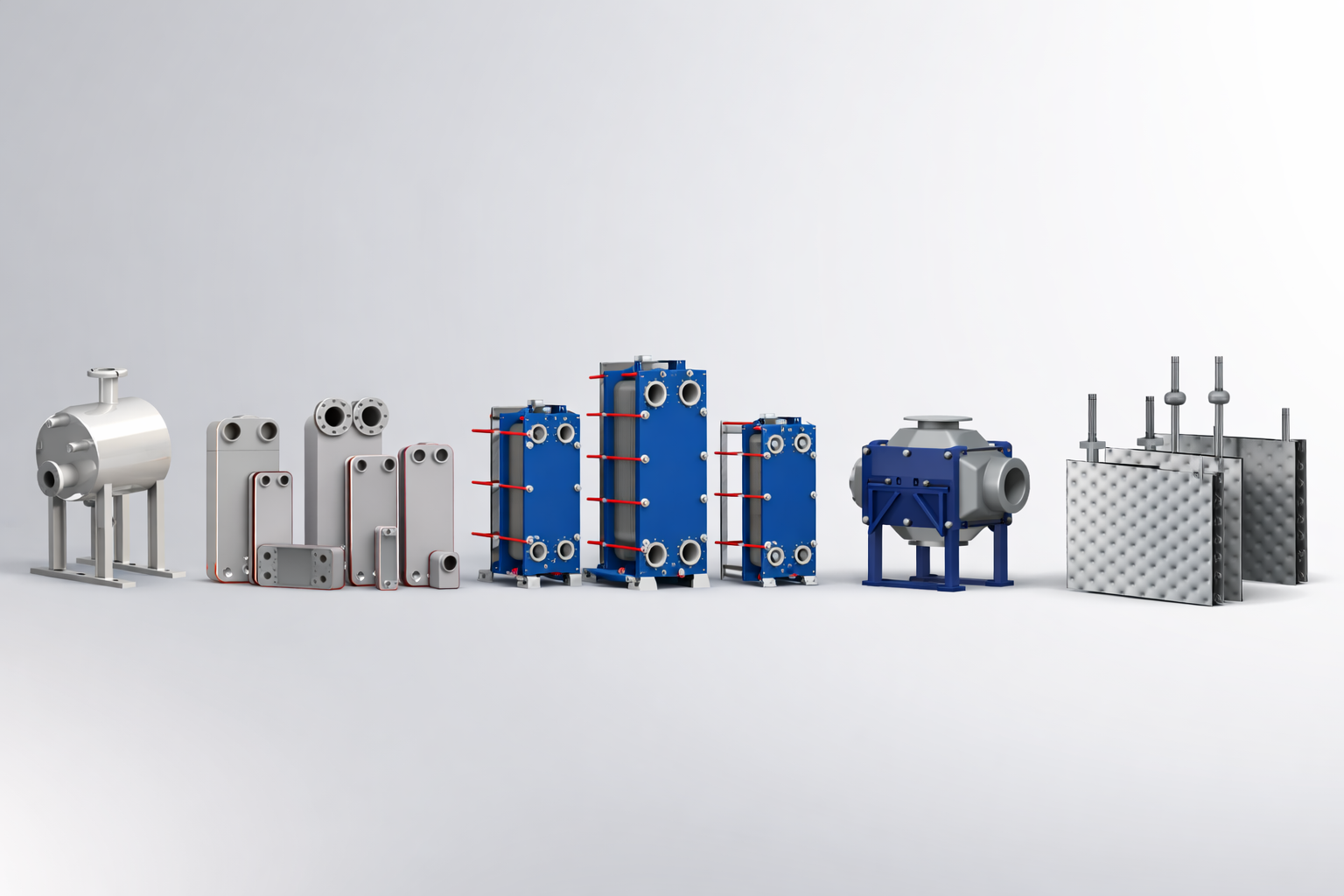
1) Brazed Plate Heat Exchanger (BPHE)
Compact High efficiency Sealed
- Design highlights: stainless plates brazed with copper or nickel; compact; low hold-up volume.
- Typical applications: heat pumps, chillers, DHW, CO₂/R410A/R32 refrigeration, oil cooler loops.
Explore BPHE: Copper Brazed PHE / Stainless Brazed PHE.
2) Gasketed Plate Heat Exchanger (GPHE)
Serviceable Expandable ΔT 1–3K
- Design highlights: replaceable gaskets; easy inspection; capacity adjustable by adding/removing plates.
- Typical applications: district heating/cooling, food & beverage, pharma, heat recovery, cooling water.
Learn more: GPHE Overview.
3) Semi-Welded Plate Heat Exchanger
Aggressive media Lower leak points Maintainable
- Design highlights: welded cassettes + gasketed side; ideal where one side must be leak-tight (e.g., ammonia).
- Typical applications: R717 ammonia condensers/evaporators, brine/glycol loops, chemical process cooling.
Product page: Semi-welded PHE
4) Shell & Plate Heat Exchanger (Fully Welded Plate Core)
High pressure High temperature Two-phase friendly
A shell & plate heat exchanger combines a fully welded plate pack with a pressure shell—delivering plate-style heat transfer with shell-side mechanical robustness.
- Typical applications: oil & gas, marine cooling, steam condenser duties, high-temperature process loops.
Product page: Shell & Plate Heat Exchanger
5) Pillow / Dimple Plate Heat Exchanger
Large area Low ΔP Custom geometry
- Design highlights: laser-welded inflated plates; flexible shapes; good for fouling-prone fluids with low pressure drop needs.
Product page: Pillow Plates
Key Selection Factors (Practical)
Pressure & Temperature Choose fully welded structures (Shell & Plate / Shell & Tube) when pressure/temperature is the primary constraint.
Fouling & Media Cleanliness Dirty streams favor wider channels (Spiral / Shell & Tube / Pillow Plate); narrow channels require filtration and CIP.
Maintenance Access GPHE is best for frequent open/inspect; Shell & Plate is for high-demand duties where leak tightness matters more.
Footprint & Integration BPHE offers maximum compactness for packaged systems (heat pumps/chillers), while GPHE fits plants requiring scalability.
FAQ
What is the main benefit of a Shell & Plate heat exchanger?
Plate-level efficiency with a pressure shell—well-suited to high-pressure/high-temperature and two-phase duties.
When should I choose GPHE instead of BPHE?
Choose GPHE when you need routine opening/inspection, capacity expansion, or handling variable operating conditions.
Can Shell & Plate replace a traditional Shell & Tube?
Often yes—especially when you need compactness and high efficiency at the same duty. Final selection depends on fouling, allowable ΔP, and materials.


