
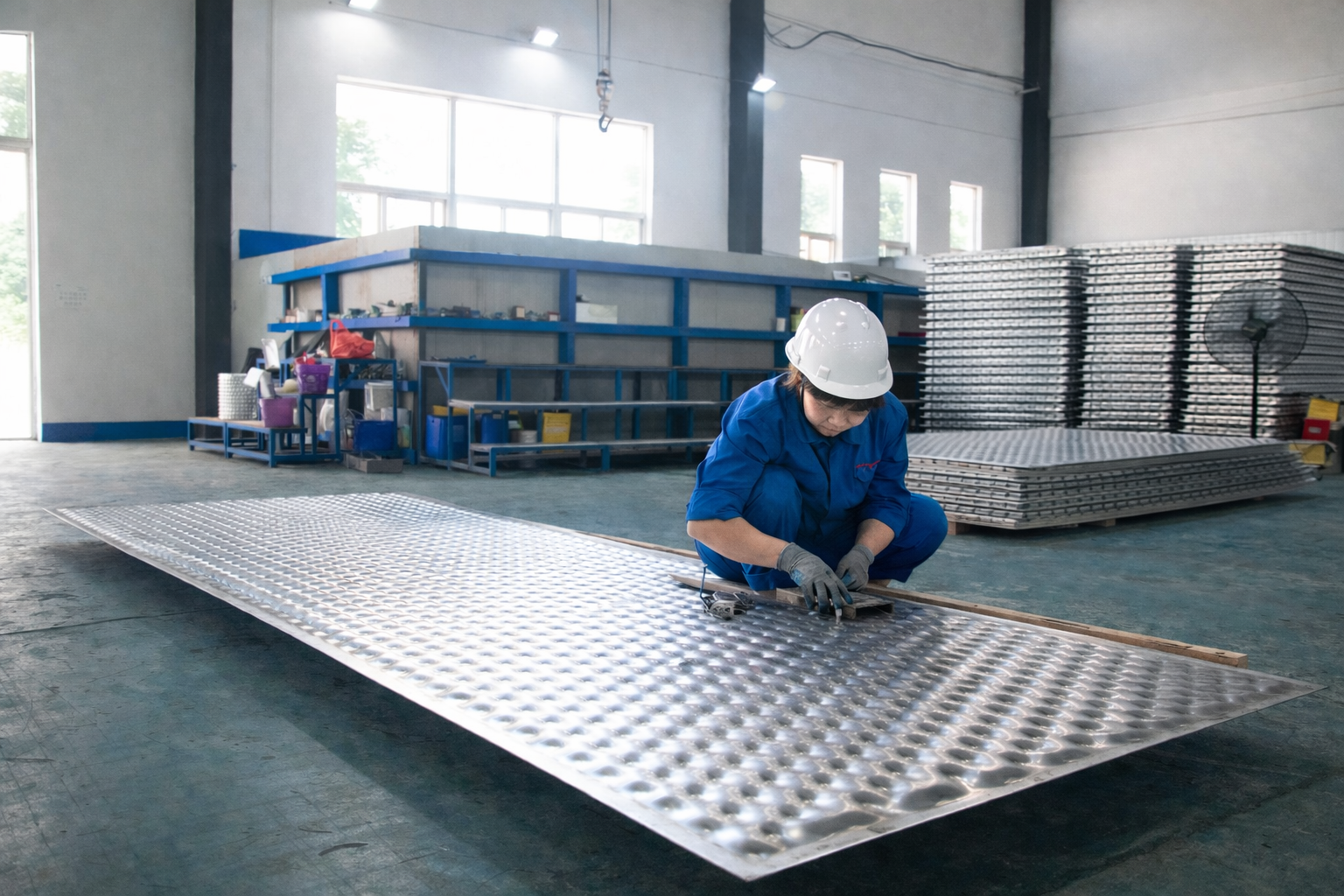
1) Manufacturing Workflow
A standard pillow plate is built from two metal sheets that are welded together in a defined pattern. The sealed “blank” is then inflated to create internal flow channels. Final steps include trimming, port fabrication, pressure testing, and surface finishing.
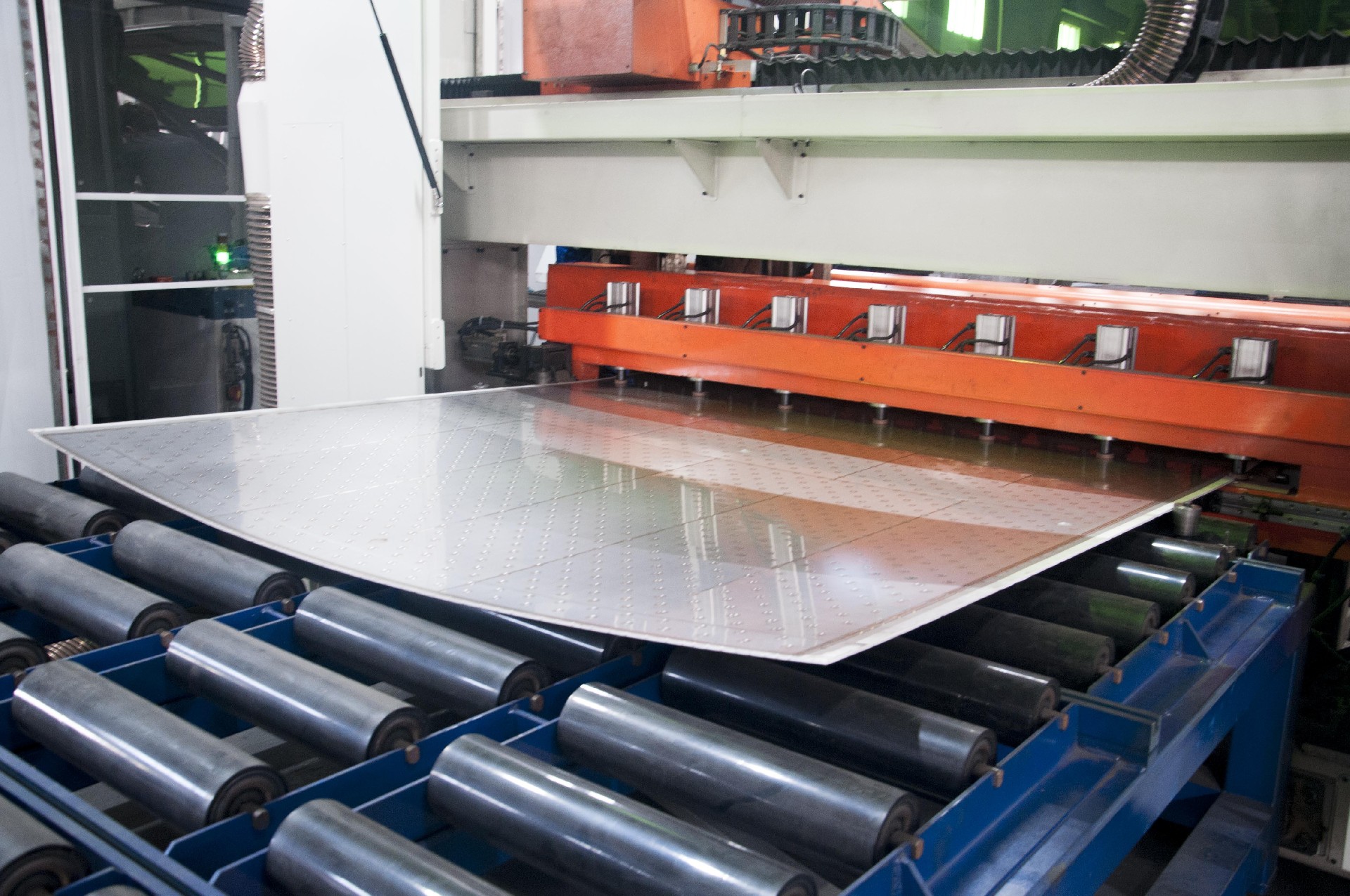 Production line: sheet processing and welding stage before inflation forming.
2) Welding Pattern & Channel Design
The welding pattern is not decorative—it directly determines heat transfer, pressure drop, channel velocity distribution, and mechanical strength. Typical design variables include weld pitch, spot/line density, channel height, and port layout.
- Higher turbulence: improved heat transfer, potentially higher pressure drop.
- Lower pressure drop designs: larger channel spacing, optimized flow routing, reduced velocity peaks.
- Mechanical stiffness: pattern density and inflation height influence panel rigidity and vibration behavior.
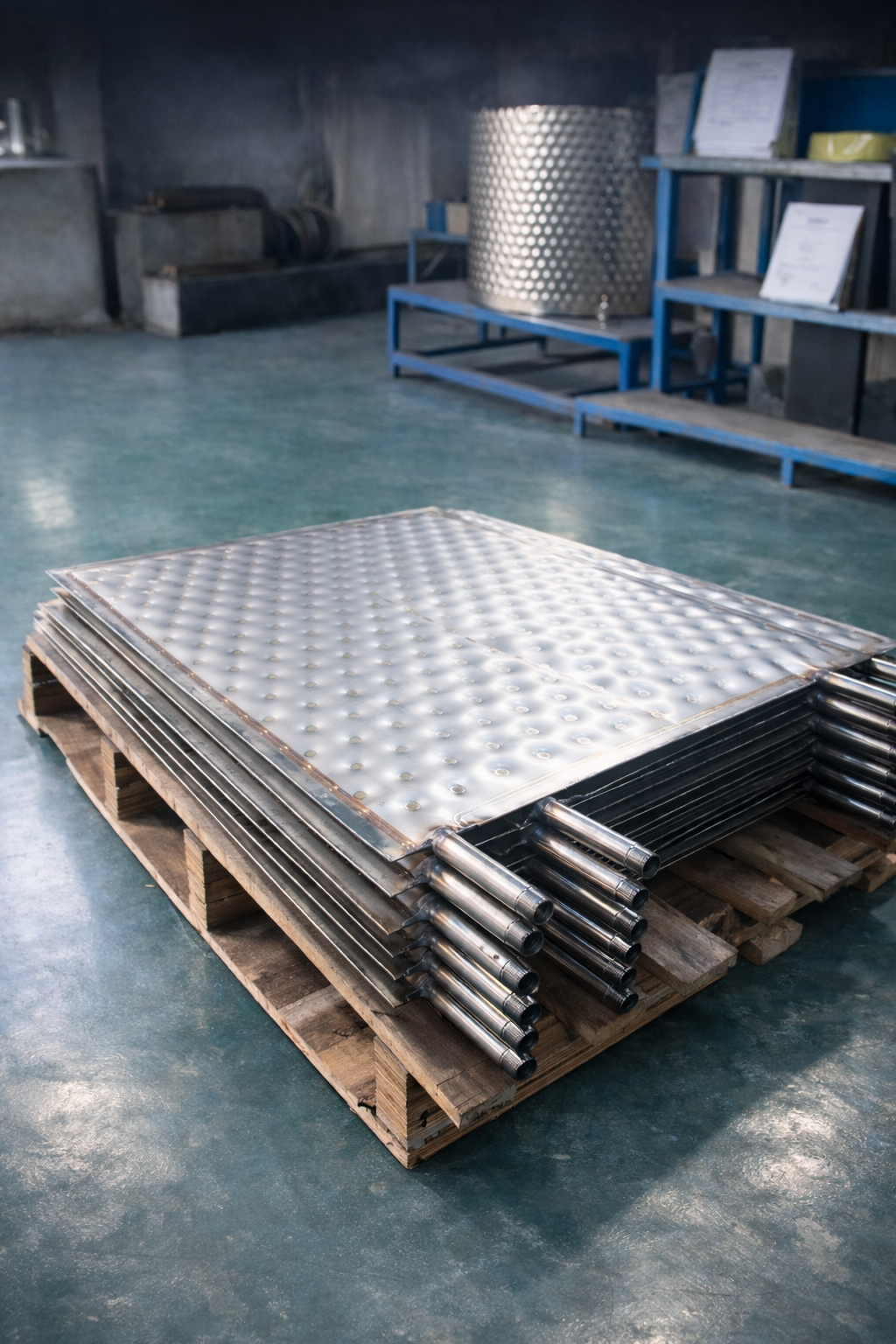 Workshop staging: panels queued for inspection, port fabrication, and final assembly.
3) Materials & Typical Specifications
Material selection depends on fluid chemistry, chloride level, temperature, and cleaning method (CIP / mechanical). Common materials include:
- 316L / 304 stainless: water, HVAC, general industrial service.
- 2205 duplex / 904L / 254SMO: higher chloride environments and aggressive water quality.
- Titanium: seawater, high-chloride brines, corrosion-critical duties.
4) Quality Control Checkpoints
- Weld continuity: visual + process monitoring to ensure sealed channel boundaries.
- Inflation consistency: channel height control for stable thermal performance.
- Pressure / leak testing: verify integrity before shipping or assembly.
- Surface quality: remove sharp edges, ensure cleanliness for sanitary or food duties when required.
5) Common Applications
- Tank heating / cooling jackets: large surface area with uniform heat flux.
- Falling film chillers / evaporators: wide-area distribution and controlled wetting.
- Immersion cooling tanks: welded panels integrated into tank walls or internal cooling panels.
- Heat recovery skids: large panels for warm water recovery and energy reuse.
FAQ
What is the difference between pillow plate and dimple plate?
“Pillow plate” often refers to a fully inflated, welded double-sheet panel. “Dimple plate” is sometimes used as a general term for similar welded embossed/inflated plates. In practice, people use the terms interchangeably—specifications should define material, thickness, pattern, channel height, ports, and test requirements.
How do I specify a pillow plate for quotation?
Provide: medium on both sides, temperatures (in/out), duty or heat flux, allowable pressure drop, design pressure, material requirements, dimensions (L×W), port size/location, and cleaning method (CIP / mechanical). If used as a jacket, include tank diameter/geometry.
Can pillow plates handle fouling fluids?
Yes—pillow plates are commonly selected when low pressure drop and wider flow channels are needed. Fouling tolerance depends on pattern, channel height, velocity, and cleaning strategy.
Are pillow plates suitable for high-pressure duties?
Many are fully welded and can be designed for elevated pressure, but final rating depends on plate thickness, welding pattern density, inflation height, and code requirements. Share your design pressure and test pressure for verification.


