
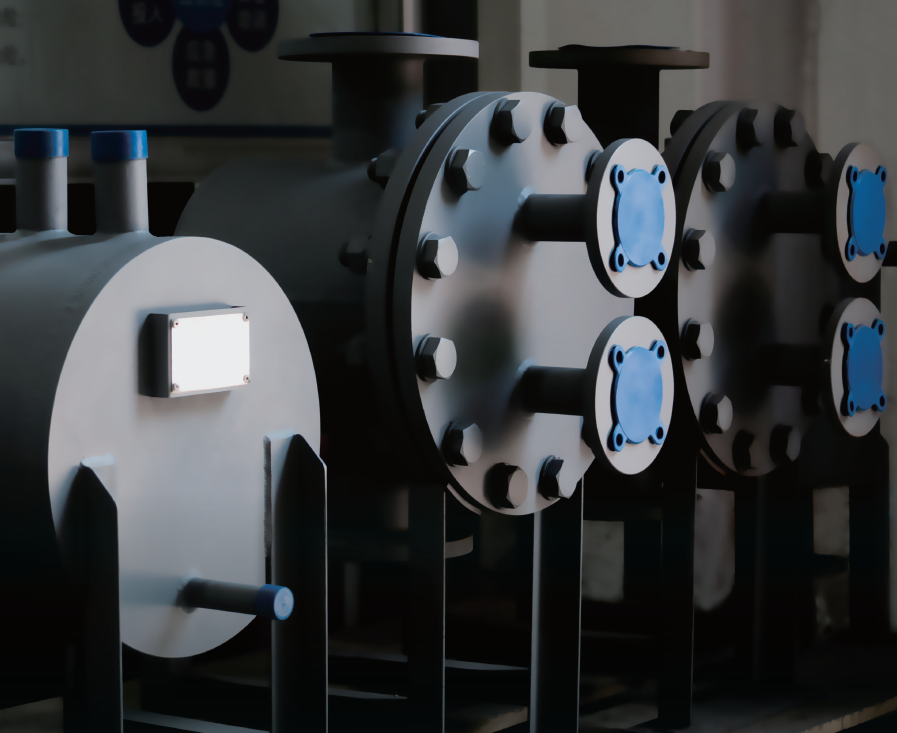
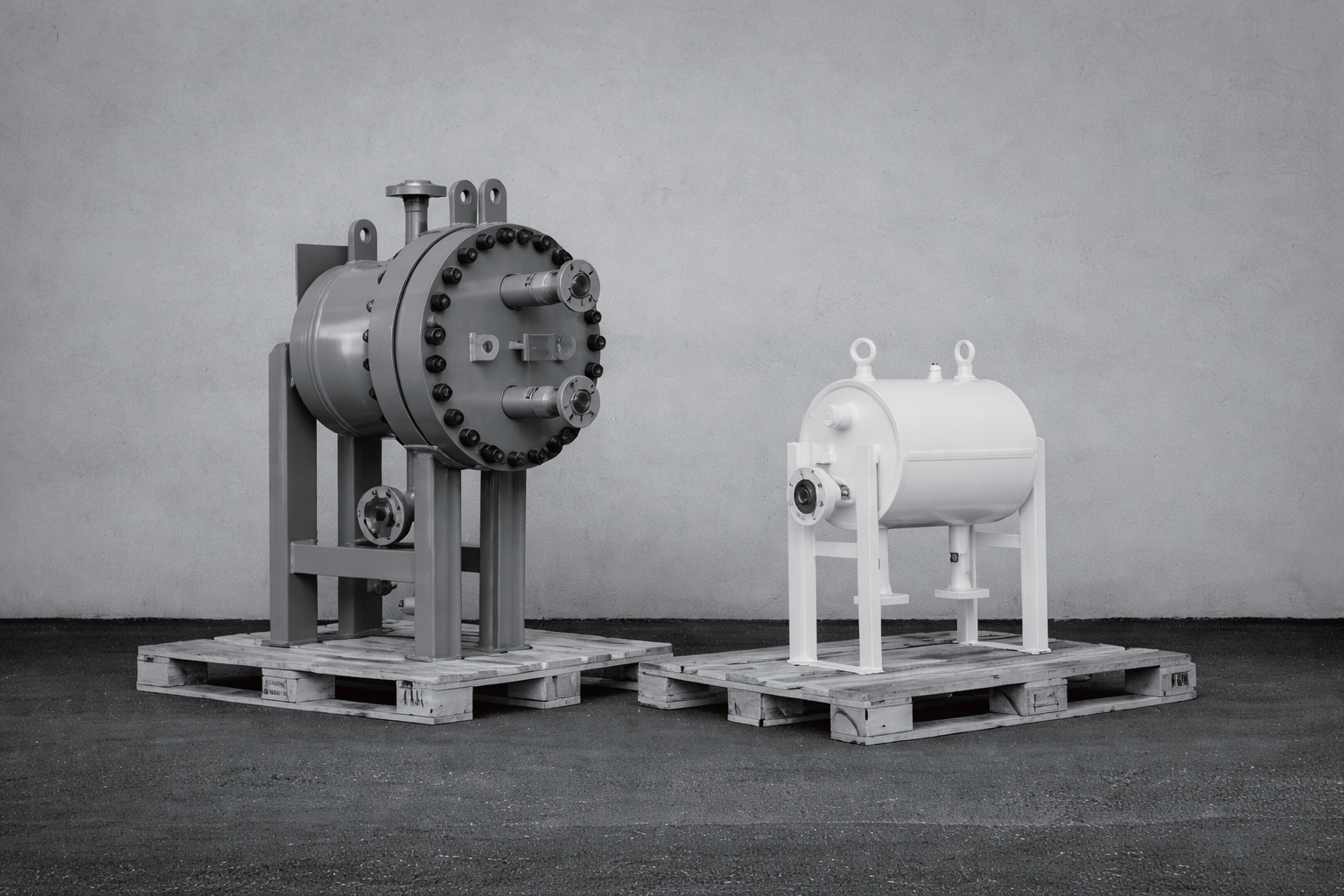
A shell and plate heat exchanger (also called plate and shell heat exchanger) houses a fully welded plate pack inside a shell pressure boundary. Compared with gasketed plate heat exchangers (GPHE), it minimizes external leak points. Compared with shell-and-tube heat exchangers, it can deliver higher heat transfer coefficients in a smaller footprint for many duties.
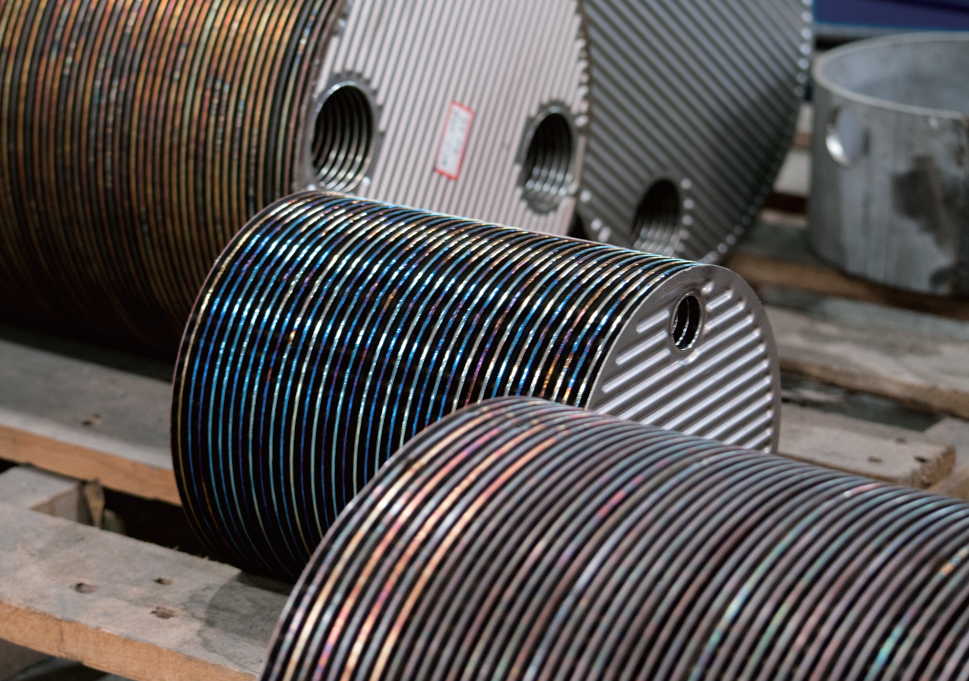
SPHE works by driving one fluid through corrugated plate channels while the other fluid flows in an adjacent passage (design dependent). The corrugations generate turbulence that improves heat transfer and helps reduce fouling under proper velocity conditions.
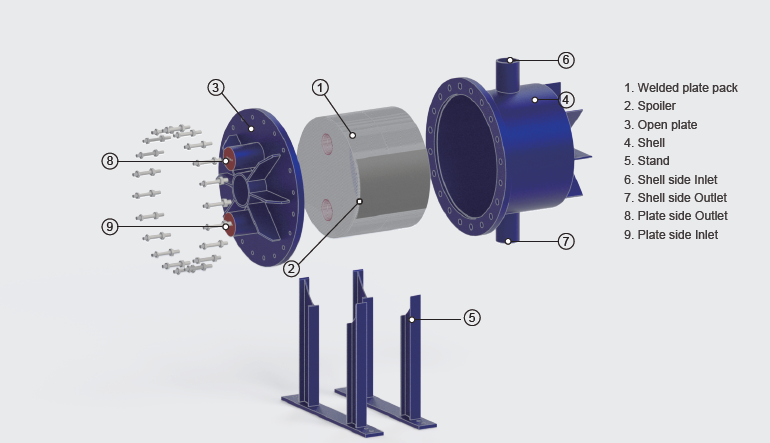
- No gasket leakage: welded plate packs remove gasket-related failure and maintenance risks.
- High thermal efficiency: corrugations create strong turbulence and higher heat transfer coefficients.
- Compact size: lower footprint and weight compared with many shell-and-tube solutions.
- Stronger operating envelope: shell boundary supports higher pressure ranges than typical gasketed plates.
- Material flexibility: plate alloys can be selected for corrosion resistance and duty suitability.
| Type | Efficiency | Pressure / Temperature | Leak Risk | Maintenance |
|---|---|---|---|---|
| Gasketed Plate (GPHE) | Very high | Medium | Gasket aging / blowout risk | Easy to open & clean |
| Brazed Plate (BPHE) | Very high | Medium to high (design dependent) | No gasket; brazing integrity critical | Typically replace, not serviceable |
| Shell & Tube | Medium | Very high | Low external leak risk; tube leaks possible | Familiar but larger footprint |
| Shell & Plate (SPHE) | High to very high | High | Very low (no gaskets) | Medium (depends on design and service) |
- Oil cooling: hydraulic oil, lube oil, gear oil cooling circuits
- Chemical processing: aggressive fluids requiring corrosion-resistant plate alloys
- Refrigeration & energy: heat recovery and high pressure loops
- Marine & transportation: compact machinery-room installations
HEXNOVAS provides Shell and Plate Heat Exchangers designed for reliability, compact layout, and stable performance across demanding industrial services.
FAQ (Click to Expand)
What is the difference between shell and plate and shell-and-tube heat exchangers?
SPHE uses a welded plate pack to deliver high turbulence and compact duty. Shell-and-tube is widely used for very high pressure and some heavy fouling duties but often requires more space for the same heat duty.
Are shell and plate heat exchangers fully welded?
Most SPHE designs use fully welded plate packs and do not rely on gaskets for sealing the main heat transfer section. Construction details depend on model and application.
When should I select SPHE instead of a gasketed plate heat exchanger (GPHE)?
Select SPHE when gasket leakage risk is unacceptable, operating pressure/temperature are higher than typical GPHE limits, or media and cycling conditions require welded reliability.
What information is needed for sizing a shell and plate heat exchanger?
Provide heat duty (kW), inlet/outlet temperatures for both sides, flow rates, allowable pressure drop, operating pressure/temperature, and fluid properties (viscosity, density, fouling factor).


