CO₂ Refrigeration Heat Recovery Solution for Supermarkets
CO2 refrigeration heat recovery solution for supermarkets, ultra high pressure brazed plate heat exchanger, supermarket hot water recovery, CO2 heat exchanger, gas cooler, heat recovery PHE, industrial refrigeration heat recovery system, HEXNOVAS.
CO₂ Refrigeration Solution
CO₂ Refrigeration Heat Recovery Solution for Supermarkets
In modern supermarket refrigeration, heat should not be treated as waste. By integrating a dedicated heat recovery stage ahead of the gas cooler, part of the high-temperature CO₂ discharge energy can be transferred to water and reused for cleaning, sanitation, and store hot water demand. The result is a smarter refrigeration system with better energy utilization, lower operating cost, and reduced carbon emissions.
System Illustration and Real Installation
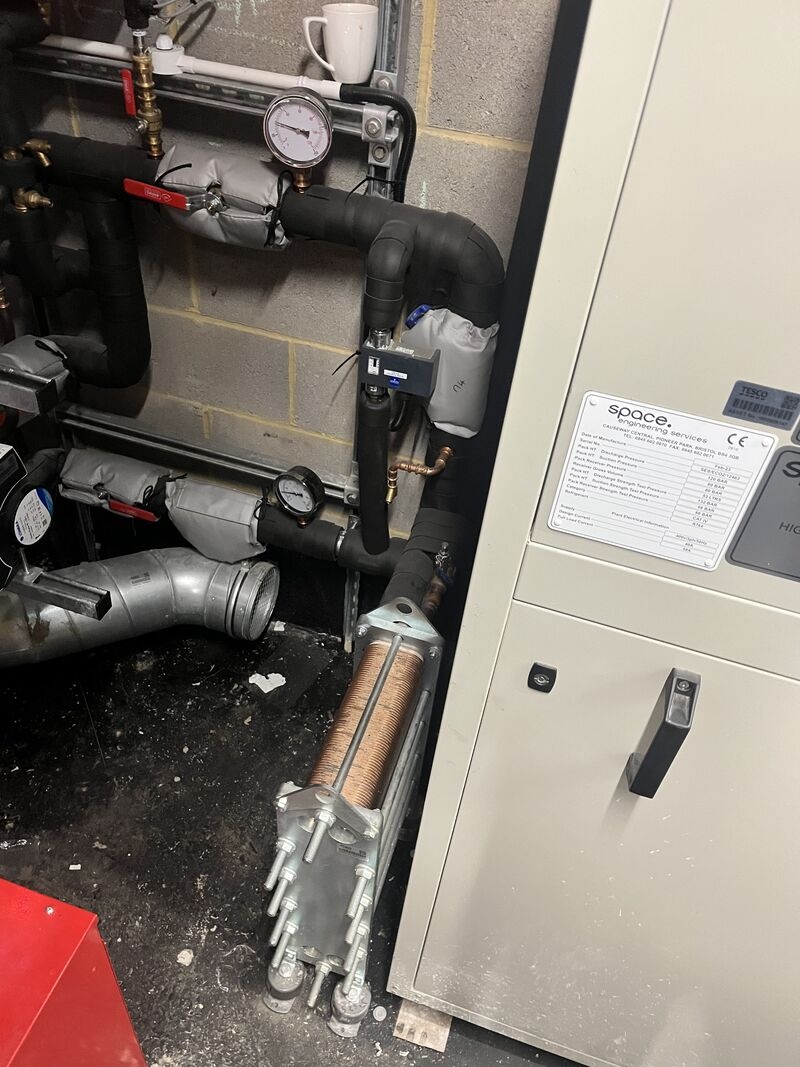
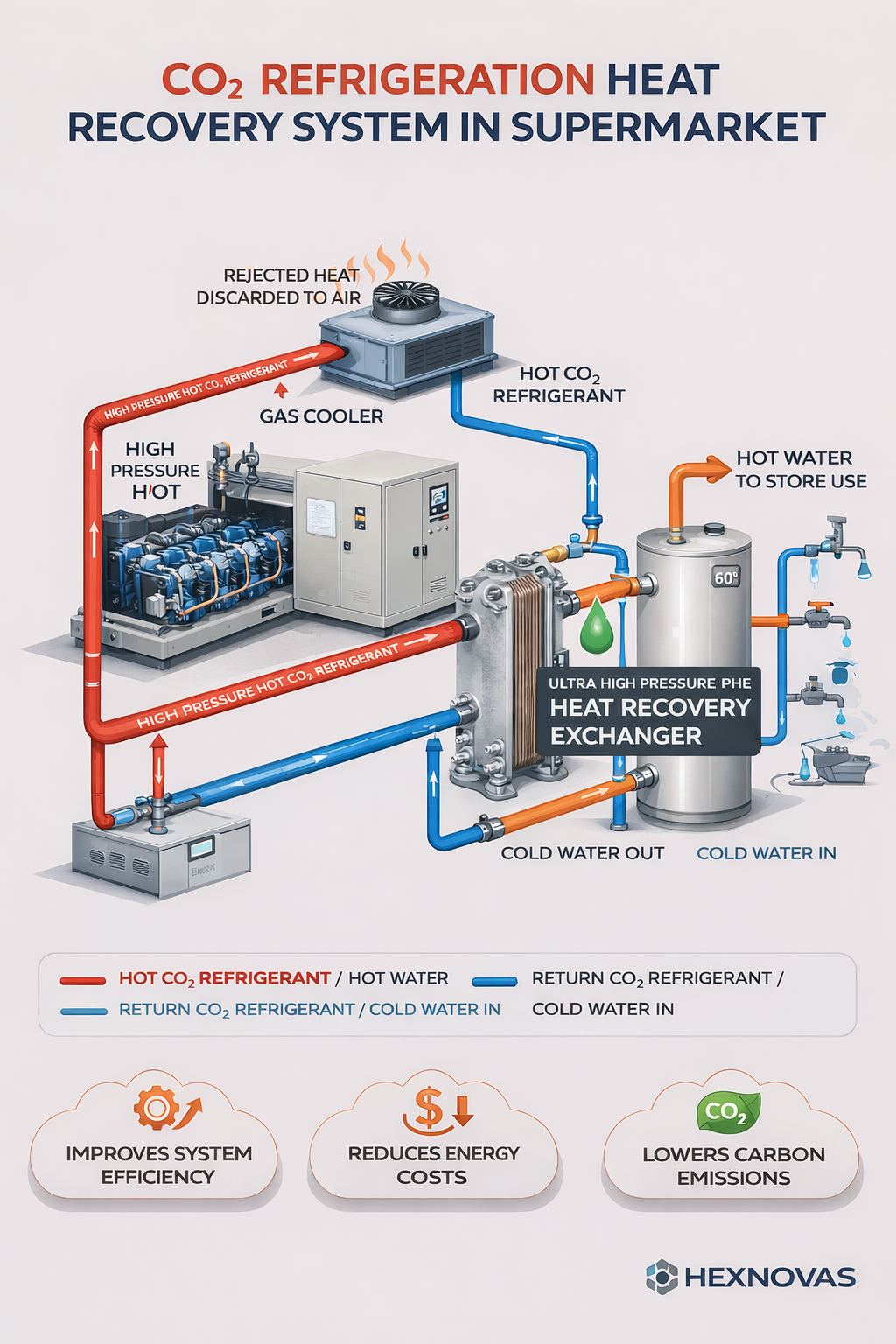
The diagram below shows the basic concept of a supermarket CO₂ heat recovery system. The real installation photo demonstrates how heat recovery is implemented in practice, where the exchanger is integrated into the plant room and connected to the water circuit.
System concept: high-pressure CO₂ refrigerant first passes through the heat recovery stage, then the remaining heat is rejected through the gas cooler.Real installation: heat recovery exchanger integrated beside the refrigeration unit and connected to the insulated water loop.
How the Heat Recovery Principle Works
In a transcritical or high-pressure CO₂ supermarket refrigeration system, the compressor rack discharges refrigerant at elevated temperature and pressure. This discharge gas contains valuable thermal energy. Instead of rejecting all of that energy directly to ambient air, part of it can be recovered by a dedicated heat recovery exchanger.
On the refrigerant side, the hot CO₂ gives up a portion of its heat before entering the gas cooler. On the water side, cold make-up water or return water absorbs that heat and is sent to a storage tank or directly to store hot water use points. This recovered energy can support floor cleaning, sanitary washing, utility water heating, and other daily store operations.
1
Compressor DischargeCO₂ leaves the rack at high pressure and high temperature.
2
Heat Recovery ExchangerThermal energy is transferred from CO₂ to the water circuit.
3
Hot Water GenerationHeated water is stored or used for cleaning and service demand.
4
Gas Cooler BackupRemaining heat is still rejected when water demand is lower than available heat.
Important engineering point: the gas cooler should still be retained in most supermarket CO₂ systems. Heat recovery demand changes throughout the day, while refrigeration duty continues to operate. The gas cooler ensures stable system operation whenever recovered heat cannot fully absorb the available discharge energy.
Main Functions of a CO₂ Heat Recovery System
Recover useful thermal energyTransform compressor discharge heat into usable hot water rather than rejecting it entirely to the environment.
Reduce water heating costLower dependence on electric heaters, boilers, or other separate hot water generation equipment.
Improve total system efficiencyUse the same refrigeration energy input for both cooling and water heating, improving the overall energy balance of the store.
Typical use points in supermarkets
Cleaning water for floors and service areas
Sanitary hot water for maintenance and washdown
Back-of-house utility hot water
General store water heating support
Why Ultra High Pressure PHE Matters in CO₂ Applications
CO₂ systems operate at substantially higher pressures than many conventional refrigeration systems. This makes the heat recovery exchanger one of the most critical components in the entire solution. It must combine compact size, strong mechanical integrity, reliable brazed construction, and efficient heat transfer under demanding pressure conditions.
For this reason, the heat recovery stage is not just any water heat exchanger. It requires a unit engineered specifically for high-pressure CO₂ service.
HEXNOVAS product involved in this solution
The core product in this application is the HEXNOVAS Ultra High Pressure Brazed Plate Heat Exchanger. It is designed for compact installation, efficient thermal transfer, and reliable performance in high-pressure CO₂ refrigeration circuits.
Application roleUsed as the heat recovery exchanger between hot CO₂ refrigerant and the water circuit.
Key advantageCompact, efficient, and more suitable for modern supermarket machine rooms where installation space is limited.
System benefitSupports stable, repeatable hot water generation while keeping the refrigeration loop integrated and clean.
Related product roles in similar CO₂ systems
CO₂ heat recovery exchanger
CO₂ desuperheating duty
CO₂ subcooling stage in selected system layouts
Why the Gas Cooler Is Still Required
A common question is whether the gas cooler can be removed once a heat recovery exchanger is added. In most real supermarket installations, the answer is no. The reason is simple: hot water demand does not always match the amount of heat generated by the refrigeration system.
During low hot water demand periods, the heat recovery exchanger can only absorb part of the available thermal energy. The gas cooler remains necessary to reject the balance and keep the CO₂ system operating safely and efficiently. A practical design is therefore a heat recovery priority arrangement, where usable heat is recovered first and surplus heat is discharged afterward.
Solution Summary
A supermarket CO₂ heat recovery system is a practical way to turn refrigeration waste heat into real operational value. By combining a compressor rack, a retained gas cooler, a storage water circuit, and a dedicated Ultra High Pressure Brazed Plate Heat Exchanger, the system delivers both refrigeration performance and hot water generation in one integrated solution.
For projects where efficiency, sustainability, and compact design all matter, HEXNOVAS provides the right product platform for high-pressure CO₂ heat recovery duty.

 System concept: high-pressure CO₂ refrigerant first passes through the heat recovery stage, then the remaining heat is rejected through the gas cooler.
 Real installation: heat recovery exchanger integrated beside the refrigeration unit and connected to the insulated water loop.


