
Compabloc Heat Exchanger Working Principle
The Compabloc heat exchanger working principle is based on a compact block of fully welded corrugated plates that create alternating flow channels for two fluids. By combining thin metal plate walls, high turbulence flow, and counter-current arrangement, a Compabloc heat exchanger can deliver very high thermal efficiency in a small footprint, especially in chemical, petrochemical, refinery, and heat recovery services.
What Is the Working Principle of a Compabloc Heat Exchanger?
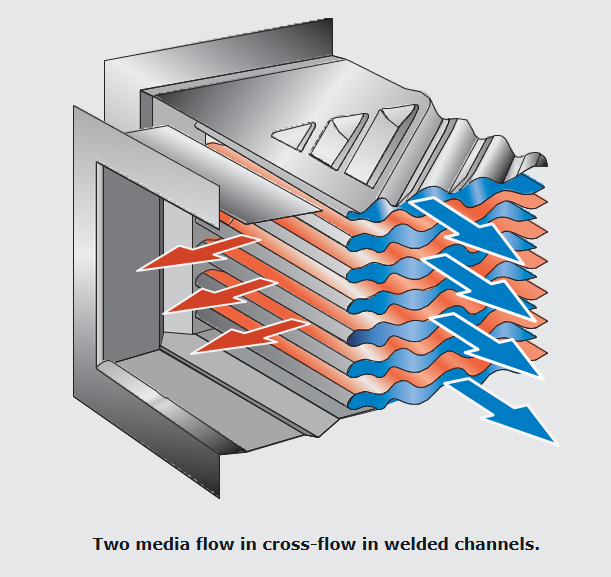
A Compabloc heat exchanger is a type of fully welded plate heat exchanger. Inside the exchanger, corrugated metal plates are welded into a compact plate block. Two process fluids flow through alternating channels, and heat is transferred through the thin plate walls that separate them.
Compared with a gasketed plate heat exchanger, the Compabloc design eliminates gasket limitations in the heat transfer area. This welded construction allows the exchanger to handle higher temperatures, higher pressures, and more aggressive media. That is why Compabloc units are often selected for demanding duties where compactness and reliability are both critical.
- Thin metal plate walls reduce thermal resistance
- Corrugated channels generate turbulence and improve heat transfer coefficients
- Counter-current flow maximizes temperature driving force
- Compact plate pack provides high thermal duty in limited space
Flow Arrangement and Heat Transfer Mechanism
The heat transfer mechanism inside a Compabloc heat exchanger is straightforward in principle, but extremely effective in practice. One fluid enters one set of plate channels, while the second fluid enters the adjacent channels. The two streams remain physically separated, but thermal energy flows through the thin metal plates from the hotter side to the colder side.
In most industrial designs, the two fluids move in counter-current flow. This means the hot fluid and cold fluid travel in opposite directions. Counter-current arrangement maintains a stronger average temperature difference along the full flow path, which is one of the main reasons the Compabloc heat exchanger working principle is so efficient.
Inside a Compabloc heat exchanger:
- One fluid flows through alternating channels
- The second fluid flows through adjacent channels
- Heat passes through thin plate walls
- The welded plate pack keeps the streams separated
- Counter-current flow increases energy recovery performance
Because the thermal path is short and the heat transfer surface is large relative to the exchanger size, a Compabloc can often achieve a small temperature approach. This is especially valuable in energy recovery, process heating, condensation, evaporation, and liquid-to-liquid duties where efficiency directly affects operating cost.
Corrugated Plate Geometry and Turbulence
The corrugated plate geometry is not just a structural detail. It is central to the performance of a Compabloc heat exchanger. When fluids flow through corrugated channels, the streamlines are repeatedly disturbed. This reduces stagnant boundary layers on the plate surface and promotes more intense mixing within the fluid.
In practical terms, turbulence means that heat is transferred faster. A smooth surface allows a thicker boundary layer to build up, which acts like thermal insulation. A corrugated surface breaks that layer and increases the overall heat transfer coefficient.
Main performance benefits of corrugated plates
- More effective heat transfer area in a compact volume
- Higher turbulence even at moderate flow rates
- Reduced boundary layer thickness
- Improved thermal efficiency compared with smoother flow paths
- Better compactness than many traditional exchanger types
This is why fully welded plate heat exchangers such as Compabloc are frequently selected when the plant wants a compact exchanger with high thermal performance and limited installation space.
Why Compabloc Heat Exchangers Are Highly Efficient
The strong reputation of the Compabloc design comes from the fact that several efficiency-enhancing mechanisms are working together at the same time. It is not just one feature. It is the combination of thin plates, corrugated surfaces, counter-current flow, and compact geometry that makes the design so powerful.
- Thin heat transfer walls reduce conduction resistance
- High turbulence flow increases the convective heat transfer coefficient
- Counter-current arrangement maintains a strong temperature driving force
- Compact welded block minimizes heat loss and installation footprint
In many applications, a Compabloc heat exchanger can offer thermal performance significantly higher than a conventional shell and tube design of similar duty. In practical industry discussions, it is common to describe the heat transfer intensity as being several times higher than shell and tube heat exchangers, depending on duty, fluids, fouling behavior, and allowable pressure drop.
| Performance Factor | Compabloc Heat Exchanger | Traditional Shell and Tube |
|---|---|---|
| Heat transfer surface | Compact corrugated plate block | Tubes inside shell |
| Thermal efficiency | Generally high because of thin plates and turbulence | Generally lower for the same footprint |
| Space requirement | Very compact | Larger installation footprint |
| Approach temperature | Can be small in suitable duties | Often larger |
| Typical selection logic | When compactness and performance matter | When geometry, fouling style, or tradition favors tube design |
Effect of Fully Welded Construction
A key difference between a Compabloc heat exchanger and a gasketed plate heat exchanger is the welded structure. Since the plate pack is fully welded, there are no gaskets in the heat transfer section to limit temperature resistance or chemical compatibility. This allows the exchanger to work in more severe process environments.
Advantages of fully welded construction
- No gasket limitations in the core heat transfer area
- Higher mechanical integrity under demanding operating conditions
- Better suitability for aggressive chemicals and solvents
- Improved resistance to thermal cycling and thermal shock
- Reliable option for refinery, petrochemical, and chemical processes
This is one of the reasons the Compabloc heat exchanger is widely associated with industries such as chemical processing, petrochemical production, refinery service, pharmaceutical manufacturing, and advanced heat recovery systems.
Typical Operating Conditions and Applications
The Compabloc heat exchanger working principle is particularly valuable where the plant needs high performance under severe process conditions. Although the exact limits depend on materials, process design, code requirements, and manufacturer configuration, Compabloc units are commonly associated with the following types of service:
- High temperature processes
- High pressure systems
- Corrosive chemical service
- Solvent and hydrocarbon duties
- Heat recovery and energy integration projects
- Condensation, reboiling, and liquid-to-liquid process exchange
In many plants, the decision to use Compabloc technology is not only about heat transfer. It is also about saving space, reducing installed footprint, and handling more difficult media than a standard gasketed plate exchanger would comfortably tolerate.
Engineering Summary
The Compabloc heat exchanger working principle combines three major strengths: thin plate heat transfer, corrugation-induced turbulence, and counter-current flow. These are packaged into a fully welded compact plate block that can deliver high thermal efficiency in difficult industrial services.
For engineers comparing exchanger technologies, the Compabloc design is often attractive when the process requires a compact footprint, strong thermal performance, and better suitability for high temperature, high pressure, or chemically aggressive fluids. That is why the Compabloc heat exchanger remains one of the best-known fully welded plate heat exchanger concepts in modern process industry applications.
Frequently Asked Questions
What is a Compabloc heat exchanger?
A Compabloc heat exchanger is a fully welded plate heat exchanger made from corrugated plates welded into a compact heat transfer block. It is designed for demanding industrial duties involving high temperature, high pressure, or aggressive media.
How does a Compabloc heat exchanger work?
It works by sending two fluids through alternating channels formed by welded corrugated plates. Heat passes through the thin plate walls from the hot side to the cold side, while the corrugated geometry creates turbulence that increases heat transfer efficiency.
Why is counter-current flow important in a Compabloc heat exchanger?
Counter-current flow keeps the temperature difference between the two fluids more effective along the entire exchanger length. This improves energy recovery and allows smaller approach temperatures compared with less efficient flow arrangements.
What are the advantages of a fully welded plate heat exchanger?
A fully welded plate heat exchanger can handle more severe process conditions because it avoids gasket limitations in the heat transfer area. It typically offers better resistance to heat, pressure, thermal cycling, and aggressive chemicals.
Compabloc vs shell and tube heat exchanger: what is the difference?
In many duties, a Compabloc heat exchanger provides higher thermal efficiency and a much more compact footprint than a shell and tube heat exchanger. Shell and tube designs may still be preferred in some heavily fouling services or where plant standards require them, but Compabloc technology is often selected when space and efficiency are critical.
Where are Compabloc heat exchangers commonly used?
They are commonly used in chemical plants, petrochemical units, refineries, solvent service, energy recovery projects, and other industrial processes where compact high-performance heat transfer is required.


