Heat exchangers rarely “fail” overnight. They lose performance gradually through scaling and fouling—driving higher energy consumption, larger temperature approach, and rising pressure drop. This guide explains the difference and how to prevent it.
A heat exchanger usually keeps running even when it becomes inefficient. The system still produces the required outlet temperature—but at a higher operating cost. That cost is often invisible until OPEX has already been impacted for months.
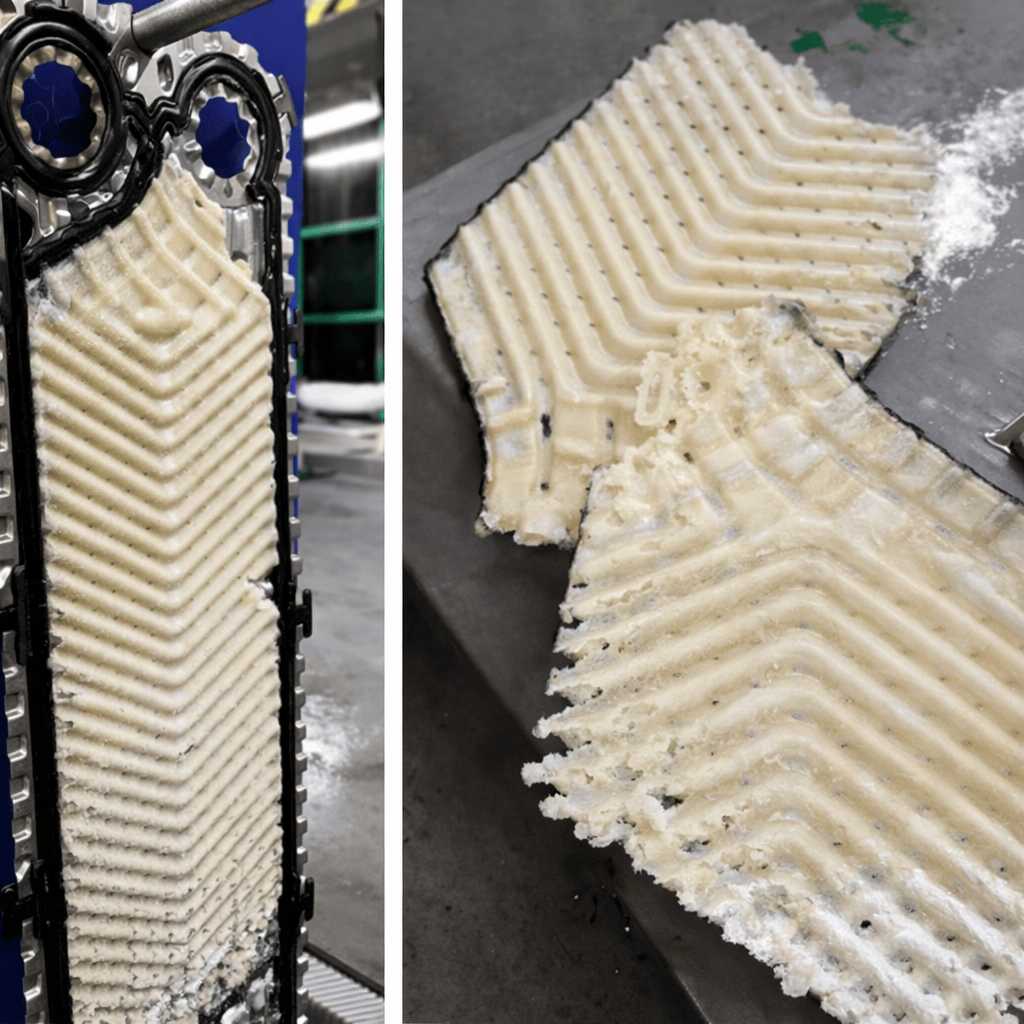
In industrial heat transfer, “dirty exchanger” is not one problem. The mechanism matters because the prevention strategy changes.
| Item | Scaling | Fouling |
|---|---|---|
| Primary source | Inorganic precipitation (CaCO₃, silica, salts) | Organic matter, biofilm, sludge, oils, fibers, particles |
| Typical driver | Water chemistry + temperature + concentration | Process conditions + flow regime + design + contaminants |
| Deposit nature | Hard/crystalline; often adherent | Soft/irregular; may grow unevenly |
| Best prevention | Chemistry control + anti-scalant + monitoring | Filtration + velocity/shear + correct plate pattern + monitoring |
Scaling and fouling add an insulating layer between hot and cold fluids. That increases thermal resistance and reduces the overall heat transfer coefficient (U-value). The process compensates by consuming more energy or losing capacity.
Cleaning treats symptoms. Design reduces root causes. In high-risk service, the wrong exchanger selection can accelerate fouling and increase OPEX. Key design variables include:
A reliable prevention program is a combination—not a single action:
Scaling and fouling do not mean the heat exchanger is “bad.” They indicate incomplete thermal management. If energy is a relevant cost in your plant, treat exchanger cleanliness as an efficiency KPI—not a maintenance event.
Scaling is typically inorganic precipitation driven by water chemistry and temperature, while fouling includes organic matter, biofilm, sludge, oils, and fibers driven by process conditions and flow regime.
Deposits reduce effective flow area and increase friction. In plate heat exchangers, partial blockage and uneven fouling can accelerate ΔP rise and reduce stable flow distribution.
Cleaning restores performance temporarily, but prevention is usually more cost-effective: chemistry control, filtration, correct plate pattern selection, and monitoring reduce recurrence and protect OPEX.
Choose Free Flow PHE when the medium contains fibers, soft solids, sludge, viscous liquids, or frequent fouling that causes channel plugging in standard chevron plates.
In sludge heat recovery and high-fouling service, a Spiral Plate Heat Exchanger (SPHE) often provides higher operational stability because it uses a continuous channel and avoids complex distribution zones.
Track pressure drop (ΔP), temperature approach (hot outlet vs cold inlet), heat duty drift, and energy consumption. Gradual trend changes usually indicate scaling/fouling long before failure.